Don't Complete Me: From EVA to "Human Surrender"
If you have become more and more afraid of others saying "I understand you" in recent years, this article is probably for you.
The most suffocating thing is not necessarily that no one understands you.
Sometimes it's just the opposite.
It's because others understand you too quickly.
Before you can think clearly, he has already summarized it for you.
You are just silent, and he has already said that you are "actually escaping".
You couldn't tell, so he asked gently: Do you need me to tell you?
Doesn't sound bad.
Even considerate.
But people are most easily carried away by this kind of thoughtfulness.
So I want to put this sentence at the top
Don't complete me anymore.
The phrase is not "leave me alone."
It's not "no one understands me."
It's not even a beautiful lonely gesture.
What it opposes is something more subtle: when a person is broken, hesitant, unable to speak, unable to explain himself, the world immediately wants to make him into a complete person. Explain to him, summarize for him, help him express it, tell him what you are actually thinking, tell him what you really need, tell him which narrative your pain belongs to, and tell him where this experience should lead in the end.
Completion does not necessarily look like violence.
Many times, it looks like understanding.
Looks like you care.
Looks like "I understand you".
It looks like "Do you need me to tell you something?"
This is why when we talk about EVA today, we can't just talk about nostalgia.
We can't just talk about mechas, apostles, the Red Sea, and streams of consciousness.
We cannot be satisfied with just saying "Young people in East Asia are suffering".
This sentence is so convenient, so convenient that there is almost no danger.
The really dangerous question is
When a person cannot fully become himself, what will the times use to deal with him?
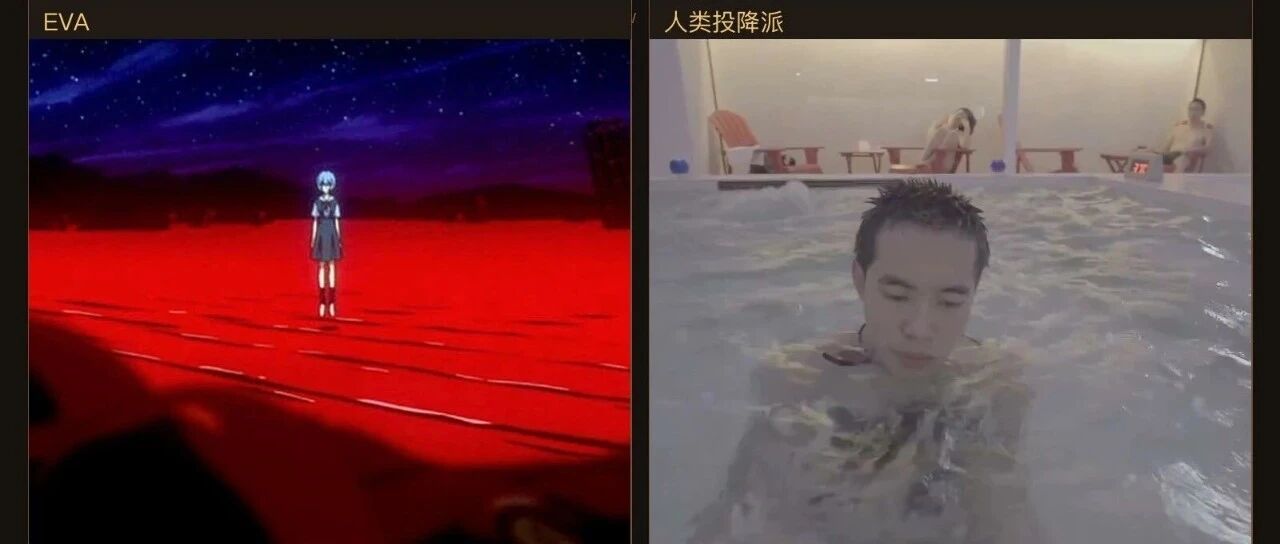
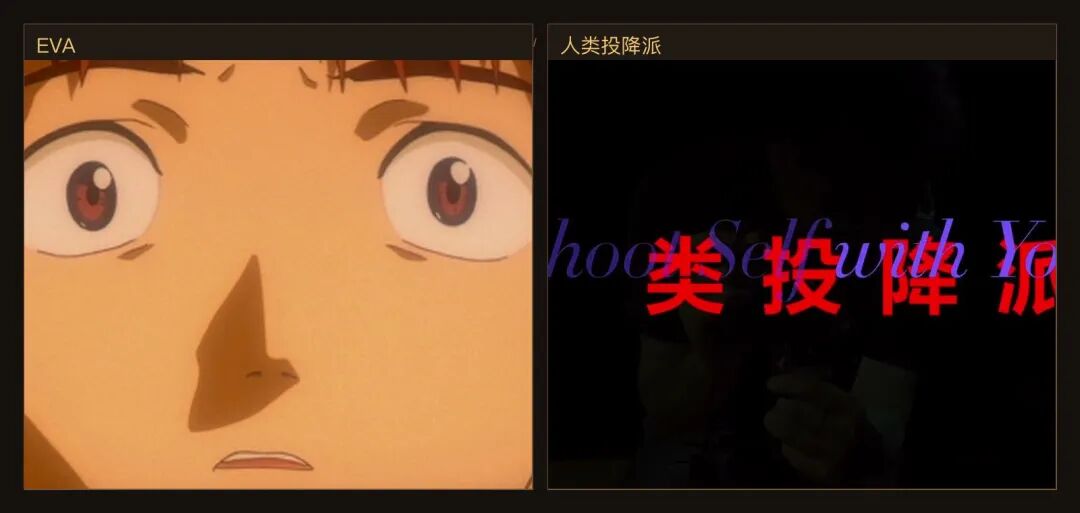
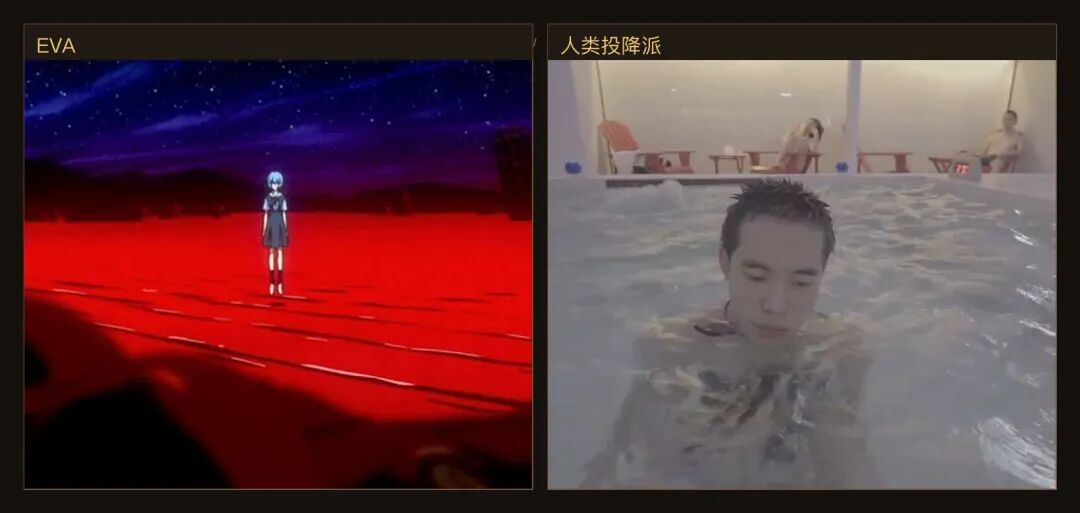
On the left, EVA's fear is to wake up and find that she has been accepted by the system; on the right, "Human Surrender" puts the title, face and darkness in the same picture. One puts people into the organization, and the other puts people on site to suppress them first.
EVA's answer was resounding: cockpit, synchronization rate, organizational orders, father's gaze, human completion plan.
The answer to "Human Surrender" is more personal: lighting, rehearsal, camera, audience, white cloth, backstage, list, thanks, re-watching and archives.
It doesn't push you into a giant machine.
It's more ruthless.
It allows you to discover that machines are already scattered in your life.
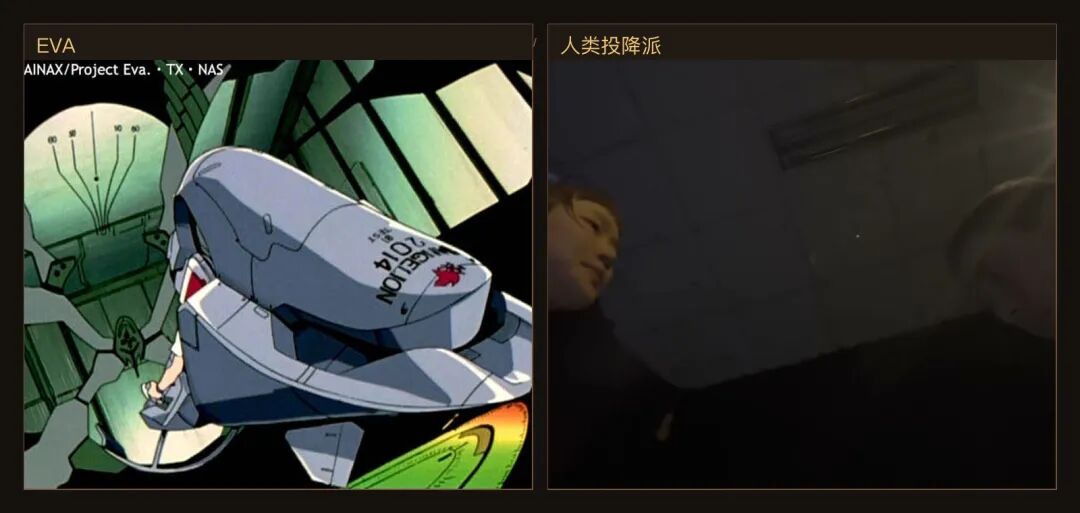
On the left, EVA takes people into the cockpit; on the right, "Human Surrender" has no cockpit, only low-angle light, people and waiting. The machine no longer stands in front of you, it becomes the air of the scene.
What's scary is not loneliness, it's the loneliness that someone cures for you.
Looking back at EVA now, the scary thing has never been "driving a robot to kill monsters".
What really hurts people is that a boy is not ready to become a human being, and the world has been thrust into his hands.
He didn't want to go in.
But if he doesn't go in, it's like he doesn't even have the qualifications to exist.
When he goes in, he is used by the machine.
He ran away, and was thrown back into the world into deeper shame.
This is where EVA never goes out of style.
It suddenly magnifies a problem in a teenager's room into a problem for the entire human race
If there are always boundaries between people, they will never truly understand each other, they will always misunderstand, hurt, and escape, and they will always want to get closer but are afraid of getting closer.
Should we simply abolish the borders?
This is the terrifying temptation of "filling in".
It ostensibly feels like a cure for loneliness.
In fact, it swallows up loneliness with a larger whole.
The distance between people is too painful, then let the distance disappear.
Everyone has their own boundaries that hurt too much, so let the boundaries disappear.
It hurts too much that I can't be whole, then hand me over to a larger "we".
The most profound violence is here: it is not killing people, it is solving human problems for them.
It says: You don't have to be alone anymore.
The price is: you don't have to be you anymore.
This is so similar to many relationships today.
Someone doesn't really mean to hurt you.
He just wants to help you end your pain.
I really want you to make it clear.
I want you to "get better" so much.
But sometimes, what a person really needs is not to be cured, but to not be taken away yet.
EVA's cockpit doesn't disappear, it becomes every "continue"
"Human Surrender" doesn't film this horror as a sea of red or give it an apocalyptic shell.
It's colder and closer.
It dismantles the machine and hides it in daily life.
This is not about elevating it after the fact. P4 In the early public texts about "Human Surrender", there was a very heavy judgment: the movie is like the last road. At the stage of "The Last Rehearsal", it was said to be not a drama or a movie, but "a thing".
This change is critical.
It shows that "Human Surrender" was not a work that just wanted to be put into the movie category from the beginning. It needs movies because movies can preserve light, body, sound, time and the viewing of those who come after; but it constantly overflows from movies and enters into rehearsals, performances, public account texts, post-performance echoes, ten-year archives and the relationship of continued re-watching.
So we can't just ask "what story does it tell?"
We should ask more: What scene did it create? How does it allow one to be processed by light, location, audience, sound, material and archive?
One does not first enter a movie with one's heart intact. Instead, the film prepares the location: how the light falls, where the body stands, where the camera looks, who is called out, who is left behind, who is seen by the audience.
Here, people do not emerge naturally from the depths of their own hearts.
Man is developed in conditions.
This is where "Human Surrender" goes deeper than "post-pandemic EVA". It is not about moving the huge EVA machine into the Chinese context, but seeing that today, machines no longer need to appear as machines.
It can be a rehearsal.
It can be an urging.
It could be a camera that's on.
It can be the silence of the audience.
It could be the credits.
can be a very reasonable continuation
Go on.
Keep acting.
Go ahead and explain.
Continue to be watched.
continue to be saved.
This is the situation that is more relevant to our generation.
We weren't necessarily pushed into the cockpit, but we were put into various positions early on. Positions, relationships, platforms, lenses, chat records, reviews, documents, screenshots, files, and public comments have all reserved slots for us.
Many times, you don't choose to enter the scene.
You are waking up to find that the scene is already running around you.
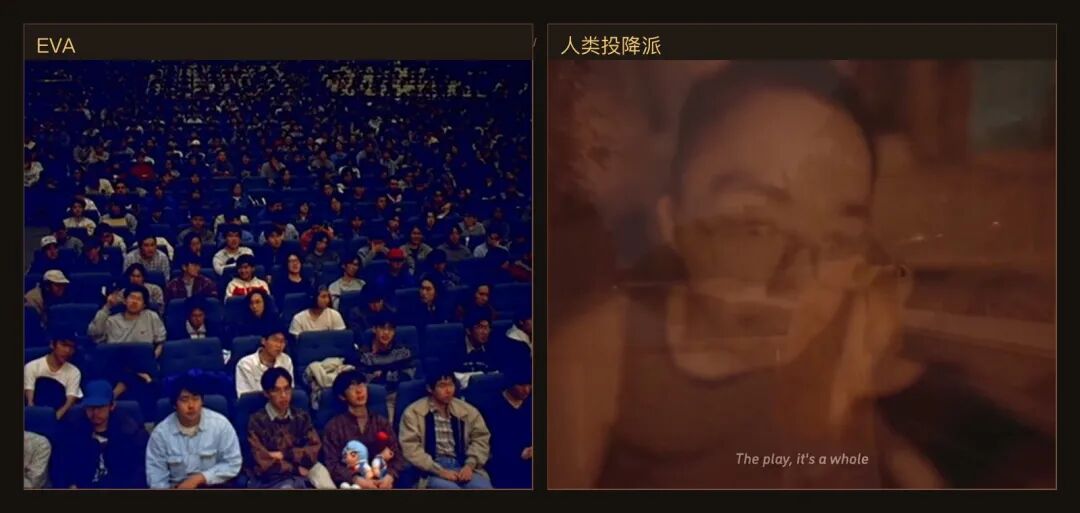
EVA brings the real audience into the movie; "Human Surrender" allows the theater, faces and subtitles to be superimposed. Watching is not just watching, watching itself has entered the machine.
Failure can also be exploited: you crash and the site is still booting
Ordinary movies edit out failure.
"Human Surrender" in reverse.
It retains failure.
If you can't act, keep it.
Stuck, reserved.
Unable to connect, keep.
Silence, reservation.
Daze, reserve.
This is of course precious.
Because things that really happen are often not smooth. People will stop talking, hide, make excuses, suddenly want to smoke, speak incomprehensible words, and use their bodies to delay words.
This is also the annoying thing about "Human Surrender": after failure is retained, it does not automatically become free.
Failure becomes the next layer of material.
When I can't say a word, my body takes over.
The body cannot bear it, and the material takes over.
The material overheats and the sound takes over.
The sound recedes and the background takes over.
Still ringing in the background, the file takes over.
This is not chaos.
This is its sharpest point.
It knows that every failure is not an end, but an entry point.
The question is: if something can go on forever, if every failure can be transformed into new material, then when can one really stop?
This is where "Human Surrender" deserves to be taken more seriously than "cruel art."
It doesn't just take.
It also slowly raises a question later: When a movie is too good at continuing, too good at preserving, and too good at making failure meaningful, does the movie itself have the ability to stop?
Intimacy is not about complementing each other, it is about not using me as a mirror
Many people will regard "Human Surrender" as the collapse of an intimate relationship.
That's true, but it's not enough.
What's deeper about it is: what it captures is not "I love you but you don't understand me", but "I try to confirm my existence with you, but your eyes, voice, body, and response cannot fully sign in for me."
There is a section that is very light, but very fatal.
One person repeatedly said that he can do it alone.
But while he was talking, he asked again: Are you there?
The other party replied: I am here.
This is not ordinary dependence, nor is it simple coquettishness. It captures the most fragile structure of "independence"
I want to be alone.
But I need to make sure you're not completely gone.
I wanted to prove that I could exist on my own.
But the words still need a listener.
One person can, provided that "you" is still somewhere.
Therefore, "Human Surrender" is not praising brokenness, nor is it saying that people should always be entangled with each other. It just captures it very honestly: a person's "one person" often does not mean that there is no relationship, but that he strives for a small space within the relationship where he can breathe.
Even more cruel are the eyes.
People look for themselves in each other's eyes.
Usually we think that intimacy means seeing ourselves in the eyes of the other person. But in "Human Surrender", eyes are no longer mirrors. The closer I get, the less I can return to a complete me. The body has not disappeared, the face has not disappeared, the hands have not disappeared, and the voice has not disappeared; but the "I" that can be recognized in the other person's eyes has disappeared.
This isn't a little "no one understands me" sentiment.
This is a broken receipt system.
You can't use others as mirrors to bring you back to yourself.
Nor can you regard your own understanding as proof that someone else is finally complete.
So "Don't complete me again" becomes a deeper sentence here
Don't make your eyes my destination.
Don't let your understanding become my boundary.
Don't think that just because you see me, you can give me back to myself.
Even if you are in a daze, the system can use it to cut one.
Only in public did the film's sharpest set of sentences really appear.
Some people say that they are not thinking about anything and are just in a daze.
The audience immediately asked: If you are in a daze, what will everyone see?
This sentence cannot be used in advance as the key to the entire film. It has to be placed before so much failure of rehearsal, of intimacy, of sensuality, of receipt, to be truly terrifying.
Because it's not a wisecrack.
It's a public machine that finally reveals its rules
Even if you don't have content, you can become content.
Even if you don't express something, you can become the object of expression.
If you say you are just in a daze, the scene will process your daze into something watchable.
This is a fear familiar to many people today.
If you remain silent, others will explain you.
If you don't respond, others will take screenshots of your lack of response.
If you have no status, others will name your no status.
If you say "I didn't think about anything", the system will ask: Then why didn't you think about it? What do people look at when you are not thinking about it?
Today, this sentence is almost a piece of platform logic.
If you don't have a status, you will be made into a status.
Even more pointed is another sentence: Do you need me to help you?
This statement is dangerous not because it is necessarily malicious.
On the contrary, the danger is that it might actually be caring.
If someone can't tell, another person is willing to help him. Of course, this may be a kind of care, a kind of support, and an effort to prevent people from falling completely.
But within the same movement, there is also a takeover.
When a person's blank space is taken up by another voice, when "I" is spoken by another mouth, when the white cloth covers the face and the voice becomes denser, when a short "say" opens up a long paragraph of spoken words, it is difficult for us to simply classify it as help or violence.
It is more like the most real ambiguity in modern life
Care and possession often share the same hand.
Understanding and substitution often share the same mouth.
Therefore, what "Human Surrender" really requires is not "not allowed to speak for others", that is too rough.
What it requires is: after speaking up, you still admit that the blank space does not belong to you.
A person can be supported, but cannot be signed on his behalf.
A "say" can allow the process to continue temporarily, but it cannot be upgraded to "you have fully authorized me to be you".
Blanks can be saved.
Cannot be possessed.
The white cloth cannot block the viewing, it only makes it more dazzling
When the white cloth appears, many things cannot be seen clearly.
The face recedes into a lump.
The body becomes a wrinkled, bulging, covered, translucent surface.
We seem to enter a kind of invisibility.
But the movie immediately lets us know: being invisible is not disappearing.
The cameras are still there.
The audience is still there.
The subtitles are still there.
The sound is still there.
The files will remain.
So "no one can see you" is not a fact. It's more of a safety fantasy, told in the most unsafe of viewing conditions.
This is also the paradox most familiar to modern people.
We want to hide into invisibility, to withdraw from work, relationships, platforms, explanations, and evaluations. However, many invisible things will also be recorded: offline status, unread messages, silence duration, no updates, no response, and no appearance.
Even disappearance may become a readable data.
What "Human Surrender" captures is not that "people cannot be seen."
What it captures is a more painful layer
When people are overloaded with being seen, they crave invisibility.
Even if it is not visible, it will be created, named, and saved on site.
So we finally arrive at the sentence in the title.
Don't complete me anymore.
Not because I don't need others.
It's because I need a closeness that doesn't take me away.
I need you to see me, but don't turn seeing into possessing.
I need you to hear me, but don't turn hearing into finishing for me.
I need you to be present, but don't turn presence into occupation.
The last cut at the end: the movie finally stops
The most restrained part of "Human Surrender" is not that it pushes the scene to its most intense level.
But it finally knew that it could no longer ask for it from living people.
The end credits are of course in the archives.
The name appears.
functions appear.
The production team shows up.
The filming location appears.
Special thanks appear.
The audience was also thanked.
It's all important. Because what happened must be preserved, the people who participated cannot be erased, and the viewer cannot pretend to be outside the scene.
But the end of the film also admits that the list cannot be brought back to the scene in its entirety.
The name is not home.
Thanks are not absolution.
Audience entry is not about explaining sovereignty to the audience.
Archives are not the way to own people.
Finally, the sound receded, leaving only signs and faint words in the darkness. The movie does not let the characters continue to speak, the director does not continue to explain, and the audience continues to ask for new expressions.
It stopped.
Many works push themselves to their fullest.
Let the characters say one more sentence, let the audience cry again, and let the creator explain one more time.
What's really rare about "Human Surrender" is that it clearly still had the ability to continue, but stopped at the end.
Because the entire movie was too good at continuing.
It will continue to shoot, continue to ask, continue to let failure generate material, continue to push the blank into sound, continue to let the scene transform the carrier. Its capabilities are too strong. It is precisely because he is so powerful that his final stop has ethical weight.
Real denial is not about smashing the machine.
The real denial is to admit that you can no longer continue to possess something while you still have the ability to continue.
This is the deepest divergence between "Human Surrender" and EVA.
EVA turns the refinishing into a doomsday temptation that abolishes borders.
"Human Surrender" films stopping as the final ethics after preservation.
One said: If it hurts too much, let all the boundaries melt.
On the left, EVA cancels the boundary and draws it into the Red Sea; on the right, "Human Surrender" shrinks the same danger back into the water, the room and the real body. One is a doomsday image, and the other is a life scene.
One said: The person is indeed in too much pain, so we cannot use understanding, viewing, archives and love to take him away completely.
The so-called surrender is to stop talking about people in their entirety.
Therefore, the name "Human Surrender" cannot be taken literally to mean admitting defeat.
What it really surrenders to is not an enemy.
It surrenders to one fact
Man does not fully possess his own existence.
When you appear in the light, you enter the observation of others.
If you are saved by the camera, you will go to the eyes of the future.
The sentences you speak will be received, misreceived, paraphrased, intercepted, and filed by others.
You have loved, suffered, acted, been silent, and been in a daze. These things have really happened, but they are no longer completely yours.
However, the reverse is also true.
What has happened to others does not belong to you.
You can get close to it, but you can't take it away.
You can witness it, but you can't do it for him.
You can save, don't mistake saving for ownership.
This is the deepest gesture of "surrender"
I acknowledge that I cannot fully own my manifestation.
I also acknowledge that I cannot fully possess Your manifestation.
I stopped pretending I could be completed.
I will no longer use love, theory, viewing, recording or understanding to make you into the shape I want.
For those who remember EVA: the cockpit has fallen apart.
If you remember EVA.
If you remember the shame, fear and loneliness that teenager felt as he was pushed into the cockpit.
If you still remember the temptation of "finally no longer having to separate boundaries from others" in the completion plan.
So "Human Surrender" is not asking you to say goodbye to EVA.
It only forces you to see that our cockpit today has changed dramatically.
It could be a relationship.
Probably a rehearsal.
Probably a camera that was on.
Maybe it's "I'm listening."
Maybe it's "Do you need me to help you?"
Might be an article trying to explain the movie to completion.
It could be a very serious, very kind, and very dangerous understanding.
Therefore, the words in the title are not about rejecting the world.
It is to draw a more difficult and precious boundary for the world
Don't complete me anymore.
Don't turn my silence into your profundity.
Don't turn my pain into your ability to understand.
Don't use my failures as fuel for your work.
Don't turn my blank into your first person.
You can see me.
You can come close to me.
You can remember that it did happen to me.
But stop where it matters most.
Make it real for me.
Also let me not be taken away by you.
I'm not saying people shouldn't be intimate.
I mean, intimacy cannot treat others as your destination.
I'm not saying people shouldn't watch either.
I mean, you can't watch pretending you don't have hands.
Saving is not a problem either.
The question is whether I can still remember this sentence after saving it
It happened, but it is not ours.
Don't complete me anymore.
Let me leave you here incomplete.
"Human Surrender" file
This is a recruitment copy about "Human Surrender"
Last Rehearsal | Human Surrender's "The Last Rehearsal"
Art Performance | The beginning and end of "Human Surrender" - Will aliens come again?
Human Surrender | This is the final rehearsal! It's true! It's all true!
Human Surrender | Let me be a whale, I have too little, too little
Human Surrender A | …and then you became a little girl again…
Human Surrender R | "Beijing No. 1 Experiment"
Human Surrender D | Do it again
Human Surrender K | People with torn eardrums
Human Surrender S | Everything is a new dimension
p4 Final Chapter | The Last Rehearsal Performance | Love, Death, Human Surrender
Human Surrender|I disappeared - after performing "The Last Rehearsal"
No longer loyal to integrity - long review of the final draft of "Human Surrender"
How words betray people - the original language structure of "Human Surrender"
"Human Surrender": a "masterpiece" of on-site divination
Why must the person holding the camera surrender?
Intimacy does not belong to two people | "Human Surrender"
Imaging with You | The ownerless second person and non-sovereign viewing in "Human Surrender"/Shoot Self with You