A visual research paper on 《Human Surrender》 / Shoot Self with You
Like you.
《Human Surrender》/
Shoot Self with You
A second name for the orphan and a non-sovereign view
Author
He Fa
Create Time
2023-2026
Arguments
"Self" must look at you, but this "you" has no master.
Purpose
Through the Human Surrender film, P4 Theater's many years of practical experience has been reduced to operational methods.
Border
Don't change the pressure of the image to a real motive, an authorized fact or an external injury.
Summary
Human Surrender is a handheld performance image around "The Last Rehearsal". The video allows people to change places between rooms, rehearsals, intimate moves, public viewing, backstage sound, video cameras and tail files.
Jean.
"Who is looking" and "who is looking" and "who is talking" and "who is being preserved" are always in a state of instability. This paper sets out the concept of "Imaging with you" as the core concept for understanding its viewing mechanism, starting with the bi-brand structure of the film. English Name
Shoot Self with You
The video was used to reveal the grammatics of action, while the Chinese name Human Surrender revealed the intellectual and ethical consequences of such action. The two are not simple translations, but together constitute a viewing device for the film.
Shoot Self with You
The point is, it's not.
Shoot Myself with You
I don't know. The inappropriate syntax in this title is a constant reminder to reflect on the structure of the film: The self here is not owned by a complete first person.
Shoot
(b) Semantic pressure associated with filming, shooting, projecting and body release; self is not myself, which is already "me", but is temporarily introduced in the photograph, hit and exposed
with you
Nor is it a stable companionship; it is a second-person condition that is constantly changing. In other words
The self in the film is not fully present, then recorded by the camera, but is visible, hit, redistributed in the pressure of the relationship with you.
The Chinese name, Human Surrender, further points to the consequences of this image. The "surrender" here is not a surrender to a certain role, director, camera, machine or authority, but rather an end to pretending that a person can have his or her own body, relationship, view, sound, end and file. The "party of surrender" has also made surrender no longer a one-time failure but a position: It implies an active withdrawal from the illusion of the sovereignty of the subject and the recognition that people do not always appear as masters in front of images, intimacy, performances and preservation mechanisms. So
"Humans" here is not a so-called grand declaration, but rather a viewing situation in which one can see, approach, re-see, record, but cannot completely occupy what is being watched.
This structure is referred to here as the "second name of the orphan". Human Surrender keeps calling out a "you" and letting this "you" actually change the relationship between body, voice, photography and archives; but the film does not allow us to place this "you" firmly in a role, camera, audience, director or researcher.
This "you" moves between different locations.
It is sometimes like a close object to the person being filmed, sometimes like a viewer behind the camera, sometimes like an open viewer, and sometimes like a later viewer, researcher and writer. It's because you can't be fixed and the viewing in the film can't be restored to a one-way gaze.
The preservation of images of past sites is often of a sort of "phantom" nature: it enables immediate return in visible form at a time when they have passed away or are no longer present. This "invisible presence" constitutes, inter alia, an important feature of documentary video media such as photography, film and video.
What is more special about Human Surrender is that it constantly pushes viewers to a location that appears to be close to the scene and withdraws the possession implied by the proximity. The movement in the room, the body in rehearsing, the touching in intimate relationships, the exposure in public view, the sound coming from the backstage, the photographic process of the camera and the archival material at the tail of the film are not simply handing over to the audience an already occurring site. On the contrary, they change the location of viewers repeatedly: sometimes the viewers seem to be in close proximity and sometimes to be excluded from the scene; sometimes the cameras appear to be a substitute for the viewers entering the body, and sometimes the voices and files remind the viewers.
He's just the one who later entered the chain.
Thus, Human Surrender does not train "unchangeable" in the general sense of the past, but rather a more concrete viewing experience: viewers are allowed to approach, but they cannot think of proximity as possession; viewers are implicated in images, but they cannot see the implication as a right of interpretation; and viewers can read, preserve and write, without thereby stabilizing the person, body and relationship at the time.
The so-called "non-sovereign watch" does not mean that all films naturally deny viewers the right to change the scene, but rather that the film transforms this disempowerment into their own form structure.
It keeps the audience in a position where you're called in, but you can't be the master.
;
You've been hit by a video, but you can't decide who it belongs to.
Keywords: Imaging with you; a second name for the orphan; a camera coming out; the ability to stop after seeing; Shoot Self with You
Let's start with the movie: What is it doing?
At the beginning of the film, it seemed like we were just going into a rehearsal space: there were people standing, there were people sitting, there were people talking, there were people with cameras. At first it was like a rehearsal that was happening, and then it slowly became something more strange. The camera is no longer just a close recorder, it's close to the body, bypasses people, follows the sound, and is suddenly seen in reverse. So the audience saw not just "what they're playing", but how the scene was a little bit of a loss of stability: who was watching, who was watching, who was arranging and who was being arranged.
If you don't read Human Surrender, you can remember the simplest thing: It filmed how a group of people were constantly changing places between rehearsals, performances, intimateness, waiting, photography, sound and tailing lists. The actor was a character, a character, a person; the director was at the director's place and was temporarily taken away by the actor; the camera was a bystander, and a person was questioned, identified, implicated. The audience sees not a sorted story, but a site where everyone is turned into each other's vision material.
After reading the article, readers do not necessarily get a single explanation of the film plot, but rather a way of seeing how to identify in the image those "you" that are effective, close to us and change us, but cannot be held by anyone. This is what this paper will later call "non-sovereign viewing". In human terms, it is: I see, but I cannot have what I see; I was called to the scene by a video, but I am not in charge of it.
At the beginning of the article, it was stated that "the p4 Theater's years of practical experience are a method", but this is not a style that sums up p4. Specifically, three operational methods are being refined
The viewer is exposed, the recording device enters the relationship, and the second person in the performance is not fixed as a master.
Films are not explaining these methods, but are putting pressure on them.
Story: expose the camera first.
The film begins with a cameraman and a film star. It's not pretending the camera doesn't exist, but it asks first: Who's watching?
Rehearsals: People are borrowed from their places.
The characters move around between actors, characters, directors, viewers and filmed people. They have entered their identities and continue to fall out of them.
Intimacy: closeness is not guaranteed
The person asked the other for admission at a very close physical distance, but said "I can't see myself" and "I'm gone". The closer you get, the less you can prove you're caught.
Later: The audience was also involved.
After the public performance, the live sound, another camera, the person looking at the camera and the end of the film appeared, the film began to ask: Who was the last to receive the scene?
The real pain in the movie is not that it's "complicated" but that a lot of little moves are like a needle, stuck to the most common viewing experience. A man close enough to say that he can't see himself in your eyes; a man who says that there's a blank in his brain and that the blanks are immediately registered as "a lot of missing words"; a person who says that he doesn't want to say that the scene has not stopped, but has left his voice to be heard; a person who asks, "Do you have a cigarette" and a daily request calls people behind the camera, the door, the window and the backstage; the phrase, "No one can see you". It sounds like shelter, but it keeps white cloths, exit lights, viewers, workstations, subtitles and photographic conditions visible.
These details are wonderful because they are small: a hand blocking an eye, a repeat smoke, a voice field after a number fades, a white cloth, an empty window for a second. But once these little things come together, they show the whole movie where it's really scary and it's really moving
It does not allow anyone to return easily to himself.
People want to be seen, and they fear to be seen; they want to be caught, and they find out that they are not masters; they want to stop, but they have replaced new carriers.
So, what we're talking about here, "Imaging you" is not a code that only people who are familiar with this film know. It comes from the most direct viewing experience of the film: I thought I was looking at people, and I slowly found myself being watched by others, cameras, voices and future viewers; I thought I could identify myself through some "you", and finally find that "you" was changing, and no one could take it completely.
It does not do three things: it does not equate the role directly with the actor himself, it does not translate the pressure from the image into a real motive, and it does not translate the perceived discomfort directly into an external injury. This paper discusses how the film organizes the pressure to watch, rather than writing for real people about motive, authorization or injury decisions. Images can force us to respond, but this response cannot go beyond the evidence and translate the viewing pressure directly into an external fact.
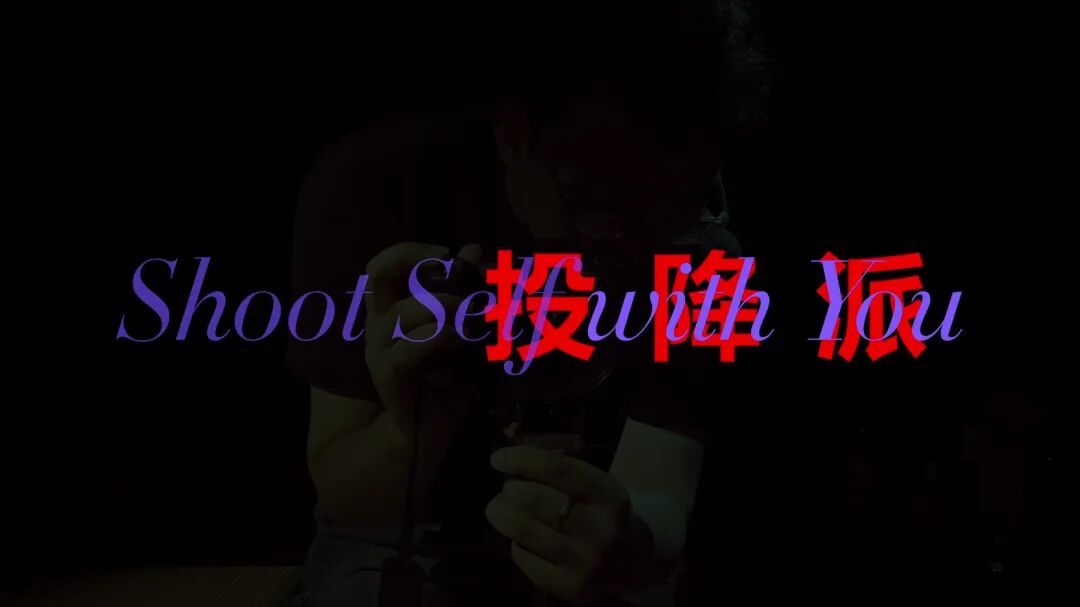
Figure 1.
The title of the film is in the same frame as the camera holder. This is not a general title page, but the name appears as a method after the photo position is pulled to the front.
This is not proof of "the camera in the film", but of the fact that the viewing position was not transparent from the very beginning.
One, two names, one orphan you.
A movie has two names. Chinese name is Human Surrender, English name
Shoot Self with You
I don't know. The two names are not simple translations. The Chinese name places the film in a group position: human beings, surrenders, sects, like statements that still stand after some kind of failure. The English name brings the matter back to a more concrete, physical and uneasy move
shoot self with you
。
Shoot Self with You
The grammar is not stable. It's not.
Shoot Myself with You
Not "I'll shoot myself with you," not "
Shoot You
Not "I shot you" or "no."
Shoot Self for You
Not "I'll film myself." It's missing a clear motto. It's gone.
my
Again.
self
Put it on.
with you
In the terms. The film starts with the title of rejecting a whole, secure, and owning its own "me": it's not that I'm holding myself steady and handing myself over to the camera; it's that self has to be filmed next to a unstable you, through you, with you.
Shoot Self with You
It's about action: self has to be visible through you. Human Surrender is talking about the consequences: human beings can no longer pretend to be self-image.
This paper refers to this mechanism as "imaging you". The image of you is not that the film simply brings in the audience, or that it creates a direct identity between the role and the audience; it means that the self in the film cannot be seen alone, but must be seen, changed by you, but you cannot be the owner of the scene. In the shortest possible way: I am only with you, but this "you" has no master.
This "you" works without a master. When people talk to each other, it is preserved by a camera; when people look at the camera, it seems to reach the audience, and it cannot simply say, "That's what they say to the audience"; when they shoot people on the camera, the operator is also exposed in reverse by image; and future viewers arrive late, but cannot speak of late understanding as the truth of the scene. The film keeps calling out you, changing the camera, the body, the voice and the relationship, but no one says
That's me, that's my case.
Conceptual level
This paper concept
Role
General concept
Like you.
Note self can't stand alone, must go through a unstable you.
Syntax
Shoot / Self / With You
This post is part of our special coverage Global Voices 2011.
On-site mechanisms
Close/ Time / Sound / Camera
This shows how the film breaks four certaintys in the specific scene: that it can be confirmed by being close, that it can be resolved in sequence, that it can be closed, and that people who see it can hide outside.
Ethical consequences
The ability to stop after seeing it.
This means that the latter can be called by the film, changed by it, but cannot be the owner of the scene. It is also called "non-sovereign viewing".
What's not "Imaging you"?
In order to keep the concept sharp, it must first be said that it is nothing. It is not an ordinary "I know myself through others", because other people in the film do not perform mirror functions in an unstable manner; it is not a general "subject-to-subject" because the relationship is not confirmed between two complete subjects, but it is a combination of positions that borrow a body, a camera, a sound; it is not a simple "audience participation", because the audience is called, and it is not entitled to do so; nor is it "a camera as a witness", because the camera itself is seen, questioned and implicated.
So, "image with you" is created only under one narrower condition: self can't be seen alone and must pass through an effective you; but you can't stabilize either of the players, photographers, viewers, archives or researchers. It's over as long as a certain "you" is fixed as a master.
The most fascinating part of the film is that it keeps making you work and keeps stopping anyone from taking you away.
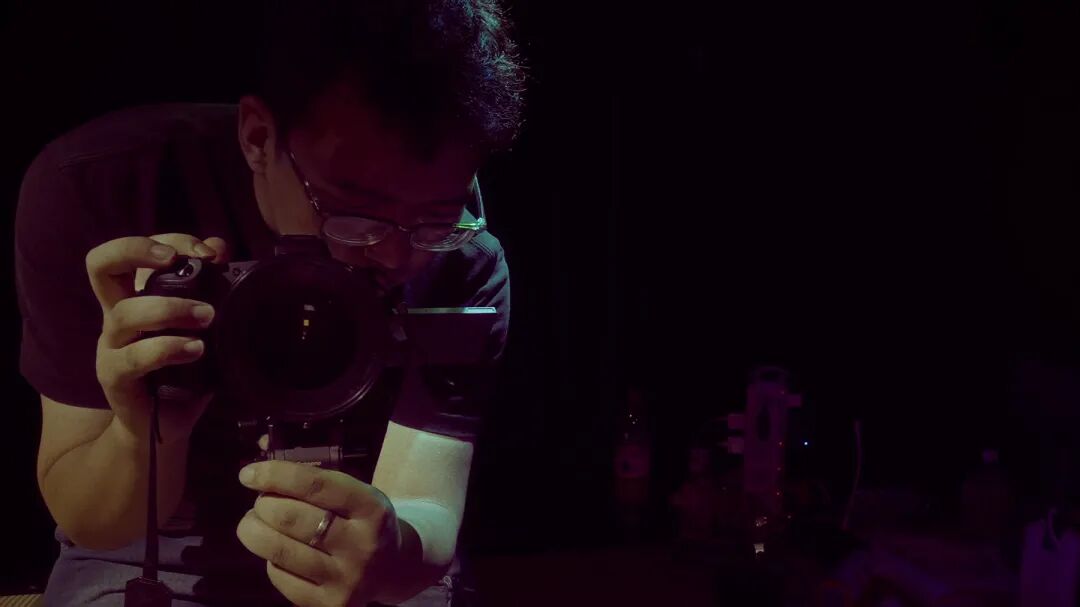
Figure 2.
The filmmaker is visible. The cameraman enters the picture in the red dark field so that the photo location is no longer merely a transparent function behind the camera.
This is not proof of the "photographer" but proof that the body was part of the film from the beginning.
II. Theoretical interface: photography is not just the past, but the future.
The paper is still in dialogue with photographic onotheism, phantoms, cinematography, sound theory and performance research, but does not use films as examples of these theories. External theory is not the master here, but the interface: they help us see where the problem comes from, and let us say more precisely where Human Surrender pushed it.
Batzanian photography theory can help to discuss the relationship between photography, time and the preservation of reality, and help us understand why long lenses are not eager to judge for the audience.
1
However, this paper is concerned not only with how photography preserves a past, but also with how photography saves the site while leaving a place to watch in advance. In other words, the problem is not just "this has happened", but "who will see it, misinterpret it, preserve it, and be stabbed by it". Bart's discussion of photography, death and thorny spots is also being pushed forward here: images are not just turning living people into returns.
2
It also brought forward future viewers to the scene.
The Delhi-style phantom and archival theory reminds us that phantoms are not a visible object, but rather a mistime, trace and filing desire.
3
But in this film, the phantom is not just about the return of the dead. More precisely, the viewers of the future were recalled in advance in the past: the images were still being filmed, and the place where the future would see, judge and look back had begun to influence how people spoke, how they left the scene and how to find a response.
The study of film phenomena, sound theory and performance offers three other limitations. Sobchak reminds us of the reversible nature of the viewing experience.
4
But the second person in this article says that the film is not immersion, but is restricted, and Hion says that the sound is re-enacting the image.
5
However, this paper is more concerned about how sound can keep the scene shut; Schneider's discussion of the legacy of the performance suggests that it will not end simply.
6
And Human Surrender brought the problem forward to the rehearsal itself: actors are not yet fully part of the role, but are no longer only individuals.
Shoot: Photography as irretrievable
shoot
First shot. But this is not a neutral recording. The filming means launching an site from now to the future, late for viewers who have not yet arrived to enter relationships that could not be responded to at that time. So-called
shoot self
It's not about saving a complete self, it's about launching a self that hasn't been firmly held by me into the image.
This self is not complete at the scene; it will be repeated only through the camera, other eyes, future viewers and archival systems.
shoot
And a shadow of shooting. As a verb, it contains direction, aim, hit and irretrievable. When you get close, you don't just take a look, but you hit someone, a body, a relationship. What's complicated is that it's not.
Shoot You
I don't know. I didn't shoot you. I shot you.
It's me with you.
Together.
Send yourself out.
and this launch party
Replay
To the pilot himself. Photography then became the echo structure: I thought I was filming you, but the camera bounced back, and I was shot in the image myself.
shoot
It also carries semantic shadows of ejection and body release. This shadow cannot be brutalized as "film equals ejaculation", which narrows the complex film mechanism into a motivational biography. A more stable understanding is that
shoot
It shows that the film was made not as a purely rational record, but with the pressure of translation after the body had failed to release. Something that cannot be closed in a direct relationship is transferred to cameras, performances, doubles, viewers and archives.
Therefore, the discussion here
shoot
The body releases shadows, not as a sexual metaphor, nor as a real motivation to judge a person or creator. Not here.
shoot
It is interpreted as violent intent and does not narrow it down to photographic terms. It's important: it's a word that at the same time engages in filming, launching, releasing and self-injecting, making self-inflicted things from the very beginning not something that stays within the body.
The photograph was not a harmless preservation, but a single dispatch; after it was sent, the image, desire, physical pressure and the viewing relationship could not be completely recovered by the originator.
The key is not to shoot itself, but to release it, but you don't belong to me.
The mechanism is referred to here as "launch imaging". Shoot the self; shoot the image into the bullet; release the irreconcilable stress to the camera; and
with you
This launch cannot be separated from the condition of the second person.
Shoot
It's a launch.
Self
It's the self that became visible after it was launched.
With You
It is an indissoluble condition of the launch.
SELf: Actor body and orphan self
The title says
self
No, it's not.
myself
I don't know. If
Shoot Myself with You
And still, this sentence is reserved for a first person who is relatively stable: I will have myself first, then film myself with you. But...
Shoot Self with You
It's gone.
my
I don't know. This self is no longer "my self."
It's a place where I can't hold on to myself, a place where I need to go through photography, performances, others, voices and futures.
This is very important for Human Surrender, because the characters in the film rarely exist as "yours".
They always change roles, actors, directors, viewers, photography and future materials.
It's like a director, an actor, a probator, a voice from the world; it's like he's putting people in places, and it's like these places are constantly being arranged.
Garret is more directly exposed to the contradictions of the actor's body: On the one hand, he entered the identification slot, intimate moves and role relationships, and sometimes enjoyed the possibility of another body; on the other hand, he hated the role of actor and took him away from performances, roles and views.
Amon keeps responding to others, and that's why he's being called by someone else's "you" to become a blind interface.
This is not a psychological diagnosis. More precisely
Films make people a place, not an entity.
The reason why a person becomes a "chare" or "Amon" is not because he has a complete kernel before being involved in the relationship; it is because the director's position, the actor's position, the response position, the double's position, the photo location, the sound position and the absentee position keep calling in.
Once the body enters, it is no longer just the original body.
Theatrical itself is this old system of orphan self. Actors stand on the floor and the body seems to belong to him; but the name, lines, actions, relationships and expectations of the audience occupy the body at the same time. The audience sees neither a purely personal nor a completely detached role, but a person is being used temporarily by another name, another relationship, another set of expectations.
The theatre is often not about what level is more real, but about how a body is called at the same time in multiple places.
Human Surrender began with rehearsals precisely because it wanted to show this dramatic structure.
Rehearsals are not the outer shell of the subject, but the introspective chassis.
The Last Rehearsal is not just a story, but a place where people continue to be incomplete, unstable, incomplete and unable to exit.
Actors have not yet become part of the role, but they are no longer only themselves; the director has not yet completed control, but control has already affected the body; the audience has not officially taken possession of the viewing, but the pressure to watch has changed the scene; the camera has not been turned into a file, but the conditions of the archives have moved forward.
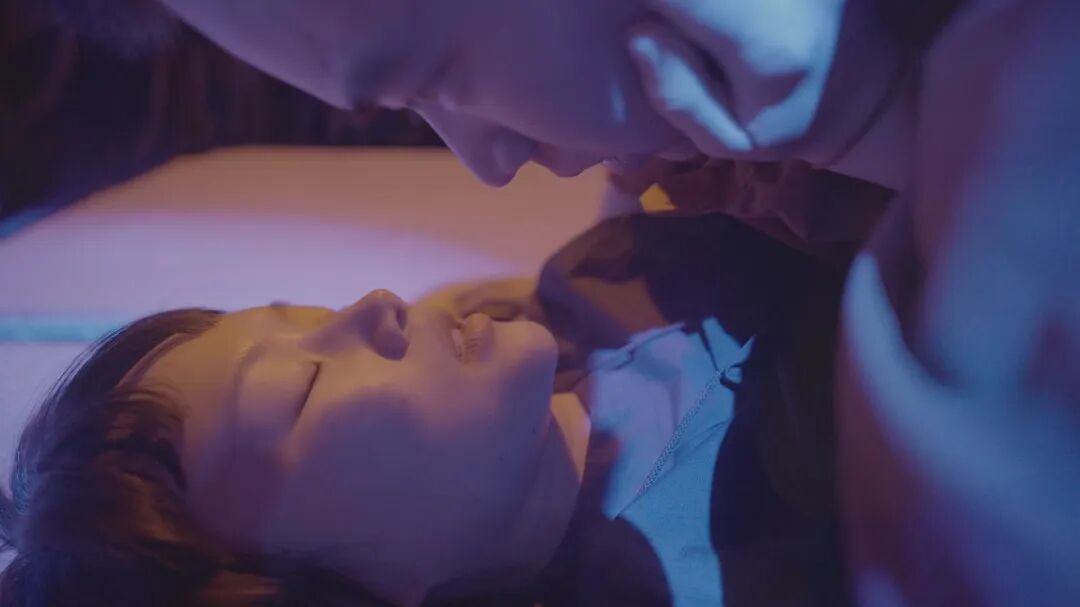
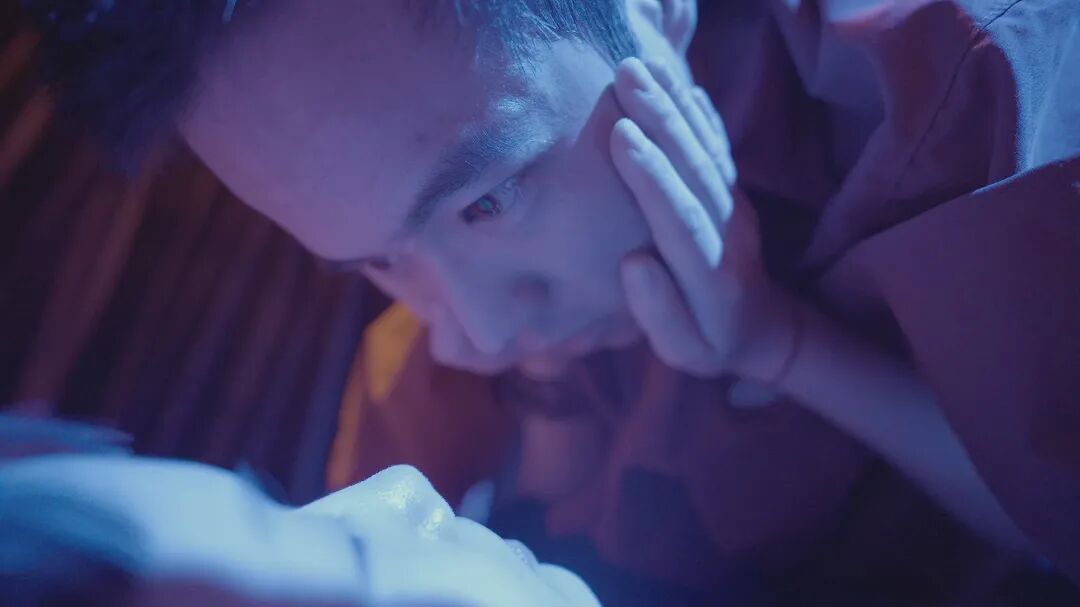
Figure 3.
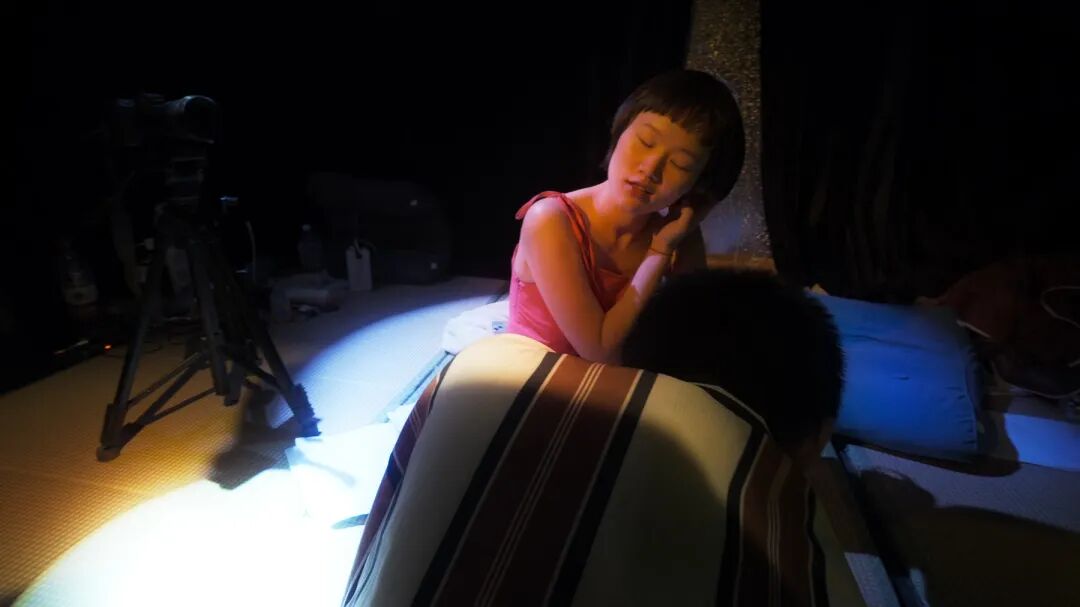
"I can't see myself in your eyes" very close to the body space. Eye lines do not take place in long-range conversations, but in the face, hand cover, cold blue light and squeezing.
This chart does not prove "intimate relationships", but rather that intimate distance itself may not be able to return to itself.
11
V. With You: This "you" really works, but it doesn't belong to anything. People
If
Self
Nope.
myself
Then...
with You
It's not a simple guest. Here.
you
Not a fixed person, not a fixed shot position. It sometimes looks like the person before it, sometimes like the person behind the camera, sometimes like the viewer of the future, and sometimes like the person who is writing, looking back and keeping the film. It's more like a condition: Self has to be in this condition, but this condition cannot be owned by anyone.
That is exactly what it means to be a "second-person orphan". The movie calls out a "you" and makes this "you" really change the scene: the body turns to it, the talking goes to it, the camera is touched by it, and then the audience suddenly feels involved. But the movie doesn't let us fix this "you." It falls unstablely between characters, cameras, viewers, archives and researchers, and is called to whomever the light comes
But the light won't belong to anyone.
Therefore, the owner is not without the object, but the object is always moving. People can be "you" for a while, cameras can be "you" for a while, outside photographers can be "you" for a while, and viewers can be late to feel themselves wiped out; but every time we say "it's him," "it's me" and "it's the audience," the film pushes the position elsewhere.
This "you" is not a blank, but a very living relationship condition: it allows things to happen and does not allow anyone to take them away.
More importantly, there is no impunity. It does not mean that no one needs to respond to video pressure, nor that any judgement can be indefinitely suspended.
It's not about responding, it's about possession.
A called viewer still has to bear his own watch, quote and explain, but it cannot be expanded to "I finally have the scene". When I see the power to stop, I start here: I answer, but I don't own it; I say my own understanding, but I don't disguise it as a final decision.
It's different from the subjective lens. Subjective lenses usually give the audience temporary access to someone's eyes, even if they are unstable, while the second person in Human Surrender claims precisely that the audience does not have steady access to the eyes. It often brings the audience to a very close place, while at the same time making the audience aware that
This is not my seat, I can't sit down to announce that I'm inside.
And it's different from the audience. Substitutes mean that the audience can place itself in a role or viewing point, temporarily enjoying an emotional, cognitive or physical alternative. The second man said the opposite: it causes the audience to be called, but it does not allow the audience to sit; it makes the audience feel that it may wipe its own words, its eyes, its sound, or its camera, and it constantly reminds the audience that you have been wiped, not as much as you have.
I look at the world, I look at it, and suddenly I'm being seen.
This phrase describes the appearance of the viewing position: I thought I was watching people on a camera, and the result was that the camera, the person's eyes, the sound and the tail file together showed that my location had been included in the film. Watching is no longer an external move, but part of the scene.
Figure 4.
"I'm gone" eye frame. The hand covers the eye, the face closes, and the cold blue light places the sight, touch and veil in the same picture.
This chart is not proof that "persons have left the picture", but proof that disappearance can occur at the smallest physical distance.
VI. Four on-site mechanisms: why not take possession after approaching
The second person in the film said that it was not a stand-alone scene, but a chain that kept bringing people closer and preventing possession. And the eye was like, "Come closer doesn't necessarily give me back." The timeline states that sequencing does not necessarily lead to the closure of the case. The sound section said that the picture seemed stable, but the scene was leaking elsewhere. The camera section said that people would be seen and the camera could not be hidden forever.
Mechanisms
The sense of certainty broken
Inner expression
Watch consequences
Eyes.
We'll know when we get close.
"I'm in your eyes" in the nearest body, but you say you can't see and disappear.
The other eye can't promise me back.
Time
We can close the case in order.
The stress cannot be absorbed by a single cause, result, flash, parallel or circular relationship.
Time saves pressure without giving the audience a final explanation.
Sound
The footage will hold the scene.
The sound is publicly awaited without a clear line, and the device returns before the person ' s language.
The scene could not be closed, and the sound field would bring back the current location.
Camera
People can hide outside.
Another camera was shot, the character-identified camera asked to swim outside the painting.
The machine itself was also seen at the scene.
1. Eyes: I can't get back near you.
There is a set of words that push the question of "you" from language to body. The man began to ask the other for a deeper proof: "Can I see myself in your eyes?" This requirement appears to be simple and almost the oldest aspiration in a close relationship: one wants to be recognized in the eyes of another and wants to exist not in isolation, but in the hands of the other.
But the film did not take this wish as a tender look-out. It places its eyes in the most crowded and unstable position of its body: close to its face, close to its eyes, breathing, covering, tearing and hard light.
The so-called disappearance does not occur in the middle, but in close proximity.
Usually we think that proximity brings confirmation: the closer we see, the closer we know the other side is present; the closer we touch, the more we know that the relationship is not broken. The film, in turn, shows that physical proximity is not automatically recognized.
2. Timing: order cannot replace closure of events
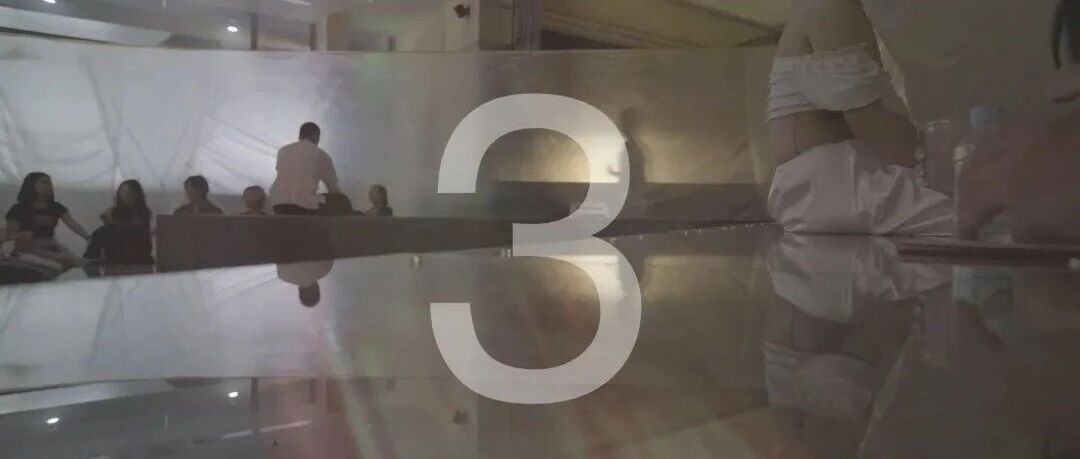
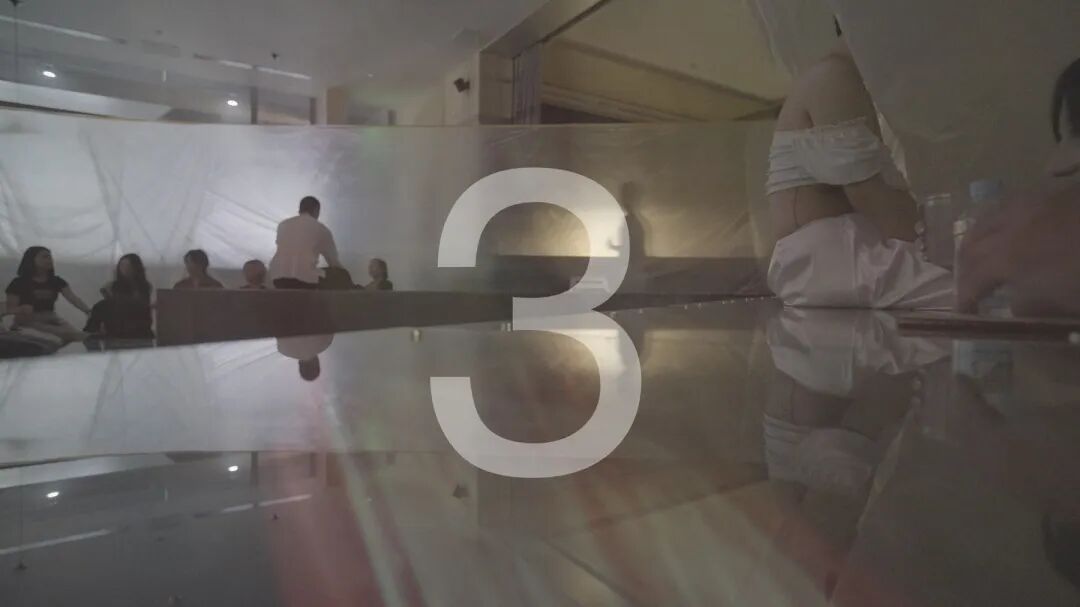
After admitting failure, the audience will naturally look for another placement: If the eyes cannot return to themselves, at least time should be allowed to order the events. But the film does not give time to a stable explanation. The number "3" suddenly casts a rule of the game into open space, and the person relationship appears to have been brought into the next round, but the picture does not immediately close the previous round of emotions; the public waiting appears to be a new phase, but still carries the physical pressure that has been left unprocessed; at the end, the list and format turn the scene into a re-readable file, but the file does not close the site completely.
This, of course, can be understood as the suspension of ordinary narratives: The film is deliberately silent and confusing the audience. But the judgment here must be narrower: the point is not simply "not to understand time", but rather that time no longer provides a safe exit here. It could not justify intimacy, it could not draw clear boundaries for public performances, and it could not close incidents once and for all through a tail list.
It is often not just to understand narratives, but also to put pressure into a manageable order.
The film refused to hand over the exit.
As a result, time saves the pressure of events without taking the final explanation.
Sound: the image cannot close the scene
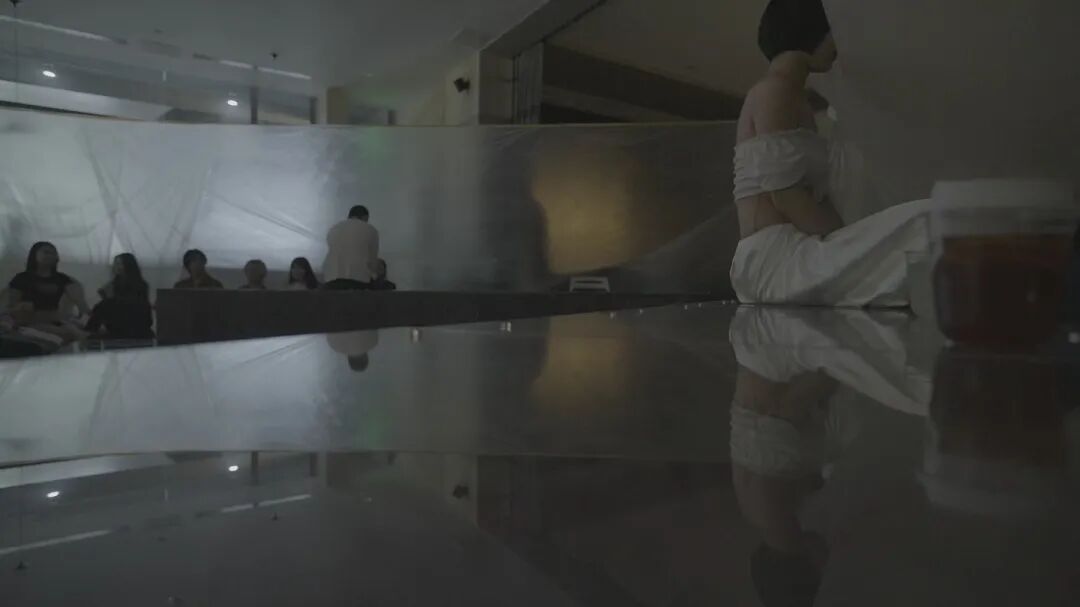
After the number "3", the film brings the audience to a low, cold, almost static open space: a mirror glass table, a semi-transparent barrier, a video clip of the audience, and a public interface of placed bodies or clothing. It looks more empty, more open and more like a stage to be watched. The video, however, did not make this open space a place to explain clearly. It begins by giving not a scene that has been completely taken back by the person, but an unspoken waiting period: the sound of the device, the sound of the environment, the sound of the person that is not fully the line, and the sound that comes in from outside the painting, to show the audience that it is not just in the picture.
Figure 5.
Publicization of the number "3". Large, semi-transparent numbers are stacked between low slots, reflectors, white plastic barriers, viewers and right-hand white packagings, putting the newly named rules of the game into public space.
This chart does not prove that the film is divided into chapters, but rather that the rules of the private game have been put into public interfaces visible to the audience.
12
Images maintain stability in open space, but voices constantly remind us that this space is not self-sufficient. It is penetrated by sound elsewhere, noise, the location of the device and the conditions outside the field. The sound here is not a "background atmosphere" or just an increase in tension. It is more like a system of redistribution of sites: some voices lead the audience backstage, some voices temporarily disable the person ' s language, and others make open spaces look like an interface waiting for instructions. The current picture could not prove that the scene was only here; the sound turned it into a space that was constantly opened elsewhere.
Figure 6.
Waiting for a single frame in public. Low plane slots, reflecting ground, white barriers, viewers and right-hand white parcels turn the scene into a public interface that is sound but is not bound by the characters' language.
This chart is not proof of "silence", but proof that the more stable the picture, the more sound the scene.
12
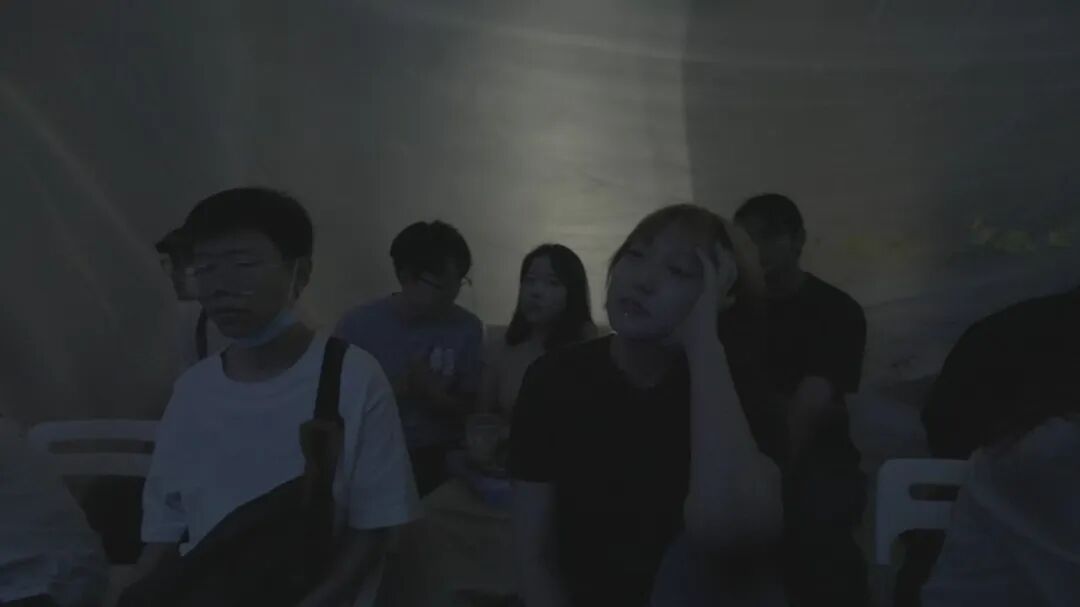
Figure 7.
The audience was seen. The public waiting is not just an audience, but also a body inside the image in smoke, projection and cold light.
This is not proof that there is a viewer on the scene, but proof that the viewer is also in the visible structure.
The most painful part of the sound line is not loud, but the void cannot be kept naturally. After Garrett said, "The brain is blank," he said, "You're missing a lot of words," and after Jarrett said, "I/I don't want to say," the scene didn't stop, but went through rocks, Seo Jinjiang, white cloth and "Do I need to say it for you," and ended up in a very short word. The word cannot be written as a complete mandate, nor can the previous rejection be erased. It's more like a very narrow, very dangerous cut
Can't a man's voice continue when he can't say it? If it goes on, who's saying it? If it doesn't go on, will the scene collapse?
14
This is the last place to write a film into pure theory. Because it's not the word "mainstream" that really stings here, but rather a more everyday and unbearable experience: Sometimes we can't say it, it doesn't mean nothing; but others say it for us, it doesn't mean they own us. The film puts these two dangerous actions together, sharing the same sound channel with the care and location.
Cameras: people will be seen.
When the sound opened the picture, the film pushed into front of the scene the conditions that had been hidden. Another camera was filmed, and the camera changed from a recording condition to a viewer; the character-identified camera was also visible. Of course, this detail can be misread as an ordinary set of scenes, or even as a "fashion" or a dollar movie. But in this film, it's not an isolated joke, it's not a self-direction. Because the direction of the person, the direction of the body and the pressure of future material are beginning to gather near the lens after the camera is painted, the viewing machine can no longer hide in a transparent position.
Traditionally, the camera looks like a window: it's there, the audience is outside, and the camera is responsible for sending it to the audience in a transparent manner. But here, the camera is no longer transparent. It's not just a "look" position, it's a "seen" object
It is not just a recorder, but also a receiving location that can be commonly pointed at by words, eyes and future re-examination.
The question is particularly clear: the question does not directly identify the audience as the recipient, nor does it allow the photographer to be the only answerer; it simply makes the "who answers" unstable.
It is precisely because this "you" cannot be stabilized by anyone that it actually enters the second term of orphan.
Figure 8.
Camera's in. When another camera was filmed, the viewing machine was no longer a condition of transparency, but a body that was seen on the scene, identified and drawn into the relationship by future material pressure.
This chart is not proof of "spot exposure", but proof that the recording device was pulled back from behind the scene.
13
Figure 9.
Body delivery to camera. The character is not only talking to each other, but also putting language, complaints, future material pressure on the unstable "you" behind the camera and camera.
This is not proof of "persons looking at the camera", but proof that the person's delivery is beginning to take place behind the camera.
Figure 10.
Ask for a smoke. After Garret left the scene, Amon stayed in the room looking for a responseable position, and "Do you have a cigarette" may pass through the camera, photographer, outside of the painting, or may be late to the audience.
This chart does not prove that "someone borrowed cigarettes", but rather that a daily problem can call the camera "you" on the back of the camera.
13
What would a challenger say?
A conservative reader can well question it: it's just a meta-film, self-anti-image, rehearsing, exposure to the scene and a sense of uncertainty of hand-held photography, and it doesn't require such complex concepts as "image with you" or "a second person without control". The camera enters the picture, which can be described as a set-up; the person looks at the camera, which can be said to be an inversion; the smoke, which can be said to be a living detail; and the end list, which can be described as an ordinary archive. This is certainly a necessary challenge, because it reminds us that all instability cannot be automatically incorporated into the theory.
This paper does not agree with this simplification, not because they are wrongly read, but because they are not sufficient. The pressure that the film really continues to create is not just that "the camera is seen", but that every sight cannot stabilize back to a master. The eye segment is not just about intimacy failure, but about the other eye not being able to give me back to me; the smoke is not just about filmmaking, but about a daily request to connect behind cameras, behind doors, window smokers and backstage spaces; the white sheet is not just about coverings, but about the more unreadable the face, the more sound works for unreadable areas; and the tail is not just a list, but a format for future re-examination.
Thus, the "second orphan" claim is not a high-level label for the film, but rather a name for the part of the pressure that remains after these inverse readings: someone is called but not the owner; a position is valid but cannot be taken away by anyone; the sightings happen but cannot be occupied. In more general terms, the film shows you and then asks you to stop.
viii. How the ghost appeared: the unattended audience has been put on the scene
Here, the ghost nature of the film can be made clearer. The phantom here is not a ghost, nor is it a dark atmosphere. It's more like a lateness: the future audience is not here when the film is being filmed; but as soon as the camera opens, those who watch, reread, judge, misread and write the article have been put on the scene.
Therefore, this paper does not refer to all shadows, dark light, memories or instability as ghosts. Minimum standards are narrower
This paper is called phantom only if a viewing location really affects the site and cannot be steadily returned to an individual, photographer, viewer or archive subject.
Ghosts are not a beautiful atmosphere, but an effective location where no master can be found.
There are at least three floors.
First level is the wrong time
The scene was still taking place and the location of future viewers had been pre-opened; the person was still talking and the pressure to be read, judged and quoted had entered the sound.
The second level is the medium device
Cameras, live sound, tailing lists and reversible document formats are constantly handed over to other locations.
The third level is watching ethics
The latter were indeed summoned by the film, but they cannot become the owners of the scene because they are late to understand something.
That's why.
Shoot Self with You
It's the whole thing.
Shoot
Is sent
Self
It's the self that comes out after it appears.
With You
It's the relationship that it can't get out of. The ghost is not from a mysterious subject.
And there's a mistake between the three: the image has been sent, the self has left yourself, you have been called, but no one can finally catch it.
The technology is not an external tool, but a device that keeps this wrong track.
Human Surrender, on the other hand, explains how this phantom becomes a condition for human beings. Their bodies are borrowed from their roles, their views are borrowed from the future, their voices are borrowed from the backstage, their names are borrowed from the ends of the film, and their judgement is reviewed and research continues to be delayed. People are still there, but people are no longer at the centre; people still happen, but in a way that no longer belongs to people alone. So the phantom technology here is not a universal concept, but a crossover of three things
The time had come to bring forward the prospective viewer, the media had transferred the scene to another location, and the latter had been asked not to take possession of the transferred site.
This phantom makes the film different from the usual nostalgia or memories. Rather than handing over a world that is past to those who come later, it allows a scene that is still happening to be seen to change in the future from the very beginning. When the person speaks, the camera is on; when the action is not completed, the material of the future is there; and when the relationship has not really left the body, it has begun to be shared by sound, material, viewer and tail format.
The post-life in the film is not a residual after-effect, but a structure that is produced earlier in the conditions of rehearsal, filming and viewing.
Thus, Human Surrender can also be understood as a pre-death ritual. The term "death" here is not biological death, nor is it a direct description of pain or absence as actual harm. More precisely
It refers to the limited life of a temporary world: it was built, rehearsed, used together, pushed to the last moment and started to produce its own legacy while still alive.
Its ceremonial nature comes not from religious processes, but from a continuing state of criticality: people are present, relationships are still occurring, cameras are still being recorded, audiences are still being involved, but the world knows that it cannot continue indefinitely.
Figure 11.
The frame of the tail file. The list is placed on the scene and the tails do not settle the incident, but continue to shift the characters, materials, sites and viewers to re-readable formats.
This chart is not proof of "the end of the film", but proof that the end itself will also leave the scene for future re-examination.
IX. CONCLUSION: TRYING TO REALIZE THAT I'M NOT THE LAST MAN
Now we can put two titles together
Shoot Self with You
= self-image is not possible.
Human Surrender = Man can no longer pretend to be self-image.
The English name compresses the film into an action: a person cannot film himself alone, he must pass through a "you". The Chinese name expands this to a common position: by recognizing this, one can no longer pretend to have a complete body, relationship, view, sound, end and file.
It must surrender or, more precisely, admit that it has been removed from relationships, images, voices, performances and archives.
So surrender is not surrender.
Surrender is the most intransigent fantasy: I can tell what happened, read it, hold it steady and close it.
I don't know. The film told us over and over, no. You can get close, but it won't let you have it; you can look back, but it won't bring back the whole thing; you can save it, but it's not done.
It doesn't make people disappear. On the contrary, it is in this incompleteness that people become more real. Man is no longer the complete master, but still the bearer of the scene; he does not have the whole body, but the body still makes the event irreplaceable; he does not have the whole view, but the view still requires ethical responsibility; and he does not have the complete possession of the file, which still requires the preservation, review and cessation of the hands of the late.
Thus, so-called non-sovereign viewing, in the simplest words, is the ability to stop after seeing. It's not less, it's not a little cold.
It's when you want to take it.
I was called to a movie, but I was not in charge of it; I was stung by something, but I could not write it into an external fact; I understood something, but I could not understand it as a final explanation.
So, "Human Surrender" is not a coalition of losers, but a group of people who finally admit that "I am not the last master". They did not surrender because they had no power.
It's because I finally saw it.
:
Once power has taken place, it has become more than the person who sent it; once it has taken place, it has become more than the person who felt it; once it has taken place, it has become more than the person who photographed it; and once it has taken place, it has become more than the person who was present.
This is Human Surrender.
Shoot Self with You
True translation. The English name says action, the Chinese name says fate. The English name says, "It must be like you." The Chinese name says: those who recognize this form surrender. Together, they constitute the deepest ghost mechanism of the film
A person who tries to film himself finds himself only visible between others, the camera, the future and the archives
One audience tried to see it, but found that he had seen it and that after seeing it, he had to learn to stop.
About Authors
He Fa, founder of the P4 Theater, author and author of the video, has long been creating and researching the relationship between film, performance, site, technology and archiving. Human Surrender is his ongoing film project on hand-held photography, rehearsing, body change, second-person viewing and technology to create a ghost; in this project, the camera is not only a recording tool, but also a device to bring people into relationships, hand them over to the future and rediscover the viewer.
He Fa writes about a recurring return: how images change relationships between people and the scene. When will it stop just watching? When will the record become part of the event? Why continue to speak in archives, in retrospects, misreads, memories and research when a closed site is over? It's within these issues, for Human Surrender/
Shoot Self with You
A one-time theory solidified.
Footnote
1. The present paper uses conceptual interfaces rather than quotes from André Bazin ' s photothematics, long lenses and film reality preservation issues. Bibliography of California Press
What Is Cinema? Volume I
(Specific address: https://www.ucpress.edu/books/what-is-cinema-volume-i/paper)
Published page.
Roland Barthes' discussion of photography, death and viewing of thorns is limited to the interface "How photography puts the living into the image state". For bibliographic information, see Macmillan / Hill and Wang
Camera Lucida
(Specific address: https://us.macmilan.com/books/978037452338/cameralucida/)
page.
3. phantom and archival theory of Jacques Derrida, respectively
Specters of Marx
and
Archive Fever
I don't know. The former is available on the Routledge page; the latter is available in the United of Chicago Press related records and library records. This paper does not write "ghost" as an object, but rather as a time and address relationship.
The cinematography of Vivian Sobchack reminds us that film experience involves a reversible relationship between the viewer and the film. For bibliographical information, see Princeton University Press.
The Address of the Eye
(Specific address: https://press.princeton.edu/books/paperback/9780691008745/the-address-of-the-eye)
page.
5. Michel Chion ' s acoustic theory suggests that voices change image sensory structures rather than merely supplementing images. For bibliographical information, see Columbia University Press.
Audio-Vision: Sound on Screen
(Specific address: https://cup.columbia.edu/book/udio-vision-son-on-screen/9780231185899/)
page.
Rebecca Schneider's discussion on the legacy and rerun of the performance provides an interface for this paper's treatment of "life after rehearsal sites have begun to produce". For bibliographic information, see Routledge.
Performing Remains
(assigned address: https://www.routledge.com/Performing-Remains-Art-and-War-in-Times-of-Theatrical-Reactment-1st/Schneider/p/book/97802038852873)
pages;DOI
10.4324/9780203852873
(Specific address: https://doi.org/104324/97802038852873)
。
Ariella Aïsha Azoulay's discussion of the public relationship between photography and the location of the addressee may provide a political and ethical background to this "image address". See Zone Books for bibliography information.
The Civil Contract of Photography
(Specific address: https://www.zonebooks.org/books/6-the-civil-contract-of-photography)
page.
8. Avery F. Gordon ' s social theory of hunting provides a methodological reminder for the purpose of avoiding the return of ghosts to atmosphere or spirits. Bibliography of Minnesota Press
Ghostly Matters
(Specific address: https://www.upress.umn.edu/978086654468hostly-matters/)
page.
References
1. Azoulay, Ariella Aïsha.
The Civil Contract of Photography
. New York: Zone Books, 2008.
Publisher record
(Specific address: https://www.zonebooks.org/books/6-the-civil-contract-of-photography)
.
2. Barthes, Roland.
Camera Lucida: Reflections on Photography
. Translated by Richard Howard. New York: Hill and Wang, 1981. Current edition record
Macmillan
(Specific address: https://us.macmilan.com/books/978037452338/cameralucida/)
.
3. Bazin, André.
What Is Cinema? Volume I
. Translated by Hugh Gray. 2nd ed. Berkeley: University of California Press, 2004.
Publisher record
(Specific address: https://www.ucpress.edu/books/what-is-cinema-volume-i/paper)
.
4. Chion, Michel.
Audio-Vision: Sound on Screen
. Edited and translated by Claudia Gorbman. 2nd ed. New York: Columbia University Press, 2019.
Publisher record
(Specific address: https://cup.columbia.edu/book/udio-vision-son-on-screen/9780231185899/)
.
5. Derrida, Jacques.
Archive Fever: A Freudian Impression
. Translated by Eric Prenowitz. Chicago: University of Chicago Press, 1996.
6. Derrida, Jacques.
Specters of Marx: The State of the Debt, the Work of Mourning and the New International
. Translated by Peggy Kamuf. New York: Routledge, 1994. Current Routledge Classics record
Routledge
(Specific address: https://www.routledge.com/Specters-of-Marx-The-State-of-the-Debt-the-Work-of-Mourning-and-the-New-International/Derida/p/book/9781041083689)
.
7. Gordon, Avery F.
Ghostly Matters: Haunting and the Sociological Imagination
. Minneapolis: University of Minnesota Press, 1997; new ed., 2008.
Publisher record
(Specific address: https://www.upress.umn.edu/978086654468hostly-matters/)
.
8. Schneider, Rebecca.
Performing Remains: Art and War in Times of Theatrical Reenactment
. London and New York: Routledge, 2011.
Publisher record
(assigned address: https://www.routledge.com/Performing-Remains-Art-and-War-in-Times-of-Theatrical-Reactment-1st/Schneider/p/book/97802038852873)
DOI
10.4324/9780203852873
(Specific address: https://doi.org/104324/97802038852873)
.
9. Sobchack, Vivian.
The Address of the Eye: A Phenomenology of Film Experience
. Princeton: Princeton University Press, 1992.
Publisher record
(Specific address: https://press.princeton.edu/books/paperback/9780691008745/the-address-of-the-eye)
.
Human Surrender file
This is a recruitment case for Human Surrender.
The Last Rehearsal, the The Last Rehearsal of Human Surrender
Art, the beginning of Human Surrender -- will aliens come again?
This is the last rehearsal! It's true!
Human Surrender, make me a whale. I have too little.
Human Surrender A Zoo and then you become a little girl...
Human Surrender R | "First Experiment in Beijing"
Human Surrender D. Zoo, one more time.
Human Surrender K. Twirlings.
Human Surrender S. Zoo, everything is new.
The Last Rehearsal of Love, Death, Human Surrender
Human Surrender disappeared from me - after the The Last Rehearsal.
No longer loyal to integrity - the final edition of Human Surrender Long Commentary
How words betray people - the original language structure of Human Surrender
"Human Surrender" as "the oracular work"
Why must the man with the camera surrender?
Closeness doesn't belong to two people.