
The Grammar of Events: Actor-Generated Topology (AGT) and the Birth of the Postmodern Subject, Part II
The Emergence of Events
Emergence
Topological crisis, liminal space, betrayal, transition.
Part II: Theoretical Verification and Dialogue - Placing AGT in a Wider Constellation

Introduction
In Part I, like engineers drawing a blueprint, we systematically constructed the theoretical edifice of Actor-Generated Topology (AGT). We defined its core axioms, coding mechanisms, and dynamic model. But even the most perfect blueprint has to pass through actual construction and weather before its value can be proven.
The task of this part is to place this newly built theoretical edifice of AGT within a broader constellation of complex phenomena and deep thought, testing its structural firmness, explanatory generality, and dialogic potential. We will first return to AGT's native soil - P4 Theater - and anatomize how an event is concretely catalyzed and generated. We will then turn AGT's searchlight toward two cultural texts of very different styles but equal depth, Hamlet and The Matrix, using them to pressure-test its cross-textual explanatory force. Next, taking P4's own complex work Human Surrender as an example, we will show how AGT analyzes contemporary cross-media practice. Finally, we will place AGT within the coordinates of contemporary thought, entering an equal and critical dialogue with mainstream personality theory and post-structuralist philosophy, so as to mark its distinct theoretical niche through reference and collision.
Chapter III: The Genesis of Events - P4 as an Engineer of Topological Dissonance
Introduction
In Chapter II, we established AGT's core dynamic law: topological resonance and dissonance. We argued that any profound transformation of subjectivity arises from an irreconcilable topological dissonance between one's internal default code and the code of the situation one inhabits. Yet in everyday situations, such violent dissonance is rare. Social norms, personal habits, and psychological defenses together build a powerful buffer that keeps us, most of the time, running in a low-energy autopilot mode relatively resonant with the environment.
How, then, can a subversive event happen? The task of this chapter is to enter the concrete laboratory of P4 Theater and anatomize P4's engineering blueprint as an event catalyst. I will argue that P4's practice is neither mysterious art nor accidental improvisation. It is a precise topological engineering. Its core technique is the coordinated, extreme coding of the three layers of Situation E - rules r, space s, and network n - consciously and maximally designing topological dissonance with participants' everyday default codes, thereby pushing them into topological crisis and liminal space, and finally creating the ripest conditions for an event to emerge.
3.1 The Engineering of Topological Crisis: How P4 Systematically Designs Dissonance
Introduction: From Allowing Failure to Designing Failure
The prelude to an event must be a profound topological crisis. In everyday life, however, our internal default code is like an old soldier hardened by battle: it has developed extremely powerful psychological defenses, enough to help us avoid or normalize most direct collisions that might produce crisis. We are skilled at filtering information, maintaining social distance, and following scripts of etiquette in order to preserve a stable and safe inner world.
Many participatory art projects are satisfied with creating an environment that allows failure. They build a tolerant atmosphere and tell participants that it is fine to make mistakes. But that is often not enough. An actor attached to their default code has an entire operating system devoted to avoiding situations in which mistakes might happen.
P4 Theater's radicality lies in going far beyond allowing failure. Through a sophisticated social alchemy, it consciously and systematically designs failure for participants: that is, it designs an impasse in which their everyday default code will necessarily fail. It does not wait for crisis to occur; in an engineering sense, it catalyzes crisis. This engineering of topological dissonance is P4's core technology as an event catalyst. The construction of the impasse is not a single attack, but a carefully choreographed and escalating hunt.
3.1.1 Coding Rules r(p): Symbolic Subversion from Norm to Game
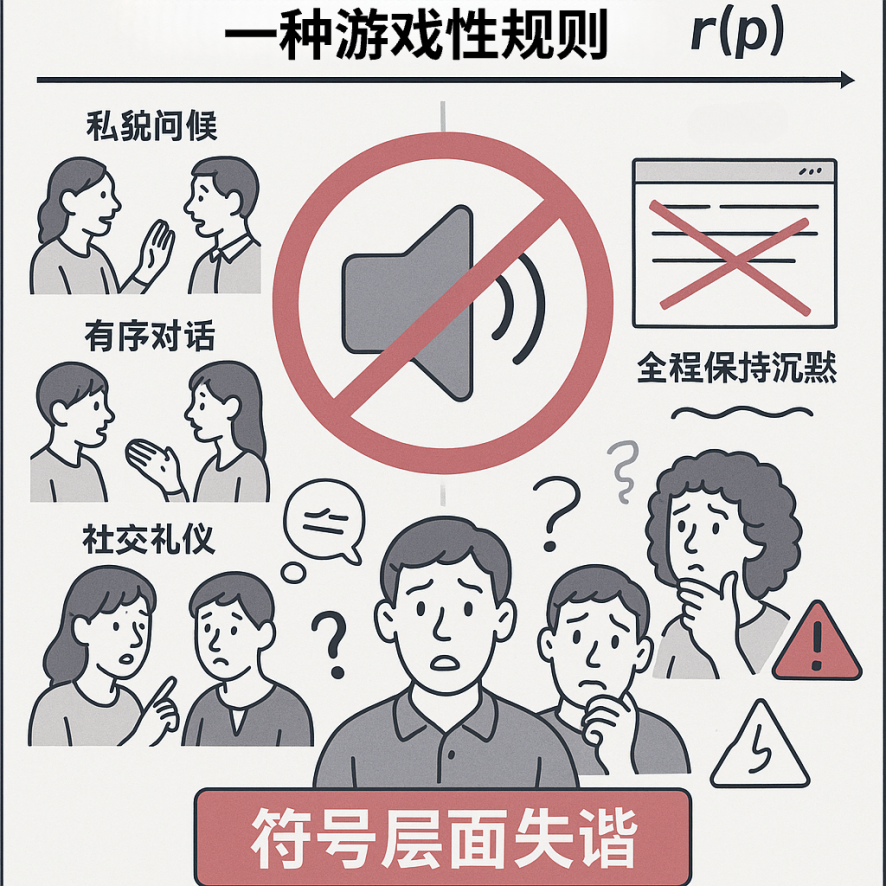
P4's first attack always points to the software layer of our internal operating system: the grammar of social interaction on which we rely. P4's core rules are essentially game rules, r(p), designed to systematically abolish and subvert the normative rules, r(n), that participants rely on in everyday life: one should greet people politely, should not interrupt others, should avoid embarrassing silence, and so on.
Case analysis: the apparently simple rule of remaining silent throughout is enormously subversive. It instantly abolishes language, humanity's most important and safest social tool. For an actor whose default code, in the Form dimension [II], relies on the Discipline [N] module ("I should say a few polite things according to etiquette") or the Lurker [V] module ("I can analyze and control the situation by asking questions"), the entire library of forms is suddenly emptied. Their preset program for how to act is completely invalidated.
Dynamic analysis: this mismatch of rule codes at the symbolic level directly attacks the participant's Form dimension [II]. The system can no longer call on its familiar [N] or [V] modules to formulate an action plan. This symbolic topological dissonance immediately triggers enormous inner anxiety: What should I do? Do I look stupid? It forces participants either into complete paralysis or into the risk of trying unfamiliar, bodily, intuitive Player [P] interaction.
3.1.2 Coding Space s(p): Physical Coercion from Convention to Chaos
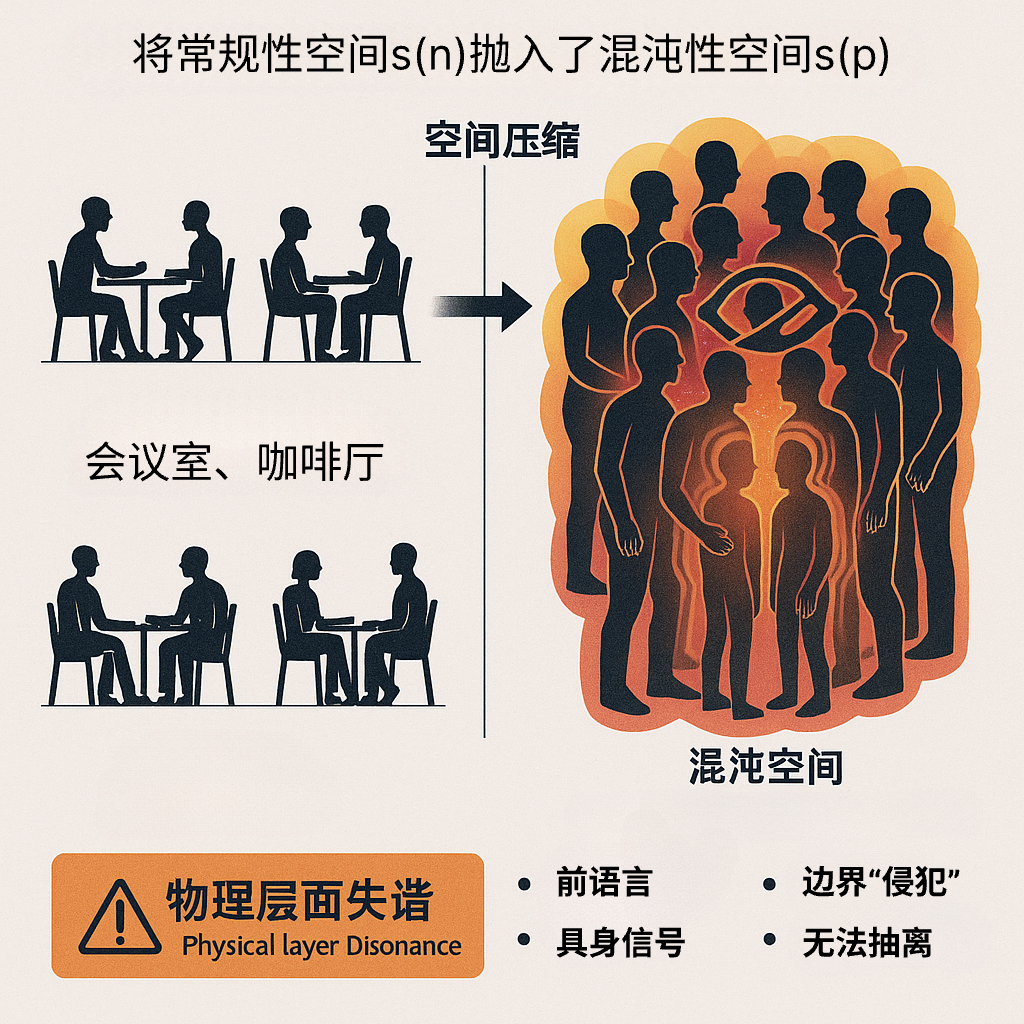
P4's second attack points to the hardware layer of our operating system: our body and its relation to physical space. P4's choice of non-fixed sites, especially extreme spaces such as the 510 office, is a deliberate manipulation of spatial coding. It throws participants out of familiar conventional spaces, s(n), such as cafes and conference rooms, each with clear and predictable norms of use, and into a chaotic space, s(p).
Case analysis: the dense topology of space. In a sixteen-square-meter office, twenty strangers are forced into bodily proximity. This chaotic space, s(p), uses an irresistible physical force to dissolve the core strategy by which participants, in the Execution dimension [III], use the Lurker [V] module to maintain a safe distance.
Dynamic analysis: physical topological dissonance. Here, observation loses its detachment, because the object you observe is breathing next to your ear. Bodily boundaries are constantly infringed. Preverbal embodied signals - temperature, smell, slight muscular tension - replace language as the main channel of information exchange. This physical dissonance makes every attempt to gain safety through withdrawal futile. It forces every actor to exist in a present and interventionist mode.
3.1.3 Coding Network n(p)/n(v): Relational Reorganization from Dispersion to Radiation
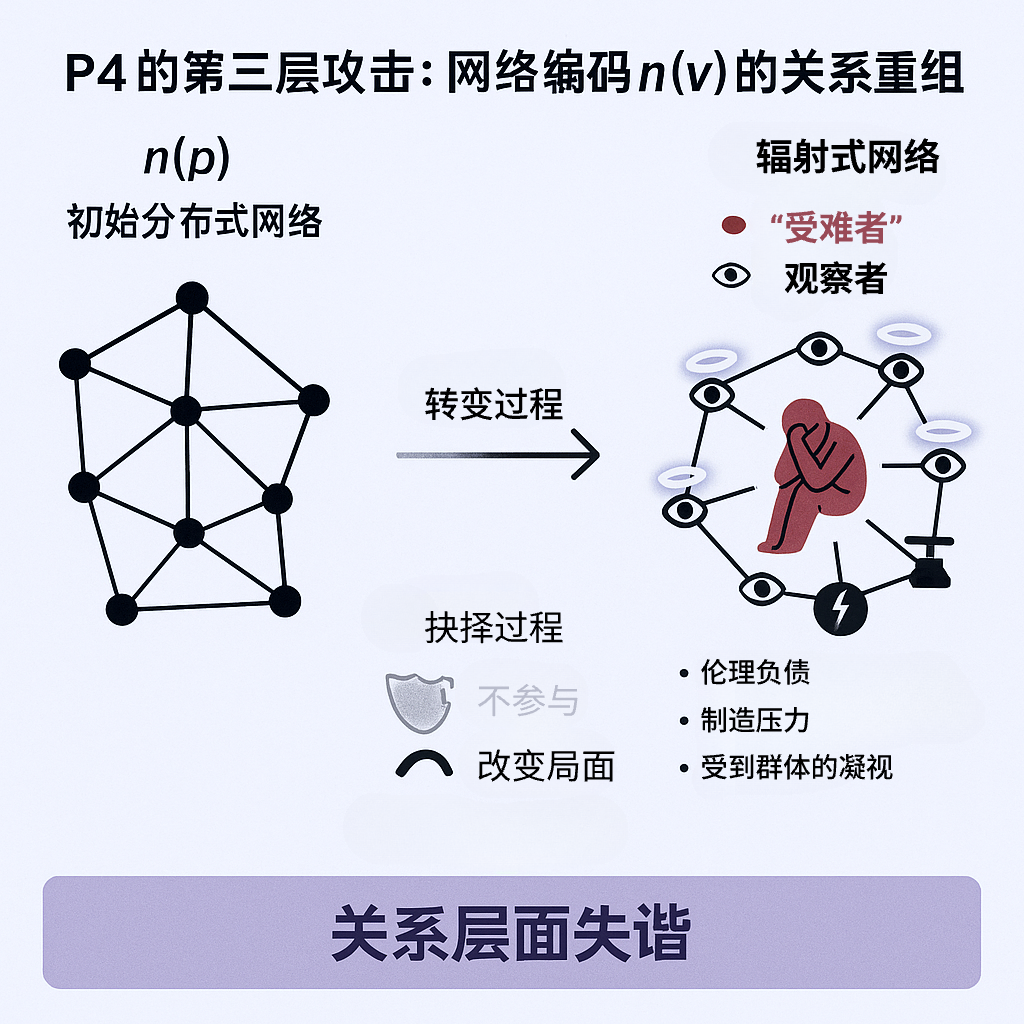
P4's third attack points to the network interface of the operating system: the patterns through which we relate to other actors. P4's victim situation is an intricate switch in network coding.
Case analysis: the victim situation. At the beginning of an event, the relational network among participants is usually distributed, n(p): everyone is an isolated node. But when the Architect designates one participant through the rules as the victim, for example by requiring them to maintain a painful posture, the topology of the entire network is suddenly reconstructed into a radiating network centered on that victim, n(v).
Dynamic analysis: relational topological dissonance. In this new network topology, all other participants are forcibly placed in the position of observers. This directly challenges the Discipline [N] module that seeks safety by blending into the group, because now everyone's inaction is visible. At the same time, it sharply increases the ethical debt of the Lurker [V] module, because observation is no longer neutral; it becomes a cold form of complicity.
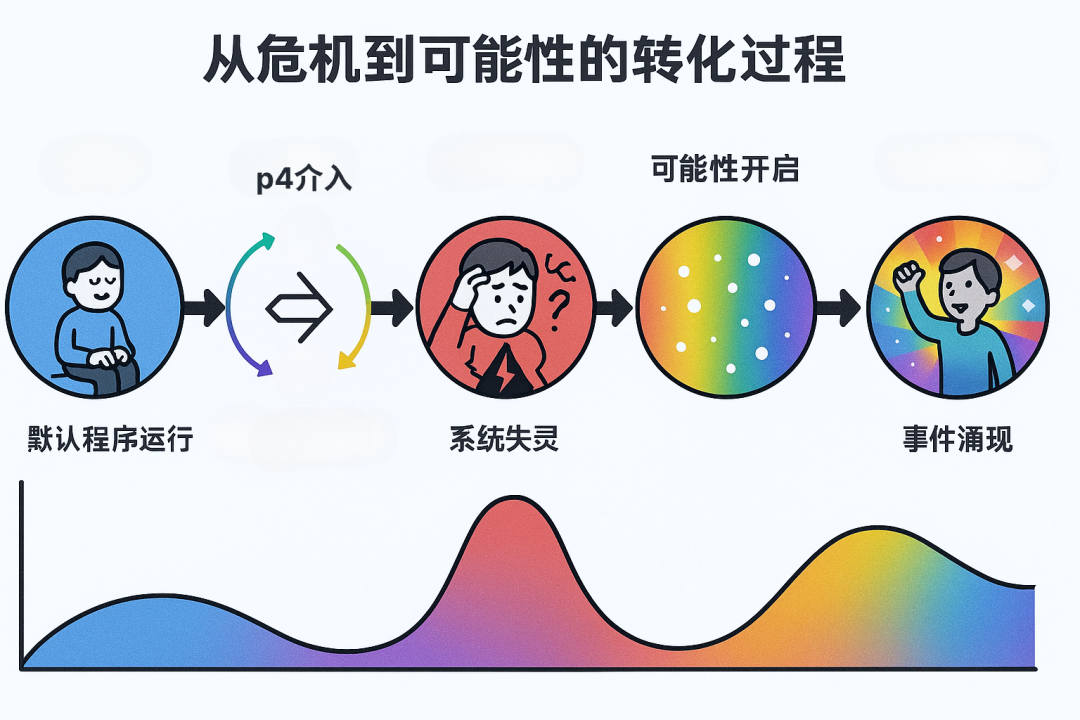
Section summary: P4's impasse is not a mysterious atmosphere, but a high-intensity field of topological crisis jointly constructed by the three codes of rule r(p), space s(p), and network n(v), and systematically dissonant with participants' everyday codes. Only at the moment when all default programs fail can a new space full of possibility open.
3.1.4 A Dialectical Supplement: P4 as a Model of Topological Flexibility
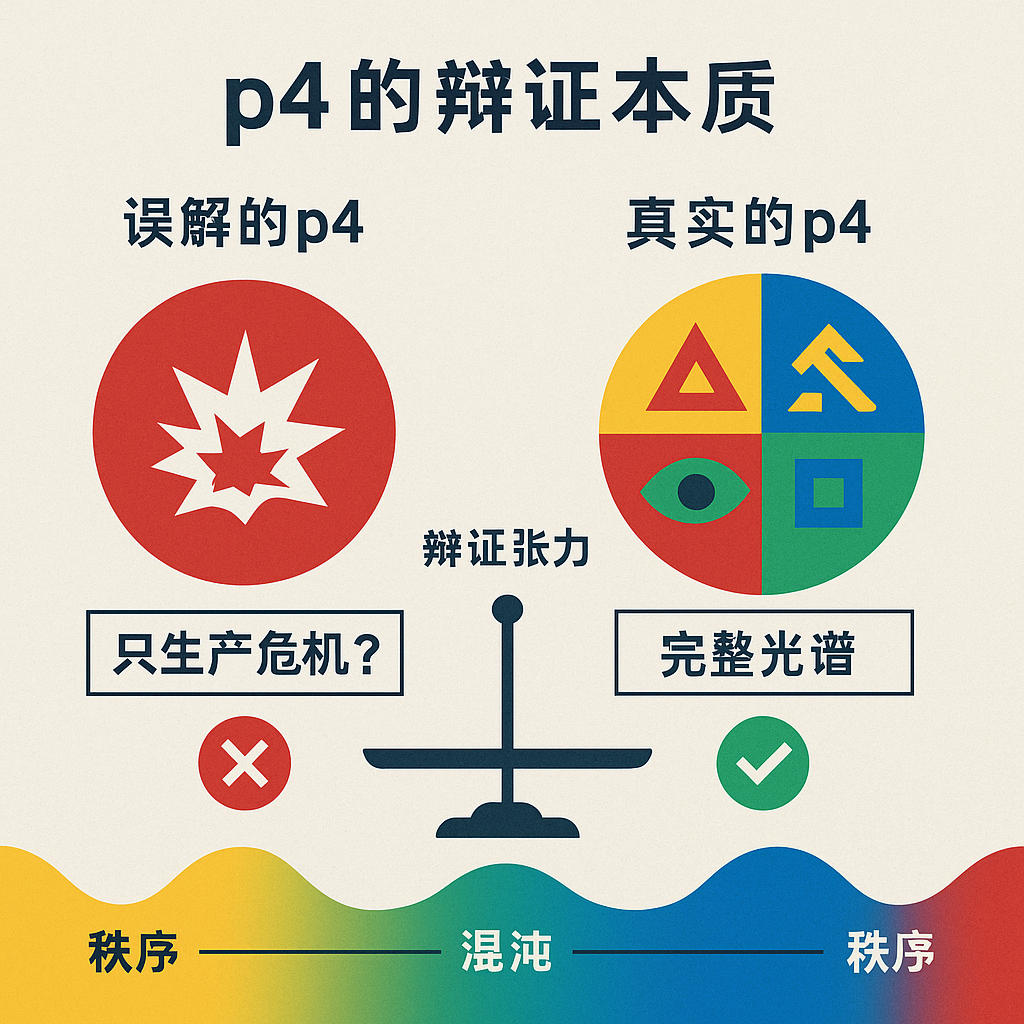
After anatomizing in detail how P4 systematically designs topological dissonance and manufactures crisis, we have to add a crucial dialectical point, in order to avoid reducing P4's practice too rigidly to a single violent aesthetic that only produces crisis.
If we treat P4's practice itself as a meta-actant, we find that it does not possess only one fixed [P]-type or [A]-type topological code. On the contrary, P4's practice is itself a model of high topological flexibility. Its strength lies in its ability to call flexibly on all four force modules according to different creative ideas [I], designing very different kinds of Situation E.
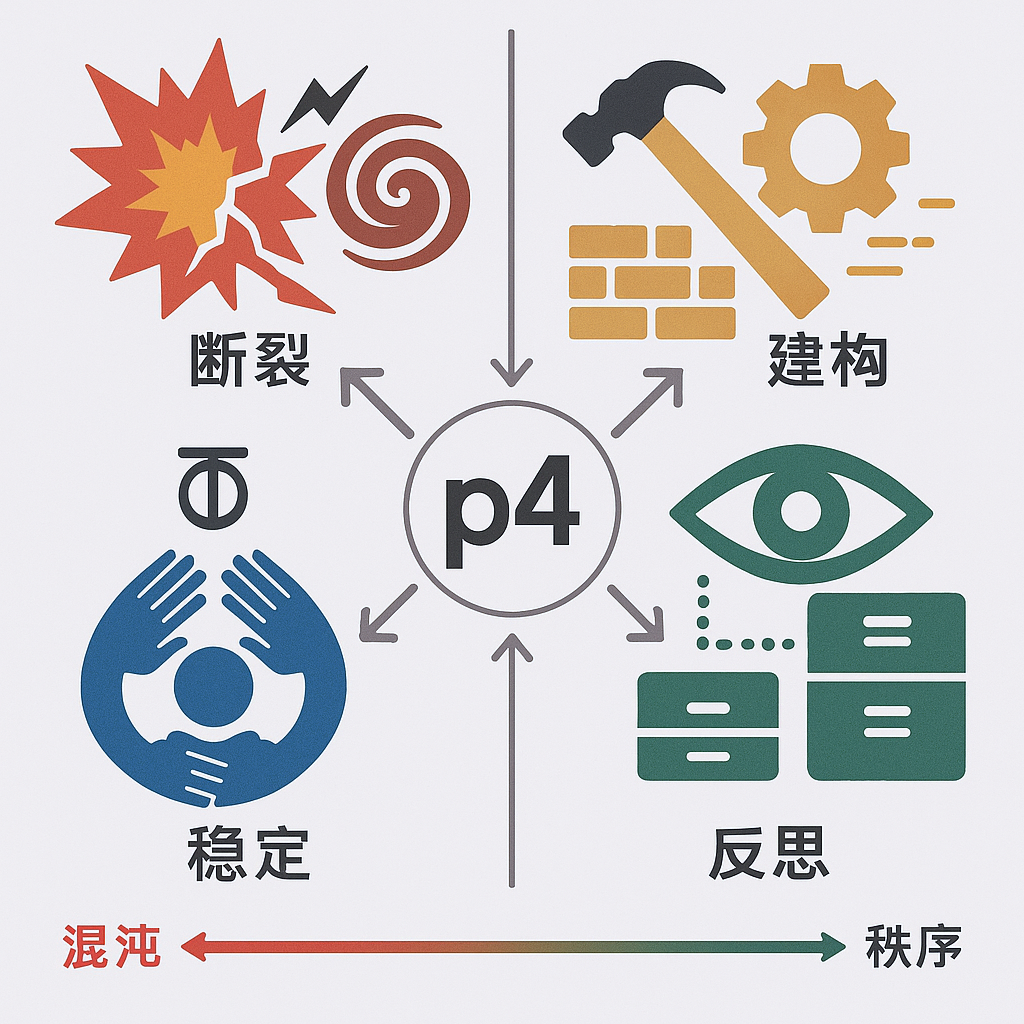
When its aim is rupture, it designs a Player [P]-led crisis laboratory. This is the mode analyzed in detail above, whose purpose is to induce topological transition.
When its aim is construction, it designs an Architect [A]-led co-creation workshop. For example, in the form-building phase of Human Surrender, the core is a rigorous Architect [A] process that organizes chaotic materials into a cross-media narrative network.
When its aim is reflection, it designs a Lurker [V]-led collective archive. In Love Drama, for example, by collecting audience narrative samples, it transforms the field into a Lurker [V] database for observing and analyzing contemporary emotional patterns.
When its aim is stabilization, it may even introduce a Discipline [N]-led ritual space. After many intense emotional experiences, P4 guides participants into a simple, Discipline [N]-style collective action or vocalization, providing a stable anchor for a temporary community that has just passed through a storm and helping it land softly.
Therefore, the engineering of dissonance analyzed in this section, although P4's most radical and subversive chemical weapon, is only one element in P4's large arsenal. P4's real essence does not lie in a preference for any single force such as chaos, but in its deep understanding and command of the full spectrum of mutual generation and dialectical tension between order [A/N] and chaos [P/V].
Section Summary
P4's impasse is not a mysterious atmosphere, but a high-intensity field of topological crisis jointly constructed by rules r(p), space s(p), and network n(v), and systematically dissonant with participants' everyday code systems. Yet we must recognize that this crisis engineering is only one of P4's many strategies of situational coding. P4's practice itself, through its topological flexibility across different projects, shows how a mature meta-actant operates. It is inside this carefully designed, tension-filled high-pressure reaction vessel, where all default programs fail, that a new space full of possibility - liminal space - can open.
3.2 Liminal Space: Generating within Neither-This-Nor-That
When topological crisis successfully erupts and the old default codes by which participants maintain everyday identity collapse, the P4 field truly becomes an extraordinary liminal space, full of danger and creative potential. We need Victor Turner's core anthropological concept in order to define and describe this crucial intermediate state with precision.
Turner defines liminality as the threshold state in ritual when an individual has been stripped of an old social identity but has not yet acquired a new one: neither here nor there. It is a zone of suspension outside structure, betwixt and between structural positions, charged with sacred danger and creative potential. In P4's artificial liminal space, its distinctive topology and psychodynamics become clearly visible.
3.2.1 Suspended Structure: P4's Anti-Theater Techniques
The generation of liminal space first depends on the systematic suspension of everyday social structures. P4 accomplishes this through its core anti-theater techniques.
Breaking the fourth wall suspends the structural opposition between actor and watcher. In P4, there is no safe audience seat. Every body is potentially watching and being watched at once, making identity based on traditional theatrical roles impossible.
Nonprofessional participation suspends the structural opposition between professional and amateur. The value of participants' actions is no longer determined by theatrical skill, but by reality and presence. This creates an equality based on existence rather than technique.
Through these techniques, P4 creates a structural vacuum. No matter what social position participants occupy in the outside world, they are temporarily returned to naked, equal, pre-structural human material.
3.2.2 Quantum Superposition: Chaotic Activation of Internal Modules
When external structure is suspended, the actor's internal default code also becomes invalid. At this point, the inner operating system enters an extremely unstable state that we call quantum superposition.
Phenomenological description: at this stage, all four primary action-force modules inside the actor - A, N, P, and V - are activated at the same time. They no longer follow a default, orderly calling sequence, but collide and combine randomly. This is exactly the chaotic state experienced by many first-time P4 participants: excited and frightened, wanting to enter and wanting to flee.
A typical inner monologue might be: I should do something to break the silence, but I do not know the rules and I am afraid of doing it wrong. I want to first see what others do, Lurker [V], but if I can come up with a good idea, maybe I can take hold of the situation, Architect [A]. These four contradictory impulses emerge simultaneously in a single instant, producing temporary paralysis of action and a sharp rise of internal energy.
3.2.3 The Budding of Communitas: Connecting through Shared Vulnerability
Yet it is exactly this apparently chaotic and paralyzed stage that creates the conditions for a new and profound human connection. Turner points out that in liminal space, relations among people also change qualitatively. They are no longer defined by social structure, but enter a direct, equal, affectively connected state of communitas.
Communitas in P4: within the P4 field, once everyone has been stripped of everyday masks and faces an unsettling impasse full of uncertainty, a sense of recognition based on shared vulnerability begins to germinate.
The root of connection: here, connection no longer depends on shared interests or social background, but on something more originary: a glance asking for help, an awkward bodily contact, a common wordless silence. Inside this structural vacuum, a direct I-you human relation beyond social role becomes possible. This budding communitas is the crucial emotional hotbed from which events can emerge.
Chapter summary: by systematically suspending external social structures, P4 introduces participants into a liminal space in which the inner operating system enters quantum superposition. This anxious, seemingly chaotic middle ground is precisely a creative hotbed. By forcing participants to face their fundamental inner tensions and begin weaving the first threads of communitas through shared vulnerability, it prepares the necessary conditions for the next phase: the brilliant emergence of micro-events.
3.3 The Emergence of Micro-Events and What Follows
In the chaos and tension of liminal space, amid the faint spark of communitas, a micro-event may - though need not - emerge. Here I strictly adopt Alain Badiou's definition of the event and miniaturize it: it is a ruptural emergence that cannot be explained or contained by the established rules of the situation, and that opens truth for those present. It is the instant in which the impossible becomes possible.
3.3.1 The Occurrence of an Event: An Unforeseeable Grace
In the P4 field, this micro-event may take many forms
A successful resolution of an ethical game: as mentioned repeatedly above, an intervener bravely breaks an impasse and rescues the victim in an unexpected way, neither simply attacking nor submitting, instantly reshaping the ethical structure of the field.
A collective, wordless bodily resonance: without any command, all participants suddenly enter the same rhythm of breathing or a harmonious pattern of collective movement, as if a single organism had awakened.
A sentence spoken into the right silence, changing the whole atmosphere: after a long silence, a participant may say something extremely plain that nevertheless strikes everyone's heart. Like an act of naming, it gives the entire chaotic experience a new shared meaning.
The occurrence of this event has the character of grace. It cannot be fully designed or predicted by the Architect, nor can it be forced by the pure will of the Player. It is a crystal accidentally and almost miraculously generated through the complex interaction of many actors, human and nonhuman, inside the chaos of liminal space. It is not anyone's work; it is the field's self-generation.
3.3.2 The Consequence of an Event: The Opening of a New Truth
The emergence of this event marks the birth of something truly new. Like lightning, it instantly illuminates the falsity of the situation, for example the default belief that strangers are necessarily alienated from one another. In a profound event of collective resonance, that belief is proven false. The event gives everyone present a new reference point with which to anchor their own existence. It opens the possibility of a new truth: we strangers can connect this deeply. The question is no longer simply, How should we act? It becomes a more decisive question: will we remain faithful to the event that has just happened?
3.3.3 The Birth of a Community of Comrades in Adventure
After an event occurs, those who choose to remain faithful to the truth it opens constitute a real community. In P4's context, this is not a therapeutic community seeking comfort and belonging. It is closer to a group of comrades in adventure.
Shared secret: they have witnessed a miracle together, a secret that cannot be fully understood by the language of the external situation. This shared secret is their strongest bond.
Shared mission: their connection is based on a common, perhaps wordless mission: after returning to the everyday world that does not believe in miracles, how can they continue to guard and practice the fragile truth opened by the event?
This community of comrades in adventure is the most precious thing P4, as an event catalyst, can generate.
3.4 The Birth of the Subject: Three Responses to the Event
In section 3.3, we witnessed the brilliant emergence of the micro-event as grace. Yet the occurrence of an event does not by itself guarantee any lasting transformation. After lightning, night may return immediately. The true force of an event lies not in the instant of its occurrence, but in how it is maintained and extended by what comes after.
The event is like a stone thrown into a still lake. It breaks the stability of the situation, and by its undeniable presence sends a silent but absolute summons to every actor involved. This summons does not demand one specific action; it demands an ethical stance. How an actor responds to that summons determines not only their future trajectory, but also retroactively defines the meaning of the event itself. It is at this moment of response that a subject in the strict sense - an existence no longer fully defined by the situation, acting for a truth - becomes possible.
I argue that in the face of the event's summons, there are three fundamental and mutually exclusive postures of response: reaction, betrayal, and fidelity.
3.4.1 Posture One: Reaction - Returning to a More Rigid Entrenchment
Reaction is a posture that tries to deny the occurrence of the event, normalize it, and translate it back into the old language of the situation.
Phenomenological description: after a deep collective resonance in P4, a reactive participant may immediately say, This is just some kind of group psychological effect; psychology has explained it already, or, It is no big deal; everyone will forget it tomorrow. Through an existing cynical knowledge framework - a defensive use of the Lurker [V] module - they dissolve the event's singular and subversive kernel of truth.
Inner dynamics: this posture is born from fear. The actor cannot bear the uncertainty brought by the event, nor its fundamental challenge to their existing worldview. To preserve the stability of the inner operating system, the default code, they retreat into an even more rigid and defensive entrenchment. It is a defensive refusal of the new, and its result is to miss the possibility of topological transition while possibly reinforcing the old code.
3.4.2 Posture II: Betrayal
Treason is a more complex posture. At first, it was attracted and inspired by the "event", even when it claimed to be "faithful" to it, but retreated from the old logic in the face of the hardships that followed it, which sustained this "truth" in the daily "situation".
Secular description: A participant who experienced deep connections at the P4 site and returned to everyday life, faced with the apathy of his colleagues or family contradictions, may find it too costly and too "idealistic" to sustain that "real". He/she may try to practice at some point (e.g. through a genuine dialogue), but after a setback quickly chooses to give up and to put on a daily social "mask".
Inside dynamics: this is an opportunistic gesture. The actors turned back and forth between the passionate possibilities opened up by the "event" and the customary sense of security provided by the "situation", and ultimately chose the latter. He/she betrays the possibility opened up by "events", which often lead to a long and endless sense of inherent conflict and guilt, making it more unstable to expand the code.
3.4.3 Posture III: "Fidelity" opens up a difficult "sustain"
Faith is the only truly creative gesture that can lead to the birth of a new subject matter. The subject acknowledges the occurrence of the "event" and makes a fundamental determination that this "event" will be used as a new "justification" or "reference point" in all future operations.
Secular description: a participant loyal to the P4 "event" who returns to everyday life and who does not naively think that the world has changed. Instead, he/she would use that "real connection" as a yardstick to look at and challenge the hypocrisy of everyday relationships and try to build new, small but real connections. His/her actions have since been "lighted" by that "event".
Inner dynamics: this is a gesture that combines love, love for the truth of events, and courage, determination to bear the consequences. The so-called "loyalty" is not blind to a particular dogma, but an ongoing and difficult process of "surrendering". In every new "situation", the subject must constantly think and practice: "What does that `event' mean to this concrete action of my own today?" It is in this process that a `subject of the Event' was forged.
Summary of this chapter
This chapter provides a complete picture of how "events" are systematically catalyzed through an analysis of the occurrence of the P4 domain. We have seen the generation theatre push participants into a "liminal space" full of productive potential through the elaborate design of a "high-pressure reaction vessel" designed to create a "peak crisis". In this space, an unexpected "micro event" may happen. The follow-up to this "event" depends on whether the participants are able to make a "loyalty" decision, thereby transforming a passing peak experience into the birth of an ongoing community in the form of "adventure accomplices". The birth of this "new matter" is the unpredictable, subversive "event" itself. However, the emergence of events is not the end of the story, but the beginning of a more profound drama. It pushes every witness to an ethical crossroads. Whether or not a subject is born depends on whether or not he/she dares to respond "indeed" to the "truth" that happens. So we've dissected the operating mechanisms of the catalyst. In the next section, we will apply this "event syntax", which was refined in P4, to a broader cultural text.
Chapter IV: Artemistic exhibition - cross-media interpretation by AGT
Introduction
In chapter III, we have witnessed how the "event" was triggered in P4 Theater, a "high-energy reactor". We have argued that the generation dramas are systematically designed to create a "sliding leap" within the body and may eventually emerge as a new social product of the "Community". The task of this chapter is now to apply the AGT set of "chemical laws", which has just been validated in practice, to broader cultural texts.
We will argue that all the deep narratives are ingrained in a storm of "poll chemistry". The tragedy and growth of the role, the conflict and the turn of events, can be accurately interpreted as a "chemical reaction" between the different individual code and the situation code E, as well as between the different individual codes. This cross-text trip is intended not only to "prove" AGT but also to "perform" AGT's powerful potential as a dynamic analytical tool. We're going to choose three media forms that are very different from the spirit of the times. - Shakespeare's classical theatre stage, the Wardowski sisters' Cyberpunk matrix, and P4 Theater's postmodern cross-media scene - to systematically display AGT's cross-media interpretation.
4.1 Reaction vessel I: the court of Shakespeare - inner chemistry and system failure
4.1.1 Situation E code: Denmark as a "teaching prison" [E{r(n), s(a), n(a)]
Shakespeare's Hamlet, whose stage - the castle of Elsino in Denmark - is not a neutral background. From the point of view of AGT, it is a proactive situational actor, E, with its own powerful escalator. We can precisely encode it as E{r(n), s(a), n(a)}
R(n) - Normative rules: The whole court operates in a hypocritical, but incompetent, court protocol and traditional norms. The first thing he did after Claudias took over was to re-establish the order of "normalization" through a lengthy speech.
Space level s(a) - Constructive space: Castle Elsino is a highly designed and functional space. Its dark corridors, hidden curtains and stairwelled halls together create a "architect" space full of surveillance, wiretapping and power shows.
Network level n(a) - Hierarchy: The Court's power relations, an unquestionable hierarchical (tree) network with King Claudias as its absolute center.
This situation E provides a systematic incentive for action modules that discipline [N] (subordination) and some Architects [A] (authority), while strongly inhibiting the energy of players [P] (immediate, genuine passion) and enablers [V] (independent, critical observation). It is a "teaching prison".
4.1.2 [V-A-P-V] by Hamlet: a violent "black-out"
It is in such a situation that Hamlet, an actor with an extremely complex code [V-A-P-V], is on the scene. His inner operating system, with every aspect of the situation, has been dramatically "defunct"
His skepticism [V] directly challenges the false harmony called for in rule Er (n) of the situation.
His form of [A] construction (designing "the play") seeks to create a new centre of power in a network that does not allow new "legislators" to emerge.n(a).
His passion and chaos in the execution of [P] is the Apollo-style undermining of the whole situation.
4.1.3 Inline "chemical warfare": self-neutralization of Hamlet operating systems
Hamlet's tragedy stems not only from an external "harmonization", but also from the devastating inherent "chemical war" inspired by this "harmonization". His "delayedness" is an expression of the anthropology of the inherent conflict of codes
[A] vs. [P] (Forms/execution of conflict): His sophisticated "architect" project (the play in play) was constantly undermined by his improvising "players" (killing Polonius). A module that seeks absolute control, and a module that embraces absolutely out of control, has a never-ending war in his heart.
[P] vs. [V] (execution/receipt of conflict): Each of his reckless "player" operations was immediately "middled" by his deep "scramber" reflection, paralyzing his remorse, suspicion and action. The passions are tempered by analysis and actions are crushed by meaningful questioning.
Conclusion: Hamlet's tragedy is an intrinsic, devastating "middle-and-reaction" inspired by external "deep-up" "coherence". He was an overly complex "chemical material" that was erroneously placed in a "reaction vessel" that could not withstand its "reactive activity", and eventually, this violent and uncontrolled internal chemical reaction destroyed not only himself, but also the entire Danish palace, a corrupt "container".
4.2 Reaction vessel II: The The Matrix - System Wars and Code Heavy Write
If Hamlet is a tragedy about the irreconcilable "decordance" between individual and situational codes, then the hacker empire's trilogy is one of "chemical warfare" between two extreme opposing situations E, and ultimately, through the leaping and self-sacrifice of a core actor (Neo), catalyzes the `upgrading' of the entire operational system of the universe.
4.2.1 "Situation code" for both universes: "chemical incompatibility" at the system level
The world of this film has shown us from the beginning two "reaction vessels" that are absolutely chemically incompatible
The Matrix's situation code can be precisely coded as E{r(a), s(n), n(a)}. It has mathematically precise rules r(a) designed by architects (the laws of physics); its space is conventional and designed to produce subservient s(n) (cities, offices); its network is highly hierarchical n(a) (human beings are placed under the absolute domination of machines). This is an extremely "architect/teaching" scenario that systematically rewards [A] and [N] modules, while treating any [P] (unusual) and [V] (suspect) as "viruses" to be removed.
Zion's situation code is an almost pure E{r(p), s(p), n(p)}. Its only ruler (p) is "to survive and resist at all costs"; its space (p) is chaotic, organic, cave-like (tip-shaped); and its network n (p) is distributed, filled with internal political games and point-to-point combat collaboration. This is an extremely "player" situation.
4.2.2 Nio ' s Tunnel: a guided "chemical transformation"
The entire journey of Nio can be seen as a carefully guided process from one "chemical" to another "finishing".
Initial code and crisis: The initial code for Nio is [V-N-P-V] ("depressed hacker") with inherent conflict. He is chemically unstable, with [N] submissiveness and [P] rebel nature. The "red pills" that Murphys provided were an external, powerful energy input that triggered his default code "expanding crisis" and forced him from the situation E{A/N} to the situation E{P}.
Thresholds and catalysts: The Nebuchadnezzar is his "liminal space", a temporary "reaction vessel". Here, Merfis [A-A-P-V] and Trinity [N-P-P-P], acting as "catalysts" and "reactions", continue to engage in "chemical reactions" with Nio, providing "activation" for its "climate shift", particularly to help shift the conceptual dimension from [V] (suspection) to [A] (conscience).
The battle of the subway station was his first critical leap. And the whole trilogy is the process by which he has continued to integrate [A], [N], [P] and [V] forces, leading to the ultimate "expanding flexibility" - that is, to become a "super-catalyst".
4.2.3 Smith's mutation: a uncontrolled "chain reaction"
However, the largest "unexpected product" of this chemical experiment was Agent Smith. He can be interpreted as a "chain reaction" to uncontrolled, exponential growth.
Initial state: Smith is a purely [N-N-N-N-N] "inert element", a perfect implementer of the Matrix system.
Chemical pollution: In his traumatic encounter with Nio, his code was "contaminated" by the forces of [P] and [A] of Nio and was disconnected from the Matrix main system.
Coding mutations: He suddenly became a brand-new, unstable radioisotope - [A-P-P-A] "Victoric Messiah". He has his own independent [A] concept (destruction of everything) and is able to grow indefinitely in [P] style.
Dynamic analysis: Smith is the real, pure "revolutionaries" in the film. Because his goal is to radically change the "chemical code" of the universe by transforming all the elements of the heterogeneity into a single "Smith element".
4.2.4 Articulation of the outcome: upgrading as a system of "crash destruction"
The film ended not as a hero's victory, but as a magnificent "pornification of chemistry".
Reaction mechanisms: The ultimate self-sacrifice of Nio was a conscious "shockdown". He had his own "positive material" with a system "resolved" flexibility, and had a positive collision with the uncontrollable "anti-material" (Smith).
Reaction products: This collision released a huge amount of energy, and the result was not nothing, but a completely new "Element" -- an upgraded, more sophisticated system to jump. This "new matrix" has been forced to integrate the possibility of "option" [P] from a closed [A-N-N] system to an open system that coexists with the outside world (Zion).
Conclusion: The The Matrix is deeply engaged in the dynamic law of AGT. It tells us that any seemingly perfect, closed system (Matrix) is bound to produce its own "Neo" and "virus" (Smith). The evolution of the system can often be achieved only through these inherently ambivalent "chemical reactions" in a sad manner that is almost "destroyed".
4.3 P4 Self-coding: "Transmediate" by Human Surrender
Finally, we have to use AGT's analytical tools for a retrogressive application, that is, to decode the P4's own creations with this theory drawn from P4 practice. For example, with its core project, Human Surrender, we can show how AGT analyses contemporary art practices. This is not just an analysis of a work, but a code for a method of "generated creation".
4.3.1 Design of "cross-media narrative" as a "multi-reaction vessel"
The most prominent feature of Human Surrender is its structure of "transmediatory narratives". It refuses to be entrenched in any single media "default code" (e.g., "theatrical should be in the theatre", "film should have linear narratives"), but rather to "leap" between a variety of media patterns, such as documentary images, behavioural arts, live performances, etc.
In AGT ' s view, this was not a simple form experiment, but an extremely sophisticated scenario E coding project. The project as a whole can be seen as a well-designed set of "embedded reactor" with an uncompassionate code E
A documentary image created a situation E{r(v), s(v), n(v)}. It requires both creators and viewers to enter a "scramber" [V] model of calm observation and reflection.
The site of "unfixed sites" such as ruins, bookstores, etc. created a situation E{r(p), s(p), n(p)}. This is a typical "player" field that encourages improvisation and physical risk-taking by participants.
On-site behavioural and artistic performances often build a high-pressure "crisis-reaction kit" designed to induce "floating".
The whole process of the creation and experience of Human Surrender is to guide participants and viewers through these "reaction vessels", which have different traverse codes. The depth of this design lies in the fact that it is in itself a maximum test and exhibition of "expand flexibility".
4.3.2 "Mechanical code" of the project [V-A-P-A]: a self-reflectional "finishment"
If we consider the "project itself" of Human Surrender to be also an actor, its escalator can be accurately analysed as [V-A-P-A] - a "depressed archivist" or a more creative "mixed foundr". This code is a profound illustration of the "Creative Syntax" of P4
Perceptions [V] (scrutinists): The starting point of the project is the observation and documentation (through documentary images) of one of the prevailing "surrenders" in the current state of human existence. It begins with a profound social insight, filled with submissive colours, rather than a dramatic scenario.
Form [A] (architect): The creator (He Fa) designed these observations as a seven-hour, well-structured cross-media narrative network spanning ruins, bookstores, residences, etc. This is a highly conscious "architect" act designed to give a clear and perceived form of art to a confused contemporary experience.
Implementing [P] (player): However, in specific live exhibitions, the core is behavioural art-style, unpredictable player games that interact directly with the audience. It refuses to be condensed into a repertoire of performances, each of which is unique.
Reception [A] (architects): Ultimately, the project attempts to turn its unique and contradictory artistic practices into a new, discussionable and analytical aesthetic paradigm by surrounding international film festivals and stimulating public discussion. It returned to the position of an "architect" during the reception phase in an attempt to construct a general theoretical framework for this chaotic experiment.
4.3.3 Chemical reactions of viewers: from "bystanders" to "collaborators"
The practice of P4, in particular through interactive devices such as the "emotional spectrometer" in the "Drama of Love", has consciously involved the audience in the entire "chemical reaction". Audiences are no longer "chemists" watching reactions, their own emotions (data) and become one of the "reactions" that influence the direction of reactions. The viewer was forced from a secure "scanner" [V] position into a position where a "player" [P] or "teaching" [N] (required to press the button) had to react. This design, which makes the creation of P4 a "collective alchemy", which is done by creators, participants, space and viewers, and whose boundaries are blurred.
Summary of this chapter
The powerful potential of AGT as a tool for "trawling chemistry" analysis has been fully demonstrated through in-depth anatomy of the "reaction vessel", which is very different from the spirit of the times. It shows us that, whether Shakespeare's palace tragedy, postmodern Saber fables, or China's cutting-edge cross-media experiments, there is an inherent and eternal drama about how individual code interacts with situational codes, conflicts, catalyzes, and ultimately generates new realities. And what AGT offered us was the language and the law that made this huge "cosmic chemical reaction map."
Chapter V: Positioning of AGT in the system of theoretical coordinates
Introduction
Actor-Generated Topology (AGT) was not born out of a theoretical vacuum. It is a creative response to the existing legacy of the theory of personality and action, its value and originality, which must be demonstrated in dialogue and collision with established frameworks. The birth of a new theory, like the brightness of a new star in the universe, can be precisely located in its coordinates and brightness only by cross-referencing with other stars.
The task of this chapter is to place AGT, the new star, in a system of theoretical coordinates consisting of three mainstream personality classification schemes (MBTI, Big Five, Type IX) and a whole post-structured ideology cluster (ANT, Deleuze, Lacan, Badiou), for an in-depth comparative and critical analysis. We will argue that AGT is not intended to simply "replace" these classical models, but rather to provide a unique insight into personality and action from a completely new dimension based on "genetic grammar", thereby deeply complementing, challenging and ultimately enriching our existing theoretical landscape.
5.1 Dialogue with the dominant personality theory: Open the "black box" and explore mechanisms for generation
Actor-Generated Topology (AGT) is not intended to launch a zero-sum game to completely negate the great value of mainstream personality theory. On the contrary, AGT recognizes and respects the contribution of each model in its own dimensions: MBTI provides a easily transmitted classification of cognitive preferences, the five largest individuals provide scientificly rigorous behavioural characterizations, and the nine individuals provide in-depth motivational insight.
However, AGT has opened up an entirely new analytical dimension through its unique "generated grammar" perspective. It occupies an ecological position where other models are not systematically explored. This section will provide an in-depth comparative and critical analysis of how AGT responds to the core challenges left by these classic models: How it counters the static labelling of MBTI; how it opens the descriptive "black box" of the five large persons by means of a mechanism of generation; and how it provides an analytical "external scaffold" for the in-depth motives of the nine-person personality, which are hard to prove.
5.1.1 AGT vs. MBTI: from "personal card" to "operational production process"
Core differences: process orientation vs. result orientation - verbs and terminology
The fundamental difference between Miles-Briggs type indicator (MBTI) and AGT lies in its core philosophical questions. The core of MBTI is classification and attribution, and it tries to answer the question "What are you?". It provides a static, noun-like label (e.g. "INTJ") that summarizes the long-term results of individuals' cognitive preferences. It depicts a relatively stable personal "portrait". And the core of AGT is generation and process, and it tries to answer the question, "How did your actions come about?" It provides a dynamic, verbed flowchart (e.g. [A-A-N-V]). AGT doesn't care what you end up with, but how you become every move you make. If MBTI provides a "personal identity card" that facilitates rapid mutual recognition, then AGT provides a detailed "production process statement" on how this "business card" is designed, printed and used in different social contexts.
AGT's Advantage One: Paradoxical Legitimacy and Structural Interpretation
The dichotomy logic of MBTI, while bringing clarity, has also paid a great price - it is difficult to deal with the deep contradictions in the body. How can a person who has been convicted of being "thinking" make decisions that are "emotional" in certain circumstances? In the context of MBTI, this is often seen as an uncontrolled outbreak of its "disadvantaging function" and as an expression of "in maturity" or "underdevelopment". However, in the framework of AGT, contradictions are no longer a "defect" to be overcome, but rather the normality of the system, which is the core source of its complexity and vitality. Through its multi-dimensional code structure, AGT provides a legal and structural explanation for this contradiction.
For example, let's analyze an actor whose name is "A-V-P-A"
Its conceptual dimension [A] (architects) may be extremely rational and programmatic, pursuing a clear and orderly goal (T/J qualities close to MBTI).
The form dimension [V] (scrambling) is expressed in the tendency to avoid risks (a rational extraction) through extensive observation and information gathering when planning.
However, its implementation dimension [P] (player) may be impulsive, emotional and even unconventional (f/P qualities close to MBTI).
Ultimately, its receiving dimension [A] (architect) will try to re-integrate this contradictory operation into a rational and structured narrative. The AGT clearly reveals that the actor's "reasonable" and "emotional" are not mutually exclusive "types", but rather the different energy modules that are called upon in the different dimensions of the process of generating its actions. His inner conflict was not because he was "not enough T" or "not enough J", but because of his [concept A] desire for order and the confusion impulse of [implement P], which was an eternal and dramatic structural tension. AGT has moved from a psychological problem that needs to be "corrected" to a dynamic structure that can be analysed and understood.
AGT's Advantage Two: Beyond Types, Seeing Individuals in Situations
MBTI's greatest risk lies in its "barnum effect" and its tendency to label. Once classified as "INTJ", an individual may act unwittingly according to the description of the label (self-fulfillment prophecy) or use the label to find an excuse to avoid a mission that he is not good at ("I am an I, so I cannot speak publicly"), thereby limiting his possibilities. AGT, for its part, has liberated individuals from the type of cage through its large volume of 256 prototypes and its dynamic concept of "topological resonance". It recognizes that a person may have a "default code", but emphasizes its enormous potential to "scramble" by using non-default modules under different situations under E pressure.
It does not see a fixed "INTJ", but rather an actor who may have set up by default [A-A-V-V] (a typical "reflective strategist" that fits the description of INTJ).
But AGT is more interested that in a "crisis" situation like P4 Theater, the [A-A-V-V] may be forced to make a leap forward from [V] to [P] in the implementation dimension in order to respond to a sudden state of emergency, showing an unexpected, improvising, life-threatening operation of his own.
Summary: By deconstructing static types as a dynamic, inherently contradictory process that can "leap" in circumstances, AGT provides deeper and more empowering theoretical tools for understanding the complexity, plasticity and context of the human personality. It encourages us not to ask "Who I am" but "Who else I can be".
5.1.2 AGT vs. Largest Five Personalities: from "Contribution List" to "Cooking Cooking Book"
Core differences: Generating models vs. Descriptive models - Big Five / OCEAN Model, which opens the "black box", are among the brightest results of contemporary academic psychology and are the "gold standard" for personality research. Through rigorous terminology assumptions and large-scale cross-cultural factor analysis, it has been able to extract five stable personality dimensions: experiential openness, due diligence, Extraversion, Amity and Neuroticism. Its excellent scientific rigour and robust predictive effectiveness make it the cornerstone of understanding the differences in human behaviour. However, the top five are an excellent descriptive model. It's like the chemical cyclical table of elements, which tells you very precisely what the composition of the "personal element" of a person who is "highly due diligence, low-extrapolity" is, and on that basis predicts his possible behavioural tendencies in various situations. However, it is, to a large extent, a "black box" - it explains how these "elements" interact, combine and ultimately generate a specific action with less capacity. It provides a list of the "constituents" of the personality, but it does not provide the "cooking" of these elements in a dynamic process of life, in which "cooking" is a complete "cooking".
AGT's Advantage One: Explaining the phenomenon of homogeneis
AGT, on the other hand, is a production model whose central purpose is to open the "black box" and provide it. It seeks to reveal how the external, measurable behavioral properties are generated by an intrinsic, four-dimensional process of action. One of the strongest interpretations of AGT is that it can clearly distinguish between those phenomena that look similar in the larger five models, but which are inherently produced with very different "synthetic isomers". Let us take the specialty of "high responsibility", which the Big Five model would describe as "structured, reliable, self-regulating, achievement-seeking". But AGT reveals that the underlying "operating systems" that make up this "due diligence" state may be quite different
Prototype I: [A-A-N-N] - "perfect bureaucracy": His "due diligence" stems from an architect-type [A], an inherent desire for order, and a discipline-type [N] strict adherence to rules. This is a due diligence to seek certainty and avoid risk. He is motivated by inner harmony and external stability.
Prototype II: [P-A-N-A] - The "enhanced revolutionaries": His "due diligence" may have originated from an early, player-[P] rebel impulse, which, after the success of the revolution or its institutional absorption, was transformed into an equally fanatical construction of the new order [A] and maintenance [N]. It is a duty of passion and even bigotry. His motivation is to transform the past into a new, defined order.
Prototype III: [V-A-A] - The "perfectist of anxiety": his "due diligence" stems from a deep fear and observation of potential mistakes and failures in the form of a Lurker [V]. In order to avoid these terrible possibilities, he has drawn on three dimensions of architect [A] for over-planning, design and reflection. This is a defensive due diligence effort driven by anxiety.
The Big Five model may accurately measure these three individuals as "high due diligence", but the AGT is able to penetrate the symptoms of behavior, revealing the vast differences between their inner power sources (order desire, vs. passion transformation, vs. anxiety drive), how they are achieved and the core conflict.
AGT's Advantage II: Providing a dynamic path for "gent development" Figure
The first five recognize the quality slowly changes with age and experience, but it does not itself provide a model of mechanisms for "how to change". AGT's "Topkinetics" provides a possible road map for this. An individual with a "low due diligence" (perhaps the default code is dominated by [P] and [V]) and the path AGT gives is not simply "more structured" but
Identification of the short plate dimensions and modules: He may lack the ability to call the [A] module on form dimensions [II], or he may lack the adherence to the [N] module on implementation dimensions [III].
Designing the "Step-up" exercise: Gradually upgrading the call capacity for non-default modules by developing a detailed plan (activating the [A] module of the form dimension) consciously in a low-risk environment or insisting on a dry task (activating the [N] module of the dimension). AGT has moved from a vague aspiration to an analytical, designable "precision training" process that targets specific dimensions and modules.
Synopsis: If the top five answered "what is a person's personality composition", then AGT answered "how this person's personality works and how it may change".
5.1.3 AGT vs. Type IX personality: from "the abyss of motivation" to "the grammar of action"
Core differences: starting point for analysis - invisible "why" vs. Visible "how"
Enneagram is a deep personality system rooted in ancient wisdom and enriched in modern psychology. What is unique is that it does not stop with the appearance of behaviour, but rather points directly to the invisible inner engine of each type of behaviour - "core fear", "core desire" and "core weakness".
The starting point for the nine personality is the intrinsic, a priori "motive": it tries to answer the ultimate question: "Why did you do it?" It believes that it is understandable to understand the root causes of all external behaviour when one's core fears are understood (for example, the core fear of Observer No. 5 is "incompetence, ignorance"). The starting point for AGT is an external, observable "flow of action": AGT has suspended its quest for the ultimate "why". It does not predetermine any a priori "core fear" or "desir", but analyses an individual in [Idea-Form-Execution-Reception], like a linguist who analyses unknown languages. The observed and documented patterns of behaviour displayed in these four dimensions in order to infer their intrinsic operating logic in reverse. It answers: "How do you do this?"
AGT's Advantage One: Providing an "extraordinary structure" for "motives"
Instead of denying the existence of deep motives, AGT provides these invisible "motives" with an analytical "extranometric structure". According to AGT, the "core fear" or "core desire" of an actor is necessarily reflected in a systematic and identifiable pattern in its combination of extended codes. Let's take the example of the Watcher of the 9th personality. Its core fears are "incompetence, ignorance" and its core desires are "incompetent and knowledgeable". How can this deep-seated opportunity be "outgrown" for an AGT code?
One possible code: [V-V-V-V] - The "Eternal Bystander" in order to counter the fear of "ununderstood", the 5th personality overwhelms the Stalker [V] module in all dimensions of his actions. His idea began with information gathering in the form of more analysis, implementation as distance observation and reception as a deeper reflection. The AGT code clearly "translates" the core motivation of the 5th to "program" its entire operating system.
The precision of distinguishing subtypes: AGT can also more precisely divide subtypes of the same nine personality type. For example, the code of another personality number 5 may be [V-A-A-V]. Like [V-V-V-V], he began with a desire for knowledge (the concept = V) and finally made a profound reflection (the acceptance = V). But he has shown a powerful "architect" in form [A] and implementation [A] dimensions, not only to understand the world, but also to build his own understanding into a tight theoretical system (such as Kant or Marx). AGT clearly reveals that it also stems from the fear of "countering ignorance", the path by which the two personality 5 "examining" it can be a purely inward "understanding" or a very structural "creation".
AGT's Advantage Two: Universal Syntax: Beyond Human Centralism
The nine personality is strictly limited to the deep psychological and spiritual dimensions of human beings. The grammatical framework of AGT, which is derived from the web theory of its actors (ANT), naturally has the potential to transcend anthropocentricism. AGT analyses not the "single", but the "grammatic of action", which is available to any "actant" capable of implementing the sequence of actions.
We can do the same thing by "expanding code" for an organization, an art project or even an artificial intelligence
A rigid, bureaucratic company whose code might be [N-N-N-N]. Its "core fear" is "disturbed and out of control".
A radical and mistested start-up enterprise whose code may be [P-A-P-P]. Its "core desire" is "subversive and growing".
A large language model AI whose code may be close to [V-N-A-N]. Its "core motivation" is defined by its program as "to generate the most relevant answers on the basis of given data".
Summary: If the nine-person personality provides a deep "motive map" of the internal dynamics of the human soul, then AGT provides an accurate set of "actional syntax" about how this map was drawn in the real world. By shifting the focus of analysis from the invisible "why" to the visible "how", AGT not only enhances the objectivity of analysis but also extends the application of the personality theory from the individual human being to all complex systems that can act.
5.2 Resonance with post-structuralism: as a interlocutor, not a cornerstone
Actor-Generated Topology (AGT), although an independent theoretical system dedicated to the construction of a universal "action syntax", was born out of the "air of thought" provided by the forefront of contemporary philosophical thinking. AGT is not a simple "application" or "derivative" of these thoughts. On the contrary, the relationship between AGT and them is a profound mutual interpretation and questioning. This section will clarify the complex resonance between AGT and several key thinkers of post-structuralism, but will always insist on the theoretical thrust of AGT - they are "interlocutors" rather than "legislators" of AGT. In this dialogue, AGT will demonstrate how it has "operationalized" these profound philosophical concepts into a set of analytical tools and, conversely, used its own grammar to ask them new questions.
5.2.1 Blood and "treachery" with the Actors' Networkory (ANT)
AGT's most direct theoretical bloodline from Bruno Latour's ANT. AGT fully inherited ANT's "relationship theory" (action before essence), the concept of "actant" (extensive symmetry between humans and non-humans) and the importance attached to "assemble" (e.g. situation E). It can be said that the whole world view of AGT is based on the post-humanism cornerstone of ANT. However, AGT also completed a necessary "creative betrayal" of ANT. The ANT of Latur, to a large extent, is a "external" descriptive science. It is extremely good at "tracing" and "characterizing" how an existing network of heterosexual actors is assembled. However, it often maintains a methodological distance from the "inner" and contradictory "black box" within the network, especially among human actors. It is here that the AGT theory of "events". It boldly claims that the "inline black box" itself is equally open to learning and networking. AGT is an attempt to "microstrate" and "internalize" the ambitious sociological analysis tool of ANT to analyse the networks within individual actors (and their combinations). It tries to answer that little ANT question: how does an actor "generate" his tendency to engage in outside network formation?
5.2.2 Resonance with Deleuze-Guattari philosophy and "cooling"
AGT shares a deep attachment to "generation", "flow" and "connection" with Droz-Guattari's mind. The AGT field is a "brain" (Rhizome) and the actor is the "mechanism of desire", which "spreads up" and draws the "offline" and "spread flexibility" towards a "body without organs" (BWO). The Deleuze philosophy of "generation" provides the deepest introspective support for AGT's "dynamic" and "anti-essential" positions. However, AGT also undertook a necessary "cooling" and "structured" of the sometimes unlimited and purely certain "flows of desire" of Deleuze-Guattari. If Deleuze's philosophy is a hymn of how desire breaks through all bounds, then AGT is a cooler "engineer" who is sure of the flow of desire. P] At the same time, equal attention is given to the power of "coding" [A], "teaching" [N] and "mapping" [V] of desires. Through its "4+4" structure, AGT provided a "nature map" and a set of "navigation rules" for the vast "sea of desire" in Derraz. It questions: Pure "de-divide" [P] if there is no "re-divide" [P] Will the efforts of A/N] ultimately lead to an incompetent, schizophrenia? The contribution of AGT is that it transforms the Deleuze philosophy of "generation" from a proclamation of an ontological theory into an analytical, diagnostic, or even designed model of "moment dynamics" with inherent tension.
5.2.3 Dialogue with LAC and "enabling"
If Deleuze is the "sult mate" of AGT, Lacan is its "hard mentor". Lacan's theory, which injects deep, negative dimensions into AGT's seemingly fluid course of action, is about "Lack", "Jouissance" and "the Real". The four dimensions of AGT can be interpreted as a "trip of desire" in three dimensions; the four modules correspond to the four basic "symptomological patterns" of the main management of "haul". Lacan's theory, deeply "complicated" AGT. AGT, in turn, has undertaken a "enabling" rewrite of Lacan's theory. The final diagnosis of Lacan's psychoanalysis is often tragic and points to a fundamental stalemate in the subject. AGT, which is rooted in its practice in P4 Theater, has always maintained an optimism about the possibility of "change". The concept of "scrambling" is precisely the response of AGT to the Lacanian stalemate. It recognizes the stability of the syndrome, but it demonstrates how it is possible to "facilitate" and restructure by introducing "situation E force disturbances". AGT opened up a gap towards "action" and "generation" by seemingly closed, decisive structures in Lacan. It asked: "What?" after acknowledging that "the big Other don't exist", "the sex doesn't exist", we said, "What?". The whole AGT system is the systematic answer to this "and then?"
5.2.4 Links to Badiou event philosophy and "microization"
Badiou's philosophy provides the final ethical and political foundation for the dynamic core of AGT - "to leapfrog". The P4 field is an "incidental site", "scrambling" is an individual's "loyalty" to "micro-events", and "tampering flexibility" is the technique that sustains such "loyalty". However, AGT also undertook a necessary "micro-ization" and "day-to-day" of "events" of general historical significance (such as revolutions, scientific discoveries) in Badiouna. Badiou's "events" are rare and come as a "munificence". AGT, on the other hand, has shown through P4 that "micro-events" - the emergence of truths that can subvert our individual "situations" - can be "catalyzed" and "trained". The contribution of AGT is that it has transformed Badhona's almost "theological" philosophy of events into a practical and designed "social alchemistry". Instead of passively "waiting" for a capital "event", it encourages us to take the initiative to create and participate in countless minor "events" that can make us "subject".
Summary of this chapter: Through this multi-dimensional theoretical positioning, the contours of AGT have become so clear. It is not an isolated invention, but a theoretical "consolidation" deeply embedded in contemporary intellectual dialogue. It has both the dynamic and the generating nature of the dominant personality theory and the profound philosophical concepts of post-structuralism, "operationalized" into a set of specific tools for analysis and application. It is a bridge between empirical science and continental philosophy, opening an entirely new channel of dialogue between two seemingly irreconcilable linguistic systems.
Part III Open Subjects
Not finished
Ghosts, bodies, emotions, self-fingerming.
Part III: From Theory to the World - Open Research Agenda and Critical Reflection
Introduction
After a systematic construction of the the theoretical edifice of Actor-Generated Topology (AGT) and its in-depth interpretation in a broad philosophical and psychological reference system, we must now look back from abstract theory to concrete practice. The ultimate value of a theory is reflected in its ability to interpret and change the world.
The task of this section is to explore the potential of AGT applications in a comprehensive manner and to engage in a critical and uncompromising reflection on its own set-up and potential dangers. We will show that AGT is not only a powerful diagnostic and creative tool, but also a weapon of thought that needs to be carefully used and that is filled with the duality of "medicines" and "drugs". This section will be divided into two chapters: chapter VI will explore the potential of AGT's application in a number of frontier areas in the form of an "open research agenda"; and chapter VII will serve as the final chapter of the entire book with a profound self-critical view of AGT and, ultimately, a vision of its future in an open, "unfinished" posture.
Chapter 6: "Specific dimensions" of AGT - complementarity of history, body and certainty
Introduction
In the previous section, we have systematically constructed, validated and explored the core framework of Actor-Generated Topology (AGT). However, any theory that attempts to produce a "general map" of human action is bound to face its own "blind spots" - "ghost dimensions" that are inadvertently excluded or reduced by its core coordinates. The maturity of a doctrine is reflected not only in its interpretation of known areas, but also in its courage to confront its own unknown areas.
The task of this chapter is to carry out a profound self-reinforcing and theoretical upgrading. We will take the initiative of calling out three "ghost dimensions" that were present in earlier discourse but not sufficiently developed: historical, physical and positive. We will argue that it is only by organically integrating these three dimensions into the framework of AGT that we can truly claim that this "grammatic of action" captures not only the logic of action, but also its "blood and flesh", "root" and "soul". This is a key expansion aimed at making the AGT theoretical building more solid, inclusive and viable.
6.1 Historical archaeology of AGT: Generating syntax as an age syndrome
AGT affirms the universality of its "4+4" structure, but any "universality" claim must answer a Foucault-style question: "What are the historical conditions under which your 'truth' can be said?" The purpose of this section is to carry out an exploration of "historic archaeology" for AGT, exploring how it has been historically and socially constructed as a unique "discussion" of our time.
6.1.1 Social history of P4: a "historical soil" that can be "upscaled"
P4 Theater (2015-present) is not an artistic miracle in a vacuum. It is deeply rooted in the unique soil of socio-cultural change in China from the second decade of the twenty-first century to the present. It is the combination of the following historical factors that together constitute the hotbed of the idea that P4 can attract participants and inspire AGT
The overall triumph of consumerism and the emergence of the "experiment of the economy": on the one hand, it provides a market for practices such as the sale of "real experience" at P4; and, on the other hand, P4 constitutes a deep resistance to the "happy experience" of mainstream consumerism by embracing "failure" and "discomfort".
The shrinking of public space and the desire to connect atomized individuals: against the backdrop of a shrinking public space in both physical and spiritual terms, P4 has created temporary, high-quality public space through its practice of "unfixed spaces" that accurately respond to the profound desire of urban youth for real human connectivity in highly atomized life.
Social media outreach and "human" performance: In an era defined by social media as when everyone is performing their own "performing", P4 provides a "backstage" space where "masks" can be temporarily removed to expose vulnerability, which gives it a strong psychological appeal.
6.1.2 The conceptual history of AGT: a syntax of the "era of networking"
The "4+4" structure of AGT itself is also deeply imprinting the spiritual imprint of our time. It is only today that it can be "seeing" and "named" because our survival experience has been profoundly "expanded"
The prominence of the "player" [P] module: "player" is at the heart of AGT, which is inextricably linked to the emergence of the trend towards the mainstreaming of contemporary play culture and the "playing of life". We are increasingly used to understanding our lives in the language of "proximity", "mission of duty".
The ethics of "extreme flexibility": AGT views "extreme flexibility" as the ultimate ethical goal of a postmodern subject, which is deeply resonated with the need for individuals to constantly renew themselves, learn new skills and adapt to the realities of unstable careers, under the terms of "gig economy" and "liquid modernity". The ethics of AGT are both a philosophical response to this reality and, to some extent, an unconscious "novel".
Through this exploration of historical archaeology, AGT is no longer a "non-historical" abstract construct. It was reinserted in its specific historical coordinates. It is both a powerful tool for analysing "actions of our time" and a profound product of "actions of our time".
6.2 Syntax: The dialogue between AGT and physical phenomena
AGT's "operative system" metaphor and its cool "coding" language, while providing analytical clarity, always faces a deep risk of becoming a new "logocentrism". Has it inadvertently returned action to a purely calculable cognitive process, thus ignoring the former language, the body, the emotional and desireful, as the ultimate carrier of all actions?
A complete operational doctrine must find a solid "body" for its abstract "grammatical". The purpose of this section is to inject a sensory, physical "blood" into AGT's structural skeletons through an in-depth dialogue with Maurice Merleau-Ponty's body anthropology. Our central question is: how can an action be combined with a body's poetry?
6.2.1 Introduction of Melo-Ponty: beyond the "heart/body" dualism
Melo-Ponty's philosophy is a thorough and fundamental liquidation of the "heart/body" dualism that has been deeply rooted in Diccal's Western philosophy since then. In his view, the body is not an objective "machine" or "object" controlled by consciousness, but rather a "le corps propre", which is the essential medium for our presence, perception and action in the world. We are not "possessed" of a body, we are "possessed" of our body. Awareness does not hang over the body, but is "mbodied". This insight provides AGT with a critical "supplement". The implementation dimension of AGT [III], which collids with the "real boundary", is not an output of an abstract "actional directive", but a process of "body-world" shaping each other with "corporal intelligence".
6.2.2 Body pattern and popping codes: physical expression of the syntax of action
One of the core concepts of Melo-Ponty is the "body scheme" - that is, our grasp of the position, posture and abilities of our bodies in space, a kind of forward reflection and dynamic. It's not our "know" knowledge of the body, it's our "live" body. AGT can be deeply linked to this concept: we argue that a long-held "default pop code" held by an individual can be profoundly, albeit often unconsciously, shaped and engraved in his/her "body pattern".
An actor led by a Lurker [V] (e.g. [V-V-V]) whose "body pattern" borders may be rigid and isolated. He/she will not consciously keep physical distance from others, and his/her attitude may be closed (e.g. arms) and his/her sense may be more in favour of "distance" vision and hearing. In the condensed space at P4, he/she will experience a strong sense of "aggression" because the defensive boundaries of his/her body are violently broken.
An actor led by a player [P] (e.g. [P-P-P]) whose "body pattern" is open and permeable. He/she prefers to explore the world through touch and motion, and its physical boundaries are mobile. In the condensed space at P4, he/she may have experienced "excited" and "the desire to connect".
Thus, in the P4 domain, the "stamping crisis" is the "temporary collapse of the body pattern" at the physical level of the participants, which is routine and entrenched by their default code. A successful "bump-up" would mean a profound reorganization and expansion of the "body pattern".
6.2.3 Emotion as a "power field": the energy source to be used by the module
AGT's two-dimensional tension field (order/disorder, intervention/dissociation) appears to be a purely logical space. However, what drives actors to choose in this space is not rational calculation, but emotion. We can interpret "emotionalism" as a "force field" scattered in "situation E" that can play a direct role for all actors. It's a former individual energy with "infective" energy.
An area filled with a climate of fear systematically inhibits the call for the "player" [P] module and reinforces the "teaching" [N] (seeking asylum) and "scramber" [V] (risk avoidance) modules.
An area filled with trust and ecstasy would greatly facilitate the call for the "player" [P] module and could temporarily disrupt the "architect" [A]'s desire for control.
AGT's four modules are not just "cognitive strategies", but four basic "emotional-action" complexes. The actions of architects are accompanied by a sense of controlled pleasure and uncontrolled anxiety; the actions of players are accompanied by the fear of adventure and failure.
This chapter is supplemented by a summary: AGT is no longer a purely "cognitive" model through dialogue with physical phenomena. It has firmly anchored itself on its physical, emotional existence. It shows us that our "action syntax" is ultimately written and carried by our "body poetry". A man's pedal code exists not only in his/her decision-making process, but more deeply in his/her breath, posture and every emotional touch with the world.
6.3 Positive shift: towards a "love" linguistic jurisprudence
AGT's theoretical edifice was built to a large extent through dialogue with philosophical ideas filled with "negativity" (such as Lacan's "miss" and Badiou's "break"). It is therefore extremely good at explaining "crisis", "conflict", "receptions" and "trauma". However, a theory that specializes only in diagnostic pathology is flawed. If AGT is to become a truly complete "language of action law", it must also be able to explain the moments of pure, active and dynamic "Creation", "Joy" and "Love".
The task of this section is to conduct a "yes turn" for the whole theoretical quality of AGT. We will argue that the power to generate and change can be derived not only from a "crisis" but also from a purely unconditional "affirmative force".
6.3.1 Re-examination of the Player [P] module: from chaos to the fate of love
We had previously defined the power of "player" [P] as a Dionysus-style force that embraces "mixing" and breaks rules. This is certainly an important aspect. But now we need to inject it into a deeper, Nietzsche-style philosophy. The highest form of the "player" [P] module is not an obsession with confusion, but an occasional, unconditional "love" to life, known by Nietzsche as "the fate of love" (Amor Fati).
An ultimate "player", the supreme criterion for his/her action, is "Acknowledging everything", including pain, failure and the meaninglessness of the world. He/she is not fighting against destiny, but dancing with fate.
In this vision, the seemingly "unpurposed" games and improvisations in the P4 domain are deeply valued not by their "subversiveness" but by their "affirmativeness". They are teaching the participants how to give up their attachment to "means" and "success" and to be pure and joyful in affirming the movement and generation of life itself.
6.3.2 Another form of "love" as an event: positive event
In Badiou's philosophy, "even though" is often associated with a violent political revolution, he also defines "love" as a fundamental "event". AGT ' s dynamic model must be able to accommodate this possibility. We assert that there are two different forms of "micro-events" that can trigger "floating"
The negative event (negative Event): The "crisis" that we analysed in detail. It has imposed new possibilities by crushing old world views.
Positive events (Affictive Event): Not "crisis" or "miss", but an unconditional "gift" or a pure "meeting" (Encounter).
On the P4 site, "positive events": in the P4 field, a "positive event" may take the form of a participant who, in the absence of any rule, merely out of pure goodwill, reached out to another participant in distress; or, in an improvising interaction, two participants unexpectedly found a deep, silent resonance and resonance between each other.
Such "love" events are equally subversive. In a gentle, non-violent way, it has suddenly broken down individualist defences and revealed a possibility of "We". An actor who has experienced such "affirmative events" also faces profound rewrite pressures.
6.3.3 AGT as "Affirmative Science" (Gaya Scienza)
By introducing the dimension of "positiveness", the final ethical thrust of AGT was elevated. It is no longer just a pathology for the diagnosis of "diagnosis", but also a "happy science" in the sense of Nietzsche. Its ultimate task is not only to help us understand and overcome our inherent "conflicts" and "crisiss", but also to become an art of discovering, nurturing and designing "event zones" that allow life to be fully recognized and mobile.
As a diagnostic tool, AGT can help us diagnose why an organization or an individual is always caught in a "negative" cycle and lacks "affirmative" energy.
As a creative tool: AGT can guide us in designing creative theatres that do not use "conflict" as the only engine of drama, and that generate "love" and "joy."
Summary of this chapter: AGT's theoretical edifice was finally fully completed by systematically complementing the three "ghost dimensions" of history, body and certainty. It is no longer a pure, communicative, cognitive and critical model. It anchors itself firmly in the soil of history, in physical experience and in the certainty of life. It proves that a truly powerful grammatical of action must both clearly describe the "logic" of existence and the "poetry" that embraces life deeply.
Chapter VII: An Open "Research Agenda" - The Future of AGT
The Actor-Generated Topology (AGT) proposal was not intended to construct a closed, forward-looking theoretical ivory tower. On the contrary, a "generic" theory, its own vitality, is constantly being applied, challenged, amended and expanded in the process of "generation". The task of this chapter is to use AGT as an open "scaffold" to explore the possibility of opening new research topics and practical paths in its broader field beyond the theatre. What we are proposing here is not a set of final answers, but a "Research Agenda", an invitation to explore the future.
7.1 A research agenda (I): Top-up dynamics towards organization
Issues to be addressed: Traditional organizational behaviors are good at analysing static structures and processes, but it is often difficult to capture the real and dynamic "culture" or "personality" of an organization. Why are some of the teams active and others trapped in a "inner volume"? How can a collective "personal personality" be shaped and guided?
Research path provided by AGT
Encoding for collective actionrs: We can consider the whole organization or team as a single "actor" and give it a go-to code. For example, a radical start-up company whose code may be [P-A-P-P] while a mature bureaucracy may be [N-N-N-N]. This code provides us with an extremely precise dynamic diagnostic tool on "organizational culture".
Diagnosis of Organization Pathology: AGT provides us with a new language to diagnose the Organization's "diseases". `Inline volume', a system trapped in [N-N-N-N] cycles, as described above. "Too many meetings and weak resolutions" could be a [V-V-V-N] "analytical paralysis".
Designing "organizational intervention": AGT's metaphor for "pornography" provides new lines of intervention for organizational development. For example, in order to break the rigidity of a [N-N-N-N] organization, managers can consciously introduce a "catalyst" employee or project with a strong [P] module to induce an active "organizational transition".
7.2 A research agenda (II): Syntax: Towards post-human actors
Issues to be addressed: As artificial intelligence becomes more and more integrated into our lives, we are facing an entirely new introspective reality: we are no longer dealing with mere human peers, but with a complex "personal" non-human AI. How do we understand and design the inner syntax of these "post-human actors"?
Research path provided by AGT
The "genetic" design of the AI personality: AGT provides a dynamic "genetic syntax" framework for the design of the AI personality that goes beyond the static "genue." We can design a "default code" for AI and create algorithms for it to trigger a "scrambling" in a given situation, thereby creating a more adaptive and "human" AI agent.
The creation of "human tectonics": AGT can be an emerging discipline for the study of "anthropodynamics". We can look at how conflicts can arise when a [P-P-P-P] user interacts with an AI passenger service programmed as [N-N-N]. How to design AI codes to better "synthetic response" with different human users?
Diagnosing the "platform" scale-up code: We can see platforms like Facebook, Uber and so on as powerful "unhuman architects" with a specific scale-up code. An analysis of the codes of these platforms (e.g., a [A-N-A-N] code that pursues extreme efficiency and control) will provide a profound insight into their mechanisms for regulating human behaviour.
7.3 A research agenda (III): Law on moving towards intercultural languages of action
Question to be addressed: Is AGT's "4+4" structure merely a "local knowledge" derived from Western individualism and rationalism traditions? Can it withstand the test of cultural specificity?
Research path provided by AGT
Testing Universality: The cross-cultural interpretation of the AGT syntax is tested through an in-depth analysis of non-Western indigenous personality concepts such as "Gang Yi" (Japan), "humanity" (China), and "Tridents" (India).
To find "cultural dialects": to study the distribution patterns of "default codes" in different cultures and the existence of "actional modules" or "dimensional dimensions" that are specific to certain cultures and need to be supplemented.
Promoting intercultural understanding: Using AGT as a "translation tool" to understand the deep "grammatical" differences behind the behaviour patterns of actors from different cultural backgrounds, thereby promoting deeper intercultural dialogue.
Chapter VIII: Conclusions - Syntax boundaries and "unfinished" ethics
Introduction
After a systematic elaboration of the theoretical construction and application potential of Actor-Generated Topology (AGT), we must move to the last and most critical step: a self-criticism without mercy. Any theoretical system that seeks to provide a "universal grammar" contains a will of power and risks oversimplification of complex realities. The maturity of a theory is reflected not only in its interpretation, but also in its awareness of its limitations. This chapter will examine the inherent limitations and potential risks inherent in the AGT theory and place it in the broader context of contemporary social diagnosis, ultimately looking at its future direction in an open, "unfinished" posture.
8.1 Theoretically self-critical: the inherent risk of AGT and "drugs" and "toxics"
As an ambitious theoretical framework, the potential risks of AGT are reflected in three main areas
8.1.1 Risks of simplificationism: "coding violence"
The core mechanism of AGT is the "expanding code", which transforms mobile, vague, sensitive human experience into a calm, four-digit letter code. This "violent abstraction" carries with it an enormous risk of simplification while bringing about analytical clarity. Are the "remnants" that cannot be completely captured by the four modules A, N, P, V - i.e., fatigue in the body, subtle changes in emotions, indescribable instincts - filtered and sacrificed in the encoded process? We must be wary that AGT may turn from an inspirational scaffold to a new "Procrustean bed" that "scrusteinbed" the experience of rich lives.
8.1.2 Misreading of the decisive doctrine: "from grammar to destiny"
Although in theory we have repeatedly emphasized the "dynamic" and "situational" nature of the extended code, in practice it is highly susceptible to being misinterpreted as a new character determination. One might use "I am a V-N-P-A" as a permanent, immutable label and as an excuse to rationalize my inertia. The intention of AGT was to reveal the "geneticity" of the action, but it could also be abused as a new and more sophisticated "determinism". Thus, in applying AGT, it must always be emphasized that the code describes a "default procedure" rather than a "hardware restriction"; a "preferance" rather than a "fate"; and a "jumping" rather than a "fixing".
8.1.3 Ethical boundaries: "From tools of liberation to weapons under control"
Any instrument that sheds light on patterns of human behaviour has the potential to be manipulated. As a powerful diagnostic tool, the ethical boundaries of AGT, if used for organizational management or social engineering, must be scrutinized. A manager who has access to his/her subordinates' pop codes may design more sophisticated control and incentive mechanisms for everyone's "system gap". A political entity may use the principles of AGT to design more inflammatory propaganda and more efficient social governance "calculations". Thus, the use of AGT must be accompanied by a deep sense of ethics - it should be used as an instrument of liberation and self-understanding, not as a weapon of control and management.
8.2 Ethics of Coding: Proposal for a "triangular cross-certification" protocol
In response to the above-mentioned risks, particularly the interpretation of subjective and ethical risks, we officially suggest that any serious AGT diagnosis should follow a "triangulation" protocol. The methodology builds a more comprehensive, reliable and convincing coding conclusion by integrating data sources from different perspectives.
The first corner: the third person's "behavioral code" - this is the most objective level, where analysts, as external observers, collect and codify observed behavioural data of actors.
Second corner: The first person's termed Narrative Coding - this is a dimension of subjective experience where analysts listen and analyse how actors themselves describe and understand their course of action, including through in-depth interviews.
Triangle: Inter-subjective Negotiation - a key element in ensuring the reliability of analysis, invites two or more analysts familiar with AGT theory to encode the same case independently and return to original data, adequate debate and consultation on differences in results.
A rigorous AGT diagnosis, whose final output should be not just a simple four-digit code, but a rich, multi-layered report, will present a "parallax" between external observations and internal narratives, thus revealing in the most profound terms the inherent complexities, contradictions and potential growth space of an actor.
8.3 Zone: Final invitation - to be the author of his own grammar
The journey of this monograph, which began with the P4 Theater, a specific "doctrinx" filled with "mixed", accidental and failed, finally reached the ambitious and open framework of the Actor-Generated Topology (AGT). AGT's core contribution lies in its success in emancipating the concept of "personal personality" from a static "noun" that needs to be discovered, into a dynamic, rewritten "verb".
It finally invited us to stop asking questions about the essentialist question of "Who am I?". The problem, like a language trap, presupposes the existence of a fixed, detectable "real self", a term waiting to be excavated. AGT's entire theoretical journey is trying to free us from this trap and turn our attention to a more creative and liberal question
"How did my actions come about? And what can I do?"
This problem has transformed self-awareness from an inward, archaeological "exploration" to an outward, future-oriented "creation". It implies that true freedom lies not in finding a "real self", but rather in acquiring a "bridging flexibility" - that is, the conscious and game-like reorganization and rewriting of one's own grammaticals - so that new, more adaptive and creative responses can be generated in the face of the world's different challenges. We are no longer prisoners of our own character, but authors of our own syntax.
AGT is not the ultimate truth, nor is it a closed system. It is the beginning of an emerging "Universal Grammar of Action" on action. It is an invitation to all researchers, creators and every individual who desires to understand himself to participate in this great intellectual adventure. In recognition of the limitations of our own inner structures, create a whole new freedom of art, science and life itself.
In this era, increasingly defined by algorithms, disciplined by platforms, divided by virtual identities, it may be more urgent than ever to understand the mechanisms that generate our own actions and to regain the power to "program" them. This is the final mission of Actor-Generated Topology.
(concluded part two)
He Fa (b. 1990)
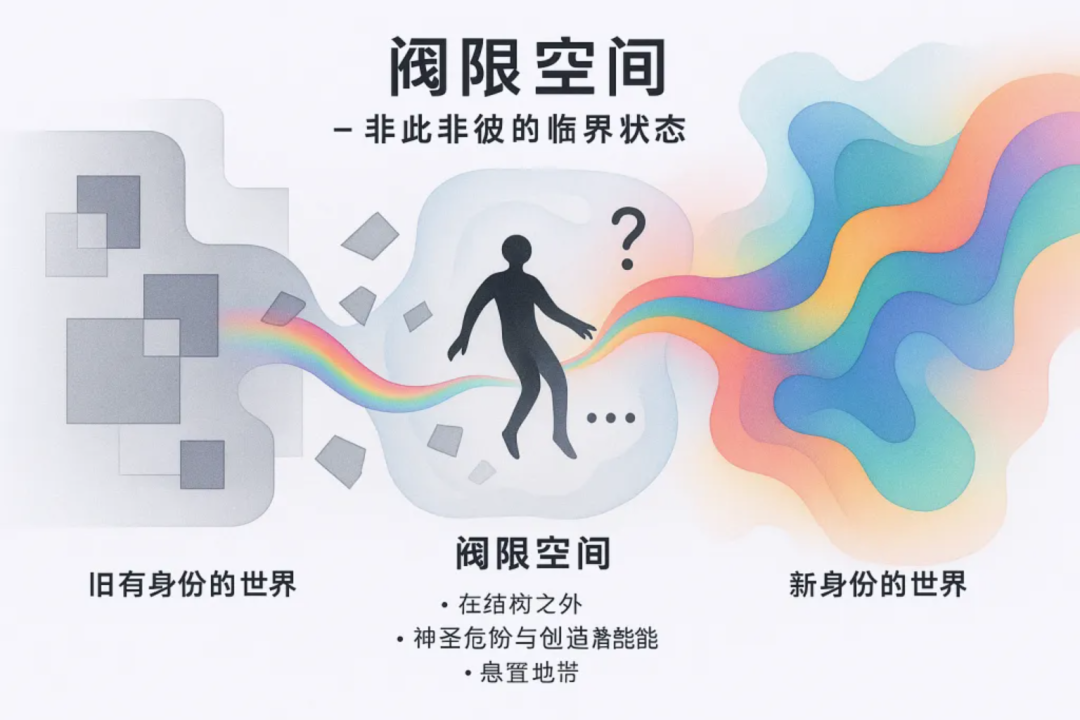
Author of cross-media theatre, space narrative researcher.
He Fa graduated from the Central Academy of Fine Arts (Bachelor) and the American University of California Arts (Master of Arts). His creative core is to explore the intersection of photography, social practice and theatre. Through its long-standing art project, P4 Theater, he focused on the camera as a "human" and embedded it in a mobile performance, working to capture and construct a "third presence" between reality and fiction.
His practice is often seen as a kind of "social alchemistry", which catalyses deep relationships and fundamental mutations between participants by designing "events" in non-target spaces such as ruins, offices and so forth. Its representative, Human Surrender, etc., combines films, dramas and documentaries, surrounds international film festivals and displays a radical aestheticism that treats the "creation process" itself as the ultimate work.