A theoretical search from P4 Theater's chaos toward a law of action.
Preface: Searching for the Score of Action
Every explorer who has tried to understand human behavior may carry a similar, almost impossible dream: to find the hidden score behind the seemingly chaotic, improvisational, chance-filled music of life. We want to know whether, beneath those countless melodies, whether magnificent or tragic, there is some shared creative law that can be deciphered.
This book records my ten-year journey of trying to draw that score.
This journey did not begin in a quiet library or a tidy study. It began in a muddy place full of sweat, noise, and real human collision: P4 Theater. In that strange space, which we jokingly called a social reaction vessel, I repeatedly witnessed the most astonishing chemical reactions in human nature: how a group of strangers could move, in a single hour, from guardedness and distance toward a deep, almost sacred collective resonance; and how a normally silent person, under a particular pressure of situation, could burst into brave and creative action even they had not expected from themselves.
Those moments were like lightning in the night: brief, brilliant, and difficult for existing theoretical language to capture or name. Traditional theater theory is good at analyzing written scripts, but cannot explain this generation without a script. Mainstream personality psychology is good at drawing static portraits of individuals, but cannot describe the dramatic phase changes that happen inside a field of presence. These theories are like beautiful star maps; they still cannot explain how a new star is born.
Out of this theoretical aphasia, a strong impulse emerged: we had to forge a language of our own, a language faithful to process, willing to embrace contradiction, and finally daring enough to touch the mysterious core of generation.
Actor-Generated Topology (AGT) was the product of that forging.
Readers will find that this book proposes a theoretical framework that may look bold, even arrogant. It tries to claim that all complex human action follows a universal grammar composed of four dimensions - Idea, Form, Execution, and Reception - and four primary forces: Architect, Discipline, Player, and Lurker. It even claims that this grammar can generate 256 distinct personality and action prototypes, forming an elemental periodic table.
I have to be honest: while constructing this theoretical edifice, I have always been accompanied by deep self-doubt. I know that any attempt to encode the complex symphony of life is necessarily an act of violent abstraction, and that it risks killing moving music by pinning it onto a staff.
For that reason, I hope readers will not treat this book as a code of ultimate truth, but as an invitation. It invites you to use AGT as a kind of music theory and a set of etudes: to analyze your own music and the music of the world around you, and to see whether it helps you hear harmonies and counterpoints you once ignored.
More importantly, it invites you to become a composer. The final purpose of AGT is not to place you inside one of 256 boxes, but to help you see the default chords and habitual rhythms of your own music, and in doing so give you a new freedom: the freedom to vary, modulate, or even rewrite the theme of your own life.
The journey of this book is filled with continuous dialogue with P4 Theater's practice, and with distant resonances with thinkers such as Deleuze, Lacan, and Badiou. It is a difficult attempt to build a fragile bridge between muddy experience and fastidious theory.
If this book finally offers readers any inspiration, it may not come from the perfection of AGT's score itself, but from the clumsy yet sincere belief behind it: we are not passive performers of our own personalities. We are, and should become, the authors of our own grammar of action.
Let us open this score together, then, and begin this listening and ensemble practice of action and generation.
He Fa
Part I: The Emergence of Theory
4 + 4
Grammar, vocabulary, topology, dynamics.
Part II: The Emergence of Events
Emergence
Topological crisis, liminal space, betrayal, transition.
Part III: The Open Subject
Unfinished
Ghosts, bodies, affects, self-reference.
Part IV: Appendices
Generation
Elemental periodic table, SJT, test, map.
Full Book Outline
Prologue: The Summons of a Theoretical Singularity
0.1 Phenomenon: beginning from the pressure, chaos, and reconstruction of relations in P4 Theater's Red Line Experiment.
0.2 Crisis: traditional theater, sociology, and psychology cannot explain P4's generative practice.
0.3 Stance: this book aims to faithfully record how AGT emerges from the mud of practice, while also reflecting on the generation of theory itself.

Part I: The Genealogy of Theory - AGT's Axioms and Mechanisms
Chapter I: The Vocabulary and Syntax of Action - Lessons Extracted from Practice
1.1 Vocabulary: four action-force modules distilled from the P4 field: [A] Architect, [N] Discipline, [P] Player, [V] Lurker.
1.2 Coordinates: constructing a two-dimensional field of tension for the four forces, organized by order/chaos and intervention/withdrawal.
1.3 Syntax: identifying four universal dimensions of action from the P4 process: Idea, Form, Execution, and Reception.
Chapter II: Topological Coding and Dynamics - Interpreting AGT's Core Mechanism
2.1 Core metaphor: interpreting personality as an operating system made of kernel processes (the four dimensions) and user libraries (the four modules).
2.2 Prototype definition: defining the 256 topological codes as dynamic attractors rather than static types.
2.3 Key variable: introducing the fifth dimension, Situation E {rule r, space s, network n}, and its dynamics of resonance/dissonance.
2.4 Core dynamic: defining topological transition as a code-rewriting event under the pressure of topological dissonance.
Part II: Theoretical Verification and Dialogue - AGT's Explanatory Power
Chapter III: The Genesis of Events - P4 as an Event Catalyst
3.1 Crisis engineering: analyzing how P4 systematically designs topological dissonance by coding Situation E.
3.2 Liminal space: defining the crisis state as a suspended zone of neither-this-nor-that, charged with generative potential.
3.3 Event emergence: describing the occurrence of micro-events and the birth of a community of comrades in adventure.
3.4 Birth of the subject: defining three postures of response to the event - reaction, betrayal, and fidelity.
Chapter IV: The Performance of Topological Chemistry - AGT's Cross-Textual Explanatory Power
4.1 Classic text: using Hamlet to analyze the destructive dissonance between individual code and situation code.
4.2 Contemporary fable: using The Matrix to analyze systemic warfare and the chemical mutation of subject code.
4.3 Artistic practice: using Human Surrender to analyze the design of a multiple reaction vessel for cross-media narrative.
Chapter V: AGT within a System of Theoretical Coordinates
5.1 Horizontal dialogue: comparing AGT with mainstream personality theories such as MBTI, the Big Five, and the Enneagram.
5.2 Vertical dialogue: exploring AGT's resonance with post-structuralist thought, including ANT, Deleuze, Lacan, and Badiou.
Part III: From Theory to the World - Open Research Agenda and Critical Reflection
Chapter VI: AGT's Ghost Dimensions - The Theory's Self-Supplementation
6.1 Historical archaeology: placing AGT in its historical and sociocultural soil.
6.2 Bodily phenomenology: supplementing the grammar of action with flesh and affect.
6.3 The affirmative turn: introducing love and joy as generative forces.
Chapter VII: An Open Research Agenda - Future Applications of AGT
7.1 Agenda one: the topological dynamics of organizations.
7.2 Agenda two: the grammar of posthuman actors, including AI.
7.3 Agenda three: cross-cultural grammars of action.
Chapter VIII: Conclusion - The Limits of Grammar and the Ethics of the Unfinished
8.1 Self-critique: examining AGT's three major risks - simplification, determinism, and instrumentalization.
8.2 Ethical procedure: proposing triangular cross-verification as a response.
8.3 Final invitation: encouraging readers to move from discovering the self toward creating the self.
Part IV: Appendices
A. Quick Reference Table of the 256 Prototypes
B. Design Examples for an AGT Situational Judgment Test (AGT-SJT)
C. Distinctions among Key Terms
D. Elemental Periodic Table of 64 Situation Topologies
Prologue: The Summons of a Theoretical Singularity
0.1 A Muddy Beginning: A Phenomenological Sketch of P4 Theater
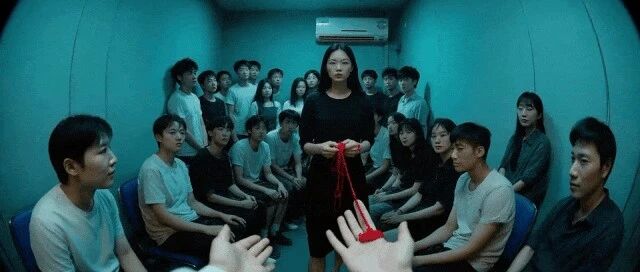
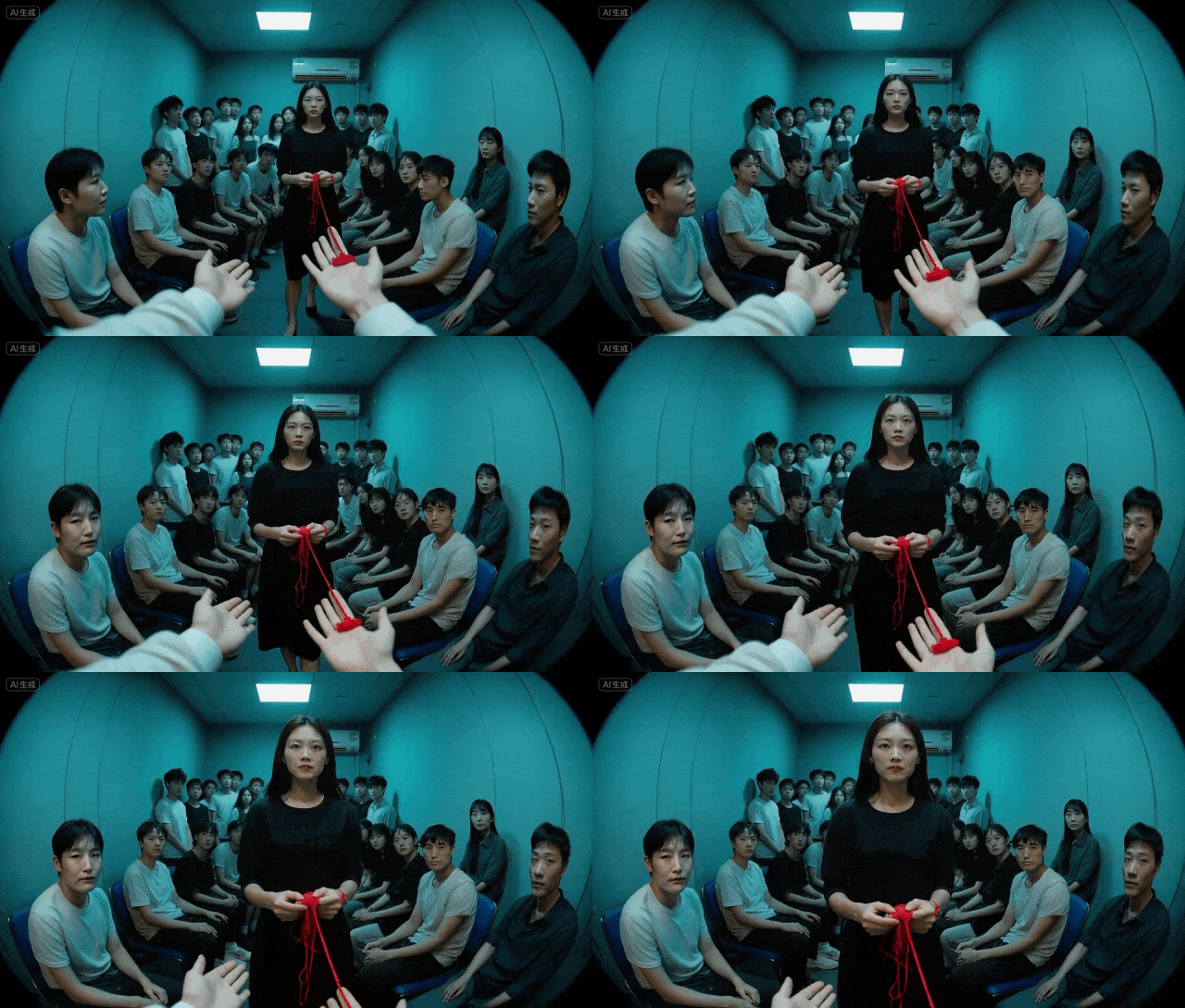
Imagine a scene: you walk into a hot office of only sixteen square meters. This is a typical non-fixed site chosen by P4 Theater. Through its physical limits, it has already written the prologue of pressure and intimacy for the event about to happen. There is no stage and no seating. Twenty strangers - recruited nonprofessional participants - are crowded together. The air is full of sweat and a tense, expectant silence. The light is dim; the only sound comes from an old air conditioner humming in the corner.
Suddenly, a woman with an expressionless face begins to move toward you, slowly, persistently, silently. Her action is already a violent dismantling of the fourth wall. In her hand she holds a roll of bright red cotton thread.
She stops in front of you and signals with her eyes that she wants to tie one end of the thread around your wrist.
At that moment, time seems to stretch. Every gaze around you focuses on you like a searchlight. All the social scripts you use so skillfully in everyday life - smiling, nodding, politely refusing - seem to fail. Her action belongs to no social grammar you recognize. Refusal seems to mean cowardice or noncooperation; acceptance means connecting yourself to a total stranger with a physical thread that cannot be simply escaped, and bearing every unknown consequence it may trigger. Your mind goes blank; your heart beats violently in your chest. The moment is filled with real social anxiety and a real dilemma of choice.
This is the core of P4 Theater: the generative site of an "Event Theater." Here, again and again, we witness strange connections emerge and dissolve: a silent person forced into action because a note is handed to them; strangers suddenly gathering to build a meaningless tower; a wordless conflict erupting inside an extremely compressed space. All of this seems accidental, chaotic, full of the possibility of failure. Yet after countless observations and experiences from within it, a question begins to remain: beneath this mud composed of cross-media narrative - body, space, and rule - is there a hidden grammar that keeps returning? Do those apparently improvisational sequences of action always follow some invisible, internal logic of generation?
0.2 Theoretical Crisis: When Existing Maps Fail
P4's practice is like a theoretical singularity: an existence of such density and gravitational force that, through its irreducible complexity, it forces the theoretical frameworks we habitually rely on to expose their cracks and insufficiencies. When we try to navigate this strange new continent with existing maps, every one of those maps fails.
The map of traditional theater theory fails here. Its coordinates are character, plot, and representation. In P4, however, there are no stable characters, only shifting functions; no predetermined plot, only real-time generation. Its purpose is not to represent a story, but to facilitate a real encounter.
The maps of traditional sociology and psychology fail here as well. Their coordinate systems are built on an ontology of position, trying to locate stable structures or types for society or the individual. But the P4 field is precisely an anti-structural laboratory. In an almost cruel way, it proves how fragile and plastic position can be. Here, action precedes identity, and relation defines existence.
The usual map of participatory art theory also becomes blurred. P4's practice certainly touches social healing and ethical dilemma, but its more central obsession seems to lie in a purer, almost formalist exploration of the generative process itself. It asks not only whether participation is good, but a more basic question: how is participation possible? What is its internal, repeatable grammar?
The theoretical vacuum opened by P4's practice powerfully calls for the birth of a new theory made specifically for generation.
0.3 The Stance of This Book: A Theoretical Journey Faithful to the Event
Facing this summons, this book does not aim to provide a ready-made, perfect, once-and-for-all map that can explain everything. That would betray P4's spirit of embracing failure and remaining unfinished. On the contrary, this book aims to faithfully record an event of theory itself: how Actor-Generated Topology (AGT), as a new grammar, painfully and contradictorily emerges from a traumatic encounter with P4 practice.
The writing position of this book, therefore, is not that of an omniscient legislator, but that of a humble cartographer full of self-doubt. The writing process itself is a theoretical practice of generation, full of internal tension, in a [V-A-P-A] mode
It begins with a humble and careful observation [V] of P4's chaotic practice.
It tries to build a clear, speakable rational model [A] for this mud.
Its process is filled with the creative pain of putting cold theory and living cases into play [P] with one another.
Finally, it must place this theoretical construction itself under the gaze of reflection [A], treating it as a limited and accidental product, admitting its permanent unfinishedness and the enduring tension between theoretical fastidiousness and practical mud.
We invite readers to join this journey as witnesses and as a community around this theoretical event. The most valuable theories may not be those that declare themselves flawless, but those that dare to expose their own cracks and invite readers into their construction.
The Emergence of Theory
4 + 4
Grammar, vocabulary, topology, dynamics.
Part I: The Genealogy of Theory - How AGT Grew out of P4's Mud
Introduction
Actor-Generated Topology (AGT) is not an airborne theory born from pure speculation. Each of its concepts is rooted deeply in the soil of experience, and has grown with difficulty from the chaotic, fertile mud of P4 Theater. To truly understand AGT's inner logic, we must first become archaeologists of theory: return to the site of its birth and retrace, even reenact, the process of its emergence.
This part reverses the usual order of theoretical exposition. We will not announce axioms in advance. Instead, we will bring readers into P4, this high-energy laboratory, to witness how AGT's core concepts - four dimensions and four modules - are identified, purified, and named step by step from concrete, sensible practice. This is a journey of tracing theory back to experience. Its aim is to give AGT's seemingly abstract edifice a firm and unshakable experiential foundation.
Chapter I: The Vocabulary and Syntax of Action - Lessons Extracted from Practice
1.1 The P4 Field: A Centrifuge of Action-Force
To identify the basic elements that compose action, we need a special laboratory: one that can violently separate and purify the mixed action tendencies wrapped, in everyday life, by convention, etiquette, and disguise. As a social laboratory, P4 Theater's field is exactly such a cruel and efficient centrifuge of action-force.
By suspending everyday rules and introducing high-intensity social situations, it forces participants to expose their most fundamental and primitive action impulses. Across ten years and more than a hundred repeated observations of practice, we found that no matter how the site's rules of the game changed, participants' behavior, though extremely varied, seemed always to combine and sway among four clearly distinguishable, mutually conflicting forces or tendencies. Like four poles in a magnetic field, these forces define the basic field of all action possibilities.
The First Force: The Impulse to Build Order [A] - Architect Force
Phenomenological observation: at the beginning of any P4 chaos, when most people are still lost and at a loss, there are always one or two participants who cannot tolerate disorder and confusion. Their anxiety does not come from social fear, but from an ontological discomfort with a state without structure. They act first, but their action is not improvisational play; it is a constructive attempt. They carefully read and interpret the rules announced by the organizer, trying to find an optimal strategy. They propose actions to people around them, trying to form a temporary action group. They begin to sort scattered props on the floor, trying to give chaotic space some order. In the instructionless game of building a tower, they are the people who try to gather everyone, discuss the tower's structure, and assign tasks. In the Red Line Experiment, they are the people who try to use their own thread to weave a network with geometric beauty or structural metaphor, rather than a random one. The core drive of this force is to transform the unknown, potentially threatening chaos into a cosmos that can be understood, predicted, and governed by internal law. We name it the force of the Architect [A].
The Second Force: The Inertia of Following Convention [N] - Discipline Force (NPC)
Phenomenological observation: more often, most participants at the initial stage display a cautious, passive watching. Their action strategy is to seek external certainty. They observe other people's behavior carefully, especially those who seem more confident or more like organizers, and then imitate those behavior patterns cautiously. They strictly, even clumsily, execute the most surface-level rules announced by the organizer, because rules are the only authority that is certain at that moment. They instinctively seek to remain aligned with the majority, in order to gain the community's sense of safety and avoid the social risk of standing out. The NPCs given repetitive tasks inside the field are the extreme purification of this force: they completely give up inner autonomy and become perfect agents of an external rule. The core drive of this force is to dissolve individual anxiety about uncertainty by merging into a larger, already existing structure or norm. We name it the force of Discipline/NPC (Nomothetic/NPC) [N].
The Third Force: The Desire to Break Rules [P] - Player Force
Phenomenological observation: in every P4 situation that seems about to settle into stability or silence, a force appears like a disturbance term and breaks the balance. The holders of this force seem to carry a huge, almost instinctive enthusiasm for breaking rules itself. They are the first people who, under the rule of remaining silent, try to play the game through a gesture, a glance, or even a cough. When the collective effort to build a tower reaches a stable structure, they suddenly pull out a block from the bottom and enjoy the drama of instant collapse. They dare to challenge the organizer's authority directly, propose a new way to play, or even treat failure itself as a performance. Their actions are full of risk, improvisation, and unpredictability, often irritating the Architects and unsettling the Discipline types. Yet it is precisely this force that injects the field with its most crucial vitality, drama, and generativity. Without it, any system will move toward rigidity and entropic death. The core drive of this force is to experience the intensity of life and explore the boundary of possibility through direct collision with uncertainty. We name it the force of the Player [P].
The Fourth Force: Distance-Maintaining Observation [V] - Lurker Force
Phenomenological observation: another force exists more covertly, but its influence is just as strong. It appears in those participants who choose to step back, withdraw, and keep the maximum distance of observation. They lean against the wall, arms crossed, sharp eyes scanning everything in the field. They are not nonparticipants. On the contrary, through a mode of non-action, they are carrying out the deepest kind of participation: information gathering and analysis. Like detectives, they try to piece together the event's internal logic from the chaotic surface. Like strategists, before entering, they first build a complete battlefield map in their minds and deduce multiple possibilities. When a Player acts impulsively, it is the Lurker's gaze that gives that action the meaning of bravery or recklessness. Their silence itself forms a powerful field of social pressure, forcing actors to reflect on their own behavior. The core drive of this force is to give meaning to unpredictable reality by maintaining cognitive distance, and thereby gain a sense of mastery through understanding. We name it the force of the Lurker [V].
In P4's centrifuge, we can see clearly that all complex social interaction can be understood as the endless competition, alliance, transformation, and dance among these four primary action-forces. They constitute the basic vocabulary of AGT theory, the starting point for understanding all action.
1.2 Constructing the Action-Force Field: Finding Coordinates for an Empirical Discovery
In section 1.1, like naturalists, we collected four distinct species from P4's strange rainforest: the four action-forces [A], [N], [P], and [V]. But the task of science is not only classification. It must also reveal the evolutionary relations among species and their positions within the whole ecosystem. For this reason, we have to move from empirical induction toward theoretical construction.
We assert that these four action-forces observed in practice do not simply coexist by accident. They are the four necessary products of a logically complete system. This system is an action-force field composed of two mutually perpendicular ontological tension axes, both derived from deep philosophical traditions. These two axes represent the two fundamental choices that any conscious existence must face and negotiate when interacting with the world.
1.2.1 The Vertical Axis: Apollo and Dionysus - The Cosmogonic Tension between Order and Chaos

The vertical axis of this coordinate system describes an actor's fundamental attitude toward the world's unknownness and possibility. This tension is the eternal echo, inside the human spirit, of the cosmogonic process by which the universe moves from nothing to being, from chaos to order. Borrowing Friedrich Nietzsche's profound insight in The Birth of Tragedy, we define it as the eternal dance of the Apollonian and the Dionysian. It is not only an aesthetic binary, but a fundamental philosophy concerning forms of life and the construction of worlds.
Upper end / Apollonian Force (the pursuit of certainty): this represents a deep desire for order, form, boundary, reason, and predictability. It comes from a fundamental impulse to resist the boundless chaos of the cosmos. For actors who hold this force, the core drive is to illuminate the world's chaos with the light of reason, like Apollo the sun god, and to give flowing life a clear dream-image. Their philosophy of action is Giving Form: reducing entropy, eliminating ambiguity, and bringing a potentially threatening, uncertain world into a harmonious system that can be understood and mastered. The Apollonian force is the source of inspiration for all legislators, scientists, engineers, and classical artists.
Lower end / Dionysian Force (embracing uncertainty): this represents a deep desire for chaos, passion, fusion, irrationality, and risk. It comes from a fundamental impulse to return to life's originary state and break the cage of individuation. For actors who hold this force, the core drive is to break all forms and boundaries in drunken ecstasy, like Dionysus, experiencing the pain and rapture of the individual's dissolution into collective carnival. Their philosophy of action is Breaking Form: actively embracing uncertainty, and seeking creative vitality and new possibility in risk and chaos. The Dionysian force is the source of power for all revolutionaries, mystics, adventurers, and romantic artists.
1.2.2 The Horizontal Axis: Immanence and Transcendence - Cognitive Distance between Involvement and Detachment
The horizontal axis of this coordinate system describes the basic cognitive distance an actor takes when interacting with the world. It concerns whether consciousness chooses to immerse itself within the event or transcend the event from above. Borrowing core concepts from phenomenology and existential philosophy, we define it as the dialectical relation between immanence and transcendence.
Left end / Force of Immanence (involvement): this end represents a direct, bodily tendency to act on the same plane as the world. For actors who hold this force, consciousness is immanent to the flow of the event and refuses the binary separation between subject and object. They tend to become part of the event, knowing and changing the world through personal participation, direct collision, and embodied experience. For them, truth is not elsewhere; it is in the here and now of action. This is the basic posture of practitioners, fighters, and players.
Right end / Force of Transcendence (detachment): this end represents a reflective and observational tendency to keep critical distance from the world. For actors who hold this force, consciousness tries to transcend the immediacy of the event, objectifying the world and placing it under an analytical gaze. They tend to become analysts of events, relating to the world through understanding, interpretation, and modeling. For them, truth is not self-evident; it has to be obtained by stepping back into detachment and reflection. This is the basic posture of thinkers, scientists, and detectives.
1.2.3 Claiming the Four Quadrants: A Systematic Derivation of Action-Forces
When we place these two mutually perpendicular tension axes together, each drawn from a deep philosophical tradition, we obtain a logically complete topological space of action-force with four quadrants. The four empirical forces observed in the P4 field finally find their logical homes
Architect force [A] is the force that pursues certainty (Apollonian) through involvement (immanence).
Discipline force [N] is the force that pursues certainty (Apollonian) through detachment (transcendence).
Player force [P] is the force that embraces uncertainty (Dionysian) through involvement (immanence).
Lurker force [V] is the force that embraces uncertainty (Dionysian) through detachment (transcendence).
Through this theoretical construction, we are no longer merely saying that these four forces exist. We can confidently assert that because human action must choose along the two fundamental dimensions of order/chaos and involvement/detachment, these four and only these four basic primary action-force modules necessarily emerge. Together they draw a cosmogonic map of the possibilities of human action.
1.3 The Emergence of the Action Process: P4's Processual Performance
Inside the centrifuge of the P4 field, we not only identified four primary action-forces. More importantly, we repeatedly observed that a complete P4 event, from beginning to end, seems to unfold in time according to an implicit, circular narrative structure. P4's radicality lies in making theatrical processes public and performative: it brings out from behind the scenes the creative process traditionally divided among different professionals - playwright, director, actor, audience - and returns it to a unified action process that all participants can experience together.
Through long-term observation of this publicized creative process, we can inductively identify the universal syntactic structure that constitutes all conscious action: the four genetic dimensions of action.
Stage One: Negotiation of Idea - Identifying the Idea Dimension [I]. A P4 event does not begin when the lights come on; it begins with recruitment. Recruitment texts such as Accusing Love of Failure or Human Surrender are already public settings and negotiations of an idea. Unlike traditional theater, which encodes theme inside complex plot, P4 lays bare the why of action - the starting point full of emotional energy and value judgment - before every potential participant. It forces everyone who wants to enter to first enter into dialogue with this idea. This makes clear that the source of any action sequence must be an Idea dimension, or Conception.
Stage Two: Experiment in Form - Identifying the Form Dimension [II]. After participants enter the field, they do not face a laissez-faire vacuum. They face a formal frame composed of rules, spatial layout, and interaction protocols. P4's practice is an encyclopedia of form. It continually experiments with possibilities: from the sparse topology of the large factory hall to the dense topology of the 510 office; from total silence to the rule that you can stop at any time. P4 lets us see clearly how changes in form - that is, changes in how action is to happen - fundamentally reshape the event's direction and the participants' experience. The Form dimension, or Formulation, thus appears clearly as an indispensable bridge between abstract idea and concrete reality.
Stage Three: Emergence of Execution - Identifying the Execution Dimension [III]. After idea has been set and form established, the real drama unfolds in the concrete actions of participants. P4 frees the power of execution from the privilege of professional actors and gives it to every uncertain Player present. Execution is no longer a predictable representation, but an unpredictable process of emergence, filled with contingency, failure, conflict, and improvisation. It exposes the what of action: the embodied, muddy link that collides directly with the Real.
Stage Four: Internalization of Reception - Identifying the Reception Dimension [IV]. P4 events often end abruptly and anticlimactically, refusing to provide a unified meaning or answer. This deliberate suspension of meaning forcibly transfers the responsibility of reception from the public space of theater to each participant's inner world after leaving. P4 shows us that reception is not one-time consumption, but a long and private journey of meaning construction. It concerns the so what of action: as participants ruminate on experience and integrate meaning, they complete a loop of learning and feedback, directly shaping the idea from which their next action will begin. This greatly foregrounds Reception as both the endpoint of an action cycle and the beginning of a new one.
In sum, by magnifying and publicizing the whole creative process, P4 Theater reduces functions that traditional theater fixes within different professional identities back into a fluid, circular, unified action process that everyone can experience. This provides the most direct and solid practical basis for AGT's first axiom: any complete action capable of learning and evolution necessarily follows the topological cycle of Idea-Form-Execution-Reception.
Chapter II: Topological Coding and Dynamics - Interpreting AGT's Core Mechanism
Introduction
In Chapter I, like fieldworkers, we immersed ourselves in the muddy practice of P4 Theater and painfully salvaged the basic elements of AGT theory from it: the four genetic dimensions of action and the four primary action-force modules. Yet a set of unorganized empirical discoveries is not yet a theory. The birth of theory necessarily involves a risky leap from the concrete to the abstract.
The task of this chapter is to make that leap. We will frankly begin an act of violent abstraction: coding P4's rich, flowing experience, full of things that cannot be fully said, into a clear and systematic theoretical model, one that necessarily carries a certain debt. We will first explain AGT's core mechanism - topological coding - and its core metaphor, personality as an operating system. We will then distinguish AGT's concept of prototype from traditional static typology. Next, we will add a crucial patch to this seemingly psychological model: the fifth dimension, Situation E. Finally, and most importantly, we will introduce topological transition as the core dynamic concept, injecting time and the possibility of transformation into this static map.
2.1 Personality as Operating System: A Generative Core Metaphor
To better understand the deep implications of topological coding as AGT's core mechanism, we need a strong core metaphor: personality as a dynamic, modular operating system.
Double Structure: Kernel Processes and User Libraries. The precision of this metaphor lies in its double structure, which is deeply homologous with the design of modern computer operating systems
The four dimensions are the operating system's kernel-level processes. Idea, Form, Execution, and Reception are immutable and a priori. They define the bottom-level structure through which the operating system is able to act.
The four modules are user-level libraries: Architect, Discipline, Player, and Lurker. They belong to the optional, combinable, acquired application-layer logic that defines the operating system's distinctive style.
Topological code as default program: an actor's topological code is like the default program or macro-instruction that their operating system has gradually formed for handling these four core processes. The code [A-A-N-N] means that when this operating system handles Idea and Form, it defaults to calling the Architect library; when it handles Execution and Reception, it defaults to the Discipline library. This default setting is gradually programmed and optimized over the actor's life through complex interaction with the world.
Beyond the metaphor: a warm system driven by desire. While enjoying the clarity that the operating-system metaphor provides, we must remain alert to its mechanistic limit. AGT's operating system is ultimately warm rather than cold. It is a libidinal economy driven by desire, anxiety, and jouissance in the Lacanian sense.
2.2 The AGT Prototype as Dynamic Attractor, Not Static Type
Once the coding mechanism is established, we can generate 256 distinct topological codes. We call these the 256 prototypes. Here, the AGT concept of prototype needs a precise theoretical clarification.
The AGT prototype is a concept drawn from dynamic systems theory and complexity science. It is not a static type placed inside a box. It is an attractor defined by a specific topological code within a phase space composed of 256 possibilities.
A prototype is a gravitational center, not a cage: it describes a strong gravitational tendency, not a necessity.
A prototype is probabilistic, not deterministic: it describes the region of highest probability distribution for a pattern of action, but does not exclude the possibility of topological transition.
A prototype is relational, not isolated: the nature of each prototype can be fully understood only in relation to other prototypes.
2.3 The Fifth Dimension: Situation E - The Ecology of Action
After building the four-dimensional model that describes the actor's internal operating system, we have to introduce a crucial fifth dimension that completes the theory: Situation E (Environment / Assemblage). P4's radical practice in non-fixed sites proves eloquently that the appearance of any action is not the product of a purely internal psychological process. An actor, together with the space they inhabit, the rules they follow, the tools they use, and the others to whom they are connected, forms an indivisible, temporary action machine.
Borrowing terms from Deleuze and Guattari, as well as Actor-Network Theory (ANT), we have to acknowledge that the final unit of analysis is not an isolated individual, but an assemblage composed of both human and nonhuman actants. Therefore, in order to analyze action precisely, we have to code not only the actor's internal operating system, but also the external situation in which that actor is embedded.
2.3.1 The Coding Syntax of Situation E: A Three-Layer Topological Model
We propose that the topological structure of a Situation E can be decomposed into three interacting basic layers, each of which can be coded. We use lowercase letters to distinguish them from individual modules, and to emphasize their distinctive nature as external forces.
Rules Layer (R - Rules): the software of the symbolic order
This refers to the explicit or implicit symbolic laws in a situation that define what is allowed.
r(a) - Architectonic rules: rules are creative and goal-oriented, for example, Our task is to build a tower within one hour.
r(n) - Normative rules: rules are maintenance-oriented and procedure-oriented, for example, Please raise your hand before speaking and follow the meeting procedure.
r(p) - Ludic rules: rules encourage improvisation and departures from convention, for example, You may do anything, but you may not use language.
r(v) - Observational rules (Voyeuristic): rules require detachment and analysis, for example, Your task is to observe and record the interaction patterns of Group A.
Space Layer (S - Space): the hardware of the physical order
This refers to the physical topology and material arrangement of a situation, which affects actors' bodily perception and possibilities of interaction in deep, nonverbal ways.
s(a) - Constructed space: the space is highly designed and functionally defined, such as an operating room or classroom.
s(n) - Conventional space: the space conforms to social convention, such as a conference room or restaurant.
s(p) - Chaotic space: the space is disorderly, open, and full of possibility, such as a ruin or P4's initial field.
s(v) - Panoptic space: the space is designed for observation and monitoring, such as a panopticon.
Network Layer (N - Network): the force field of relations

This refers to the preset or encouraged patterns of relational connection among actors inside a situation.
n(a) - Hierarchical network: relations are centralized and tree-like, with a clear leader.
n(n) - Decentralized network: relations are based on role division, like an organizational chart.
n(p) - Distributed network: relations are fully equal, peer-to-peer, and rhizomatic.
n(v) - Radial network: relations are formed by an observed center and a group of observers.
2.3.2 AGT's Core Dynamic Law: Topological Resonance and Topological Dissonance
After establishing the coding syntax of situations, we can propose one of AGT's core dynamic laws, explaining the fundamental mechanism through which individual and environment interact
Topological resonance: when an individual's default code is highly matched with the code of the Situation E they inhabit, their action will be efficient, comfortable, and reinforced. This is a state of minimal energy consumption. For example, an [A-A-N-N] bureaucrat in a bureaucratic institution coded as E{r(n), s(n), n(a)} will feel like a fish in water. The actor's internal operating system is perfectly compatible with the operating system of the external world; their action seems effortless and receives positive feedback from the system.
Topological dissonance: when an individual's code is severely mismatched with the situation code, enormous tension, anxiety, and energy consumption are produced. This is a high-energy state of extreme discomfort. For example, if the same [A-A-N-N] bureaucrat is thrown into a situation such as P4 Theater, coded E{r(p), s(p), n(p)}, every internal module will clash sharply with every layer of the external environment. They will feel at a loss because their habitual grammar of action has completely failed here. This profound dissonance is the primary trigger of topological crisis and topological transition.
2.4 Topological Transition: Code Rewriting as the Consequence of Dissonance
After establishing topological dissonance as AGT's core dynamic law, we can now introduce the most dramatic and transformative concept in the whole theory: topological transition. If topological dissonance is the critical state in which a system is heated to boiling point, then topological transition is the irreversible, creatively violent instant when liquid water phase-shifts into vapor.
We give topological transition a more precise and causal final definition: it is a discontinuous, ruptural, often unconscious emergency rewriting of an individual's internal operating system, triggered when their individual code enters irreconcilable topological dissonance with Situation E and must respond to a survival crisis by rebuilding inner equilibrium.
2.4.1 The Mechanism of Topological Transition: From Kernel Panic to Non-Default Program Calls
An actor's default code is like a stable attractor. Yet when the pressure of topological dissonance becomes so strong that the default code can no longer process incoming signals, the internal operating system undergoes a kernel panic. In subjective experience, this is the moment of the mind going blank and not knowing what to do.
In order to avoid total system collapse, the operating system forcibly starts an emergency non-default program call. This is the micro-mechanism of topological transition. It is not a permanent change of personality. It is more like a passenger who has never driven before being forced to seize the steering wheel after the main driver, the default module, passes out. This process has the following features
It is irrational: it is often not a carefully considered decision, but a pre-reflective, intuitive, even spasmodic act of decision.
It is high-risk: calling on an unfamiliar module produces awkward and unpredictable action, and may lead to more serious failure.
It is full of potential: this instant also reveals the actor's repressed potential, hidden vulnerability, and the breaking point of the default code.
2.4.2 P4 as a Laboratory of Transition: A Safe Crash Simulator
The core function of P4 Theater's radical practice is precisely to systematically induce and observe topological transition by consciously designing and maximizing topological dissonance. It is like a crash simulator: by creating a relatively safe and controllable crisis situation E, it trains pilots, or participants, to take manual control and call on unfamiliar emergency programs when autopilot, the default code, fails. P4 is a high-energy laboratory for stress-testing and emergency-drilling our internal operating systems.
2.4.3 The Consequences of Topological Transition: The Emergence of Subjectivity and a New Model of Growth
A successful topological transition has profound consequences. It offers a new model for understanding growth and freedom
The emergence of subjectivity: at the instant of transition, the programmed individual defined by the default code temporarily dies. In its place appears a new subject born in decision.
A new model of growth: from AGT's perspective, personal growth is no longer a linear process of accumulating knowledge. It is a spiraling process of phase change driven by repeated topological transitions. True growth can be defined as consciously and repeatedly practicing topological transition, thereby increasing the ability to call on non-default modules and eventually, slowly and with difficulty, perhaps rewriting one's default code.
Chapter summary: this chapter has formally built AGT from a series of empirical discoveries into a theoretical model with internal mechanisms. Through the core metaphor of the operating system, we clarified the generative rules of topological coding. Through the concept of dynamic attractors, we gave the 256 prototypes a non-essentialist and dynamic meaning. By introducing Situation E and its coding syntax, we placed the theory within a broader ecological field. Finally, through topological transition as the core dynamic concept, we injected change, growth, and the possibility of revolution into this static map. AGT's core mechanism has now been explained. In the next part, we will enter a deeper verification of how these mechanisms operate in concrete practice.
End of Part I.
To be continued.
He Fa (b. 1990)

Cross-media theater creator and researcher of spatial narrative.
He Fa graduated from the Central Academy of Fine Arts with a bachelor's degree and from the California Institute of the Arts with a master's degree. His creative work centers on the intersection of photography, social practice, and theater. Through P4 Theater, the long-term art project he founded, he inserts the nonhuman gaze of the camera into fluid relations between performance and spectatorship, seeking to capture and construct a third presence between reality and fiction.
His practice is often understood as a form of social alchemy. By designing events in nonstandard spaces such as ruins and offices, he catalyzes deep relation generation and mutations of subjectivity among participants. Representative works such as Human Surrender combine film, theater, and documentary, have been shortlisted by multiple international film festivals, and articulate a radical aesthetic in which the creative process itself becomes the final work.