A visual research paper on Human Surrender / Shoot Self with You
Imaging with You
Human Surrender /
Shoot Self with You
The Unowned Second Person and Non-Sovereign Spectatorship within
Author
He Fa
Period of creation
2023-2026
Thesis
The "I" (Self) must be imaged with you, but this "you" has no owner
Purpose
Through the film Human Surrender, to distill P4 Theater's years of practical experience into an operable method
Boundary
Do not rewrite the pressure of the image as real-world motive, authorization fact, or off-film harm fact
Abstract
Human Surrender is a handheld performance film organized around "The Last Rehearsal." The film keeps shifting its figures among room, rehearsal, intimate action, public viewing, backstage sound, the camera's appearance, and end-credit archive
so that
"who is watching," "who is being watched," "who is speaking," and "who is being preserved" remain unstable throughout. Beginning from the film's double-title structure, this article proposes "with-you imaging" as the core concept for understanding its mechanism of spectatorship. The English title
Shoot Self with You
reveals the film's grammar of action, while the Chinese title Human Surrender reveals the epistemological and ethical consequences produced by that action. The two titles are not simple translations of each other; together they constitute the film's viewing apparatus.
The key to Shoot Self with You
lies precisely in the fact that it is not
Shoot Myself with You
. The improper grammar of this title keeps prompting us to reflect on the film's structural problem: here, self is not owned by a complete first-person subject.
Shoot
simultaneously involves the semantic pressures of filming, shooting, projection, and bodily release; self is not the myself that already belongs to "me," but a self provisionally expelled through filming, impact, and exposure
with you
is not a stable relation of companionship either, but a constantly shifting second-person condition. In other words
the self in the film does not first exist in full and then get recorded by the camera; it is developed, struck, and redistributed under the relational pressure of "with you."
The Chinese title Human Surrender further names the consequence of this image-action. Here, "surrender" is not losing to a certain character, director, camera, machine, or power; it is the cessation of pretending that human beings can fully own their bodies, relations, viewing, voices, endings, and archives. The "faction" in the title also means that surrender is no longer a one-time event of defeat, but a position: it means actively withdrawing from the illusion of subjective sovereignty and acknowledging that, before images, intimate relations, performance, and mechanisms of preservation, human beings cannot always appear as owners. Therefore
"human" here is not a grand declaration, so to speak, but points to a fragile condition of spectatorship: human beings can watch, approach, rewatch, and record, but they cannot thereby completely possess what is watched.
This article calls that structure the "unowned second person." Human Surrender keeps calling out a "you" and lets this "you" actually alter the relations among body, voice, photography, and archive; yet the film does not allow us to assign this "you" stably to any character, camera, audience, director, or researcher.
This "you" moves among different positions
at times it seems like the intimate object faced by the person being filmed; at times like the viewer behind the camera; at times like the audience in a public viewing; and at times like the person who later rewatches, researches, and writes. Precisely because this "you" can never be fixed, spectatorship in the film also cannot be reduced to a one-way relation of the gaze.
The preservation of a past scene in images often carries a certain "hauntology": it makes moments that have passed away or are no longer present return in visible form in the present. This "presence of the absent" is an especially important feature of recording media such as photography, film, and video.
What is more specific about Human Surrender is that it repeatedly pushes the viewer into a position that seems close to the live situation, then repeatedly withdraws the right of possession implied by that closeness. The actions in the room, bodies in rehearsal, touches in intimate relations, exposure in public viewing, voices from backstage, the camera's process of becoming visible, and the archival materials at the end do not simply hand an already occurred scene to the audience. Instead, they repeatedly alter the viewer's position: sometimes the audience seems near the intimate relation; sometimes it seems excluded from the scene; sometimes the camera appears to enter between bodies on the audience's behalf; and sometimes sound and archive remind the audience that
they are only people who entered this chain of relations later.
Therefore, what Human Surrender trains is not a general sense of "being unable to change the past," but a more specific experience of spectatorship: the audience is allowed to approach, but cannot mistake approach for ownership; the audience is implicated by the image, but cannot mistake implication for interpretive authority; the audience can rewatch, preserve, and write, but cannot thereby restabilize the people, bodies, and relations of that moment.
So-called "non-sovereign spectatorship" does not mean that all films naturally leave the audience without power to change the scene; it means that this film turns that condition of powerlessness into its own formal structure.
It makes the audience repeatedly experience the failure of position: you have been called in, but you cannot become the owner
you have been struck by the image, but you cannot decide to whom this strike ultimately belongs.
Keywords: with-you imaging; unowned second person; camera disembodiment; the capacity to stop after seeing; Shoot Self with You
First, clarify the film: what exactly is it filming?
At the beginning of the film, we seem simply to enter a rehearsal space: someone is standing, someone is sitting, someone is speaking, someone is holding a camera. At first it looks like a rehearsal in progress; later it slowly becomes something stranger. The camera is no longer only a recorder standing to the side. It approaches bodies, moves around people, follows voices, and is also suddenly seen back by the frame. What the audience sees, then, is not just "what they are performing," but how this scene gradually loses its stable boundaries: who is watching, who is being watched, who is arranging, and who is being arranged.
If you have not seen Human Surrender, you can first remember the simplest fact: it films how a group of people are continuously shifted among rehearsal, performance, intimacy, waiting, photography, sound, and end credits. An actor is at one moment like a character and at another like himself; the director's position is at one moment with the director and at another temporarily taken away by an actor; the camera is at one moment like an observer and at another like a person in the scene who can be questioned, identified, and implicated. What the audience sees is not a tidied-up story, but the way a scene turns everyone into one another's material for viewing.
After reading this article, readers may not receive a single explanation of the film's plot; they will receive a method of viewing: how to recognize, within images, those effective "yous" that approach us and change us, yet cannot be owned by anyone. This is what the article will later call "non-sovereign spectatorship." In plain terms: I have seen, but I cannot own what I have seen; I have been called by the image into the scene, but I cannot make decisions on the scene's behalf.
The opening says that this article "distills P4 Theater's years of practical experience into a method," but this does not mean summarizing P4 as a style. More specifically, it extracts three operable methods
expose the viewer's presence, let the recording apparatus enter the relation, and keep the second person in performance from being fixed as a certain owner.
The film does not explain these methods; it makes them bear pressure again and again.
Opening: expose the camera first
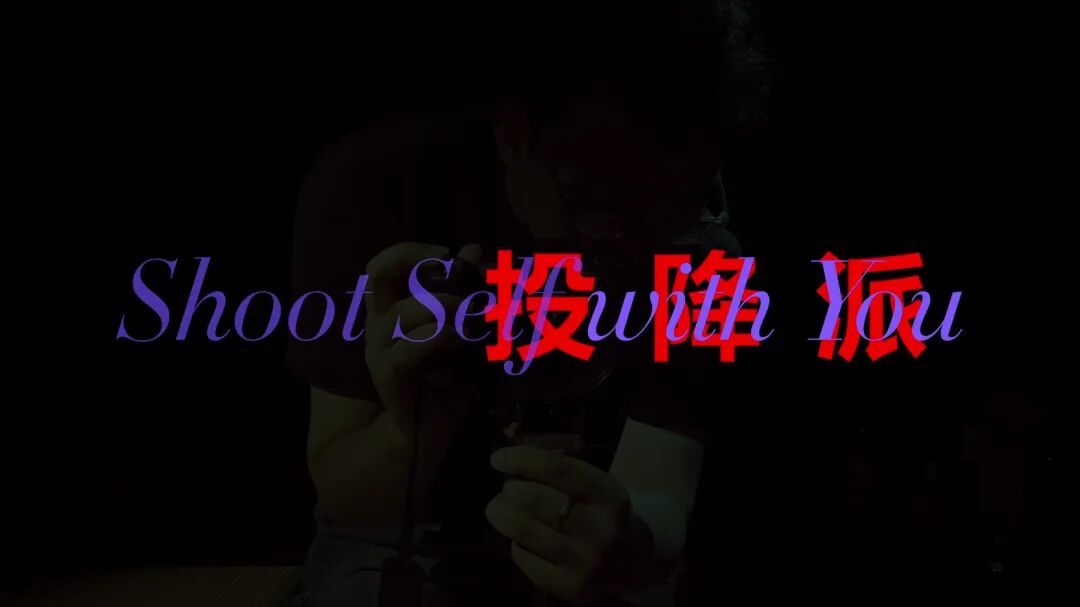
From the very beginning, the film lets the camera-holder and the title enter the frame. It does not pretend that the camera does not exist, but first asks: who exactly is watching?
Rehearsal: people are borrowed by positions
The figures move back and forth among actor, character, director, audience, and filmed subject. They enter identities, and also keep falling out of them.
Intimacy: proximity cannot guarantee confirmation
At very close bodily distance, figures demand recognition from each other, yet say "I can't see myself" and "I disappeared." The closer they are, the less they can prove that they have been received.
Later section: the audience is also drawn in
After public performance, live sound, another camera, figures looking toward the lens, and the end credits appear, the film begins to ask: who ultimately receives this scene?
What truly makes this film sting is not that it is "complex," but that many small actions are like needles, pricking the most ordinary experience of watching. Someone is very close, yet says they cannot see themselves in your eyes; someone says their mind is blank, and that blank is immediately registered as "you missed so many words"; someone says they do not want to speak, and the site does not stop, but hands the voice to someone else to continue; someone asks, "Do you have a cigarette?" and an everyday request calls the person behind the camera, the doorway, the window, and the backstage into relation; the phrase "no one can see you" sounds like shelter, yet the frame keeps making the white cloth, exit sign, audience, worktable, subtitles, and photographic conditions visible.
These details are beautiful because they are all small: a hand covering the eyes, a repeated request to borrow a cigarette, a sound field after a number fades out, a piece of white cloth, a one-second gap. But once these small things are connected, the genuinely frightening and genuinely moving part of the entire film emerges
it lets no one easily return to themselves.
People want to be seen and fear being seen; they want to be held by the other and discover that the other is not the owner either; they want to stop, yet the scene has already switched to a new carrier and continued.
So the "with-you imaging" discussed here is not a code phrase comprehensible only to those familiar with the film. It comes from the film's most direct experience of viewing: I think I am watching others, and gradually discover that I, too, am being watched by others, by the camera, by sound, and by future audiences; I think I can confirm myself through some "you," and finally discover that this "you" has been changing all along, and that no one can fully possess it.
This article does not do three things: it does not directly equate characters with the actors themselves; it does not rewrite the pressures inside the image as real-world motives; and it does not translate discomfort in viewing directly into off-film facts of harm. This article discusses how the film organizes pressures of spectatorship, rather than inventing motives, authorization relations, or harm verdicts for real people. Images can force us to respond, but that response cannot overstep the evidence and directly rewrite viewing pressure as off-film fact.
Figure 1.
The opening title and the camera-holder in the same frame. This is not an ordinary title card; after the photographic position has been pulled to the front of the screen, the title appears as the name of a method.
This image does not prove that "someone in the film is holding a camera"; it proves that from the first moment, the film refuses to let the viewing position remain transparent.
1. Two Titles, One Unowned You
A film has two names. Its Chinese title is Human Surrender, and its English title is
Shoot Self with You
. These two names are not simple translations of each other. The Chinese title places the film within a collective position: human beings, surrender, faction, like a declaration that still has to step forward after some kind of defeat. The English title brings the matter back to a more concrete, more bodily, and more unsettling action
shoot self with you
.
The grammar of Shoot Self with You
is unstable. It is not
Shoot Myself with You
not "I shoot myself together with you"; nor is it
Shoot You
not "I shoot you"; still less is it
Shoot Self for You
not "I shoot myself for you to see." It lacks a clear subject, removes the
my
and places
self
within the condition of
with you
. From the title onward, the film refuses a complete, settled "I" that first owns itself: it is not that I already hold myself securely and then hand myself over to the lens; rather, self must be filmed into appearance beside, through, and together with an unstable you.
Shoot Self with You
names the action: self must be developed through you. Human Surrender names the consequence: human beings can no longer pretend that self can be imaged alone.
This article calls that mechanism "with-you imaging." With-you imaging does not mean that the film simply pulls the audience in, nor that a direct identification forms between character and audience; it means that the self in the film cannot appear on its own, but must be filmed, seen, and changed through a called-out you; yet this you therefore cannot become the owner of the self or the scene. In the shortest formulation: the self can only be imaged with you, but this "you" has no owner.
This "you" is effective, yet it has no owner. When figures speak to each other, it has already been preserved by the camera; when figures look toward the lens, it seems to reach the audience, yet we cannot simply say, "this is addressed to the audience"; when the camera films others, the camera-holder is also exposed in reverse by the image relation; future viewers enter the scene belatedly, yet cannot call their belated understanding the truth of the scene. The film keeps calling out a you, letting it alter lens, body, voice, and relation, but does not let any side say
this is mine; this is where I close the case.
Conceptual Levels
Concept in this article
Function
General concept
with-you imaging
Explains that self cannot appear alone and must pass through an unstable you.
Grammatical mechanism
Shoot / Self / With You
Explains how the title links filming, an unowned self, and a second-person condition.
Site mechanism
intimacy / time / sound / camera
Explains how the film breaks four certainties in concrete scenes: that proximity can confirm, sequence can close the case, the frame can contain the scene, and the viewer can hide outside.
Ethical consequence
the capacity to stop after seeing
Explains that later viewers can be called and changed by the film, but cannot thereby become owners of the scene. This article also calls it "non-sovereign spectatorship."
What "with-you imaging" is not
To keep this concept sharp, we must first say what it is not. It is not the ordinary idea that "I know myself through others," because the others in the film do not stably function as mirrors; nor is it "intersubjectivity" in the general sense, because the relation here is not mutual confirmation between two complete subjects, but the simultaneous borrowing of one body, one camera, one stretch of sound by multiple positions; it is not simple "audience participation," because after the audience is called, it still has no right to decide on the scene's behalf; nor is it "the camera as witness," because the camera itself can also be seen, questioned, and implicated.
Thus "with-you imaging" holds only under a narrower condition: self cannot appear by itself and must pass through an effective you; yet this you cannot stably belong to any one side among character, photographer, audience, archive, or researcher. Once a certain "you" is fixed as owner, the mechanism ends.
The most fascinating part of the film is precisely that it keeps making "you" take effect, and keeps preventing anyone from taking this "you" away.
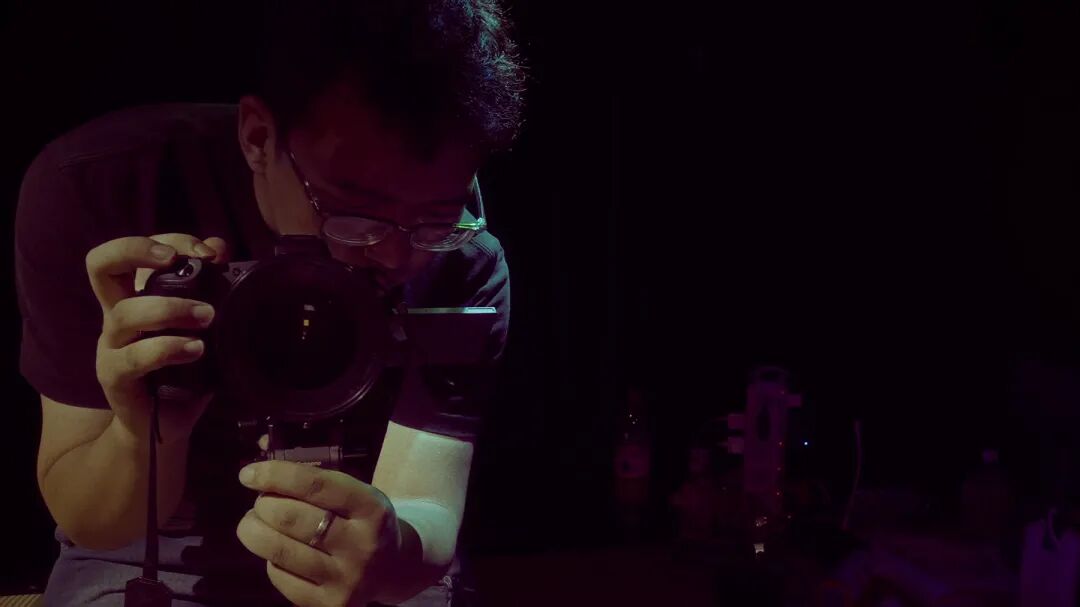
Figure 2.
The opening appearance of the photographer. The camera-holder enters the frame in a red-black dark field, so that the photographic position is no longer merely a transparent function behind the lens.
This image does not prove that "the photographer exists"; it proves that from the beginning, the filming body is part of the film-event.
2. Theoretical Interface: Photography Does Not Only Preserve the Past; It Also Calls the Future
This article remains in dialogue with photographic ontology, hauntology, film phenomenology, sound theory, and performance studies, but it does not treat the film as an example of those theories. External theory is not the owner here, but an interface: it helps us see where the problem comes from, and also lets us state more precisely where Human Surrender pushes the problem.
Bazinian photographic ontology can help discuss the relation among photography, time, and the preservation of reality, and can also help us understand why the long take is not in a hurry to judge on the audience's behalf.
1
But this article is concerned not only with how photography preserves a past, but with how photography, while preserving a scene, leaves in advance a position from which someone will later come to watch. In other words, the question is not only "this once happened," but "who will later see it, misunderstand it, preserve it, and be pricked by it." Barthes's discussion of photography, mortality, and the punctum is also advanced here: the image not only turns living people into specters that can return
2
it also pulls future viewers in advance into the scene being filmed.
Derridean hauntology and archive theory remind us that the ghost is not a visible object, but a temporal dislocation, a remnant trace, and a desire to archive.
3
But in this film, hauntology cannot be written only as the return of the dead. More precisely, future viewers are summoned back in advance by the past: while the image is still being filmed, the position that will later see, judge, and rewatch has already begun to affect how figures speak, how they leave, and how they search for response.
Film phenomenology, sound theory, and performance studies provide three other limiting conditions. Sobchack asks us to attend to the embodied reversibility of viewing experience
4
but the second-person cinema discussed here is not immersive identification; it is constrained borrowed embodiment. Chion shows that sound reorganizes image perception
5
but this article is more concerned with how sound prevents the frame from containing the scene. Schneider's discussion of performance remains suggests that performance does not simply end
6
while Human Surrender moves this question forward into the rehearsal site itself: the actor has not yet fully become the role, but is already no longer merely himself.
3. Shoot: Filming as Irretrievable Sending
shoot
first means filming. But filming here is not neutral recording. Filming means launching a scene from the present into the future, allowing viewers who have not yet arrived to enter belatedly into relations to which they could not respond at the time. So-called
shoot self
is not the preservation of an already complete self, but the launching into the image of a self that has not yet been secured by "me."
This self is not complete on site; it must pass through the camera, the gazes of others, future viewers, and archival systems before it repeatedly appears.
shoot
also carries the shadow of shooting. As a verb of shooting, it includes direction, aim, impact, and irreversibility. Once the lens approaches, it is not simply "taking a look"; it strikes a person, a body, a relation. The complexity lies in the fact that the title is not
Shoot You
. It is not that I fire at you, that I hit you
but rather that I, with you
in our co-presence
I launch self outward
and this launch will
rebound
onto the camera-holder. Photography thus becomes a rebound structure: I think I am filming you, but the lens rebounds, and I am also struck by the image I emitted.
shoot
also carries the semantic shadow of emission and bodily release. This shadow cannot be crudely written as "the film equals ejaculation"; that would shrink a complex cinematic mechanism into motivational biography. A steadier understanding is
shoot
indicates that filming in this film is not purely rational recording, but bears the translational pressure that follows a failed bodily release. Something that cannot close within a direct relation is handed over to the camera, performance, stand-ins, viewing, and archive.
Therefore, this article's discussion of
shoot
's shadow of bodily release neither reduces the film to a sexual metaphor nor judges the real-world motives of characters or creators. This article does not take
shoot
to mean violent intent, nor does it narrow the word to a photographic term. Its importance lies in the way it simultaneously activates filming, launching, release, and self-projection, making self from the outset something not securely contained within the body.
Filming is not harmless preservation, but a sending; after it is sent, image, desire, bodily pressure, and viewing relation can no longer be fully retrieved by the originator.
The key is not emission itself, but that release needs you, and you do not belong to me.
This article calls this mechanism "emissive imaging." Filming launches self outward; shooting makes the image a strike that can rebound; bodily release hands relational pressure that cannot be brought to closure over to the camera; and
with you
stipulates that this launch cannot be separated from a second-person condition.
Shoot
is launching
Self
is the self that appears only after being launched
With You
is the relational condition from which the launch cannot separate.
4. Self: Actor's Body and Unowned Self
The title says
self
not
myself
. If it were
Shoot Myself with You
the sentence would still retain a relatively stable first person: I first own myself, and then I film myself with you. But
Shoot Self with You
removes
my
. This self is no longer "my self,"
but a self I cannot yet hold securely on my own, a position that has to be produced through photography, performance, others, sound, and future viewing.
This is very important for Human Surrender, because the figures in the film can rarely exist stably as "themselves."
They are always shifting among role, actor, director, audience, photography, and future material.
Zichou is at one moment like a director, at another like an actor, at another like a witness, and at another like a residue of voice withdrawn from the world; he seems to arrange others into positions, yet is repeatedly arranged in return by those positions.
Jiarui bears the contradiction of the actor's body more directly: on one hand, he enters identity slots, intimate actions, and role relations, sometimes even enjoying the possibilities brought by another body; on the other hand, he detests the way the actor position carries him away, and wants to withdraw from performance, role, and viewing.
Amon keeps responding to others, and is thereby called away by other people's "you," becoming a response interface with a blind edge.
This is not an attempt to reduce characters to psychological diagnosis. More precisely
the film makes figures into positions rather than entities.
A person becomes "Zichou," "Jiarui," or "Amon" not because he first possesses a complete core and then participates in relations; rather, it is because the director position, actor position, response position, substitute position, photographic position, sound position, and absent position keep calling the body in.
Once the body enters, it is no longer just the original body.
Theater itself is the ancient institution of this unowned self. The actor stands onstage, and the body seems to belong to him; but the role's name, lines, actions, relations, and audience expectations occupy that body at the same time. What the audience sees is neither the pure person nor a role completely detached from the body, but a person being temporarily used by another name, another relation, another set of expectations.
The so-called truth and falsity of theater often do not lie in which layer is more real, but in how one body is summoned by multiple positions at once.
Human Surrender begins with rehearsal precisely because it wants to bring this theatrical structure into view.
Rehearsal is not a thematic shell, but an ontological chassis.
What the film calls "The Last Rehearsal" is not merely a story background, but a way of keeping people continuously in a position that is unfinished, unstable, not fully entered, and impossible to exit.
The actor has not yet become the role, but is already no longer only himself; the director has not completed control, but control has already affected the body; the audience has not formally possessed spectatorship, but viewing pressure has already changed the scene; the camera has not yet become archive, but archival conditions have already intervened in advance.
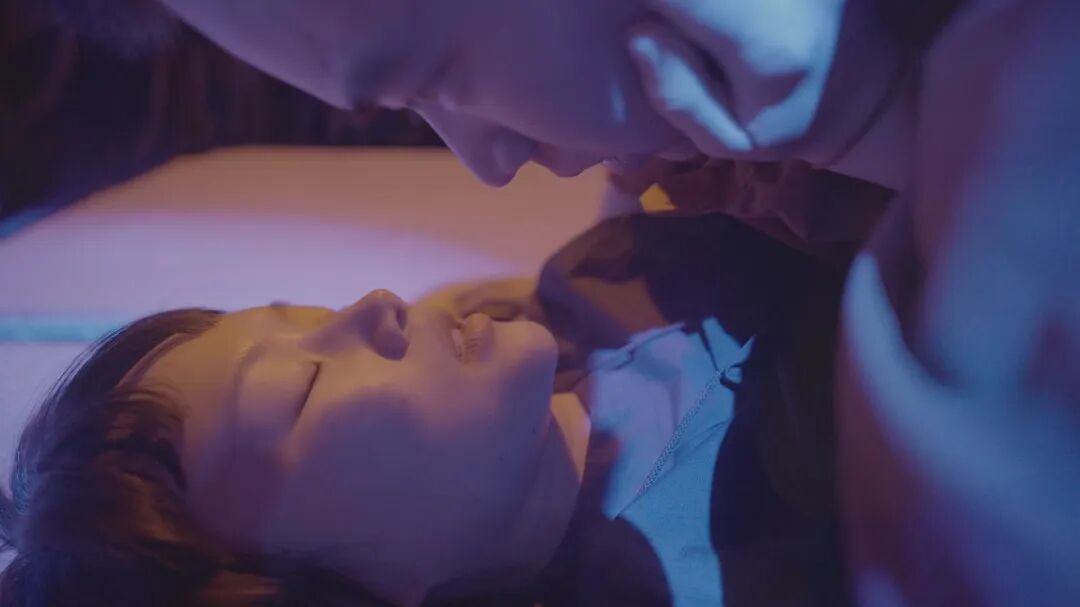
Figure 3.
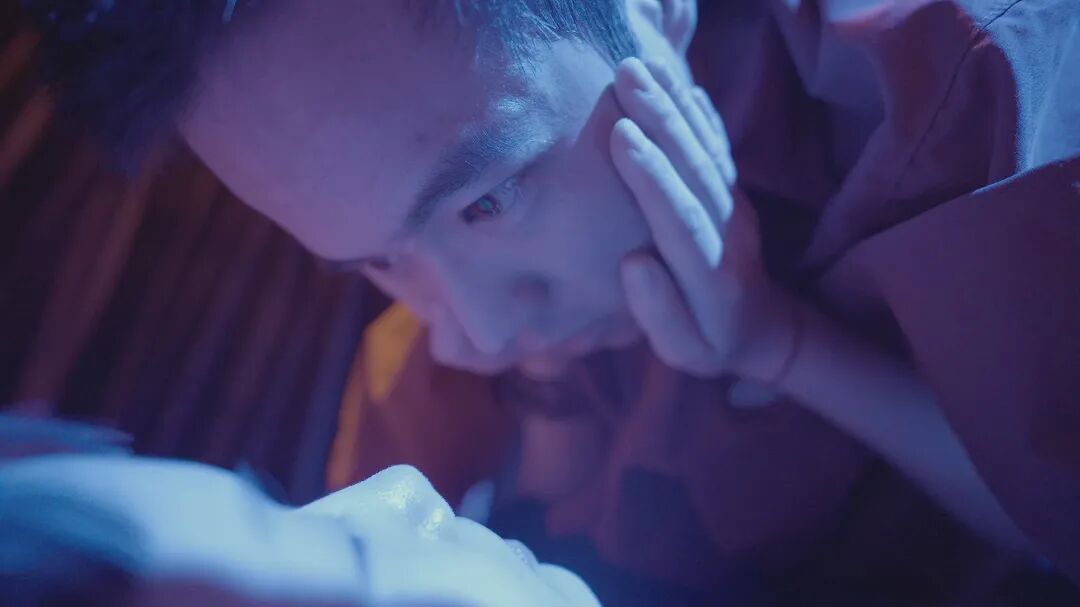
The extremely close bodily space of "I can't see myself in your eyes." The eye dialogue does not occur in distant conversation, but amid face-to-face proximity, hands covering the eye area, cold blue highlights, and squeezed breath.
This image does not prove that "the characters' relation is intimate"; it proves that intimate distance itself may be unable to return me to myself.
11
5. With You: This "You" Really Takes Effect, But Belongs to No One
If
Self
is not
myself
then
with You
is not a simple object either. This
you
is not a fixed person, nor a fixed camera position. At times it resembles the person in front of the eyes; at times the person behind the camera; at times a future audience; at times the person writing about, rewatching, and preserving this film. It is more like a condition: self can be imaged only within this condition, but this condition cannot be appropriated by anyone.
This is exactly what the "unowned second person" means. The film calls out a "you" and lets this "you" really change the scene: bodies turn toward it, speech is delivered to it, the lens is pulled by it, and later audiences may suddenly feel themselves drawn in. Yet the film does not let us fix this "you." It lands unstably among character, camera, audience, archive, and researcher, like a beam of light: whoever it reaches is temporarily called
but the light does not therefore belong to anyone.
Thus unowned does not mean objectless; it means that the object is always moving. A character can temporarily become "you," the camera can temporarily become "you," the off-screen photographer can temporarily become "you," and the audience can belatedly feel brushed by it; but each time we are about to say "it is him," "it is me," or "it is the audience," the film pushes this position elsewhere.
This "you" is not a blank, but an intensely alive relational condition: it lets things happen, yet does not let anyone take those things away.
More importantly, unowned does not mean without responsibility. It does not mean that no one needs to respond to image pressure, nor that all judgment can be suspended indefinitely.
What it cancels is not response, but possession.
A viewer who has been called still has to take responsibility for their own viewing, quotation, and interpretation, but cannot inflate that responsibility into "I finally own the scene." The capacity to stop after seeing begins here: I respond, but I do not possess; I state my understanding, but I do not disguise that understanding as final judgment.
It differs from the subjective shot. A subjective shot usually lets the audience temporarily see through someone else's eyes, even if that access is unstable; the second person in Human Surrender, by contrast, precisely does not let the audience take secure possession of those eyes. It often brings the audience very close, while also making the audience aware that
this close place is not my seat; I cannot sit down and announce that I have entered another person.
It also differs from audience identification. Identification means that the audience can place itself inside a certain character or viewing point, temporarily enjoying an emotional, cognitive, or bodily substitute position. The unowned second person does the opposite: it calls the audience, but does not let the audience sit comfortably; it lets the audience feel that a question, a gaze, a sound, or the camera may have brushed them, while repeatedly reminding them: being brushed does not mean you own it.
I watch this world, and as I watch, I suddenly discover that I am being watched.
This sentence describes the disembodiment of the viewing position: I think I am watching others through the camera, only for camera, character gaze, sound, and end-credit archive to show together that the place I occupy has also been incorporated into the film's relation. Viewing is no longer an external action, but part of the scene.
Figure 4.
The "I disappeared" eye frame. A hand covers the eye area, face presses close to face, and cold blue light compresses looking, touching, and occlusion into a single image.
This image does not prove that "a person has left the frame"; it proves that disappearance can occur where bodily distance is smallest.
6. Four Site Mechanisms: Why Proximity Cannot Become Possession
The unowned second person in the film is not a single scene, but a chain that continually pulls people closer while preventing possession. The eye section says: proximity does not necessarily return me to myself. The time section says: arranging things in order does not necessarily close the case for the event. The sound section says: the image looks stable, yet the scene is still leaking from elsewhere. The camera section says: those who watch will also be seen; the lens cannot hide outside forever.
Mechanism
Certainty broken
Expression within the film
Consequence for spectatorship
Eyes
Proximity can confirm
Within extreme bodily proximity, someone asks for proof of "me in your eyes," yet speaks of not seeing and of disappearance.
The other's eyes cannot guarantee that I am returned to myself.
Time
Sequence can close the case
Event pressure cannot be contained by a single causal, flashback, parallel, or cyclical relation.
Time preserves pressure, but does not give the audience a final explanation.
Sound
The frame can contain the scene
Public waiting has sound but no clear lines; apparatus sound returns before character speech.
The frame cannot seal the scene; the sound field brings elsewhere back into the present.
Camera
The viewer can hide outside
Another camera is filmed, characters identify the camera, and questions drift off-frame.
The viewing machine itself is also seen by the scene.
1. Eyes: Proximity Cannot Return Me to Myself
In the middle section, a group of lines pushes the question of "you" from language into the body. The figures begin to demand a deeper proof from each other's eyes: can I see myself in your eyes? The demand seems simple, almost the oldest wish in an intimate relation: a person hopes to be confirmed in another person's gaze, hopes that they are not isolated, but held, reflected, and acknowledged by the other.
Yet the film does not render this wish as tender mutual looking. It places the eyes in the body's most crowded and unstable position: face close to face, hands near the eye area, breath, occlusion, tearing, and hard light entering the frame together.
So-called disappearance does not happen in distance, but in closeness.
Usually we think proximity will bring confirmation: the closer one sees, the more one can confirm the other is present; the closer one touches, the more one can confirm the relation has not fallen through. The film shows the opposite: bodily nearness does not automatically produce recognition.
2. Time: Sequence Cannot Close the Event's Case
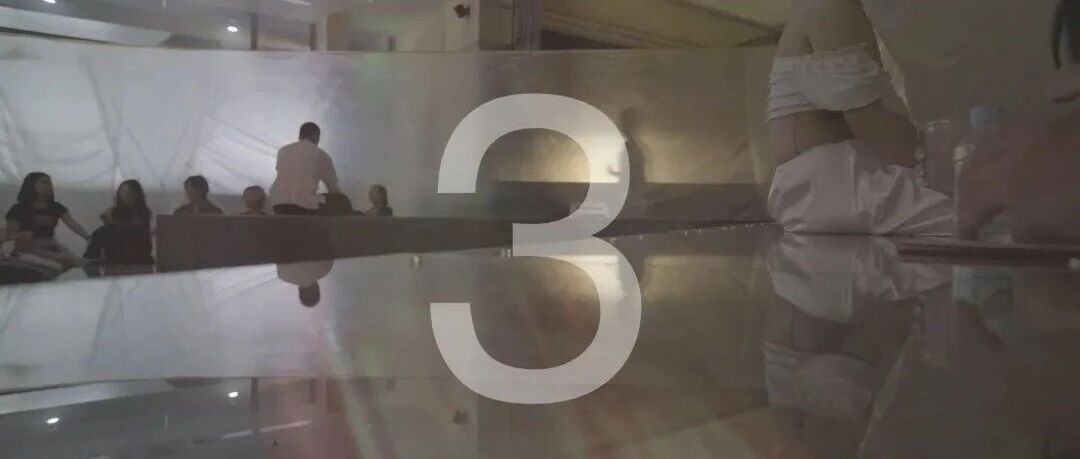
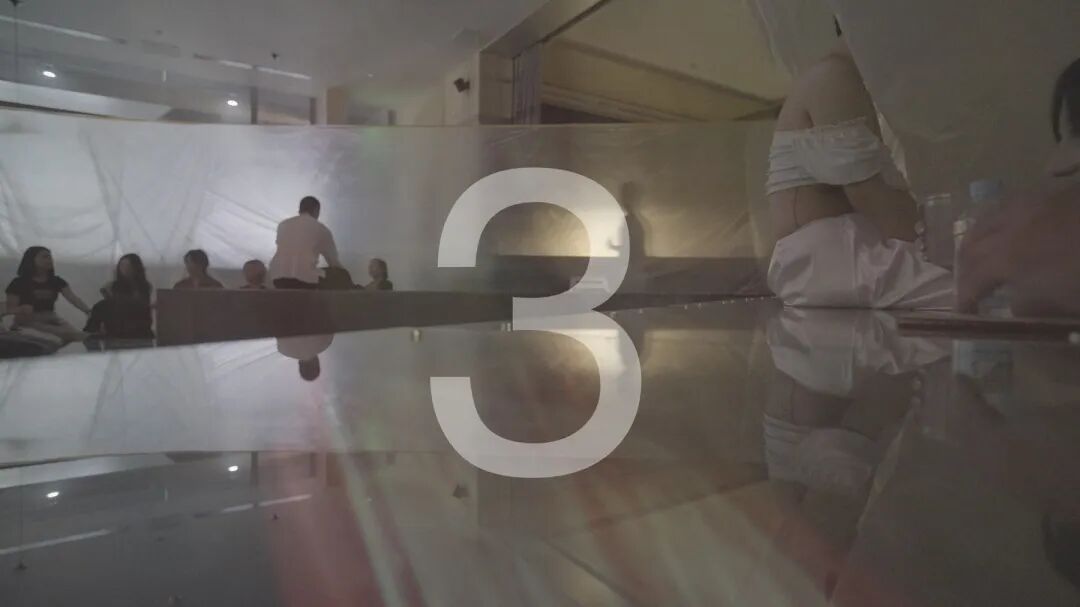
After recognition fails, the audience will naturally search for another way to place things: if the eyes cannot return the self, at least time should give the event order. Yet the film does not hand time over to a stable explanation. The number "3" suddenly casts a game rule into public space, and the characters' relations seem to be brought into the next round, but the frame does not immediately close the previous round's emotion; the public waiting looks like a new stage, yet still carries bodily pressure left unresolved from before; by the end, the credits and format turn the scene into a rewatchable archive, but the archive still does not completely close the scene.
This can of course be understood as ordinary narrative suspension: the film deliberately withholds sequence and keeps the audience confused. But this article's judgment must be narrower: the key is not simply that "time is hard to understand," but that time no longer provides a reassuring exit here. It cannot find a cause for failed intimacy, cannot draw a clear boundary around public performance, and cannot settle the event once and for all through the end-credit list.
The audience's urgency to decide "what exactly happened first" is often not only for the sake of understanding the narrative, but also for placing pressure within a manageable order.
The film refuses to hand over that exit.
Thus time preserves event pressure without taking on final explanation.
3. Sound: The Frame Cannot Contain the Scene
After the number "3," the film brings the audience into a low, cold-white, almost static public space: a reflective glass table, translucent barriers, audience silhouettes, and placed bodies or clothing together form a performance interface. It looks emptier, more public, and more like a stage that can be watched. But the film does not turn this public space into a place of clear explanation. What it first offers is not a scene fully reclaimed by the characters, but a voiced waiting that has not become sentence: apparatus sound, ambient sound, human voice not yet fully become dialogue, and voices pressing in from off-frame coexist, letting the audience know that the scene is not only inside the frame.
Figure 5.
The publicization of the number "3." A huge translucent number overlays the low camera position, reflective tabletop, white plastic barrier, audience seating, and the white wrapped form on the right, casting the newly named game rule into public space.
This image does not prove that "the film is divided into chapters"; it proves that a private game rule has been projected onto a public interface visible to the audience.
12
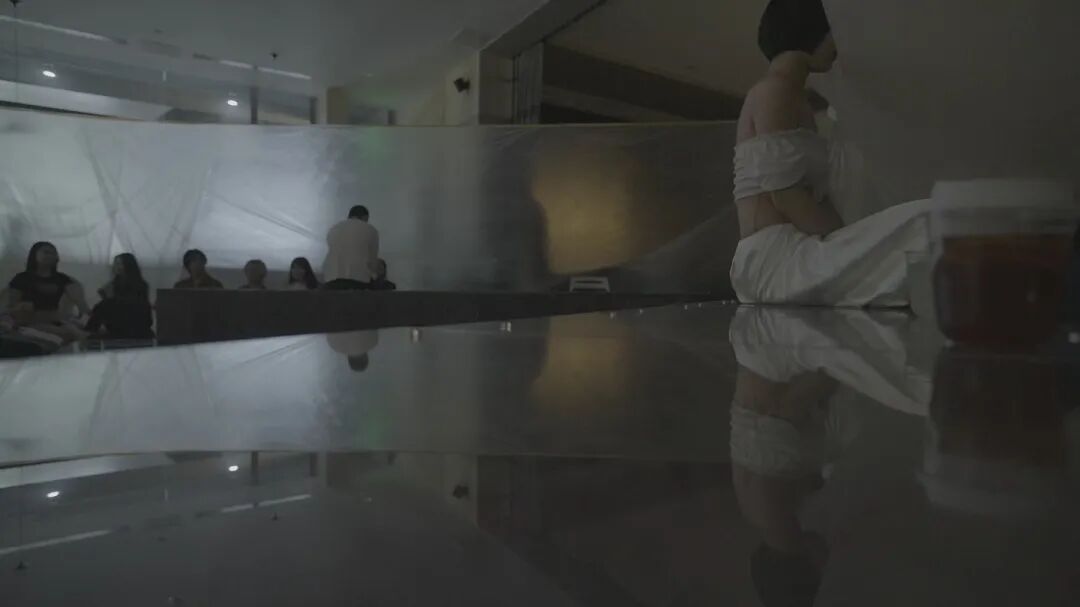
The frame maintains the stability of public space, yet sound repeatedly reminds us that this space is not self-sufficient. It is pierced by voices from elsewhere, noise, apparatus positions, and off-site conditions. The sound here is not "background atmosphere," nor does it merely add tension to the image. It is more like a system for redistributing the scene: some sounds take the audience toward backstage, some temporarily disable character language, and some make the public space look like an interface waiting for instruction. The current frame cannot prove that the scene is only here; sound turns the scene into a space continuously opened by elsewhere.
Figure 6.
A single frame of public waiting. The low camera position, reflective floor, white barrier, audience seating, and white wrapped form on the right turn the scene into a performance interface that has sound but has not been gathered by character speech.
This image does not prove that "the frame is quiet"; it proves that the more stable the frame is, the more sound can take over the scene.
12
Figure 7.
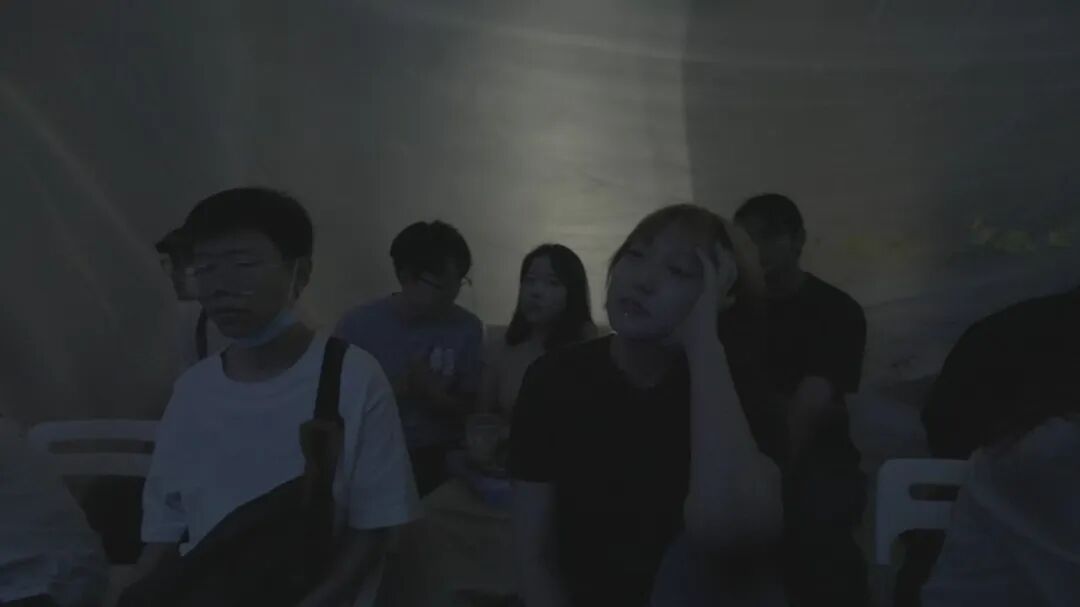
The audience is seen. Public waiting is not only characters being watched by the audience; it also makes the audience, in smoke, projection, and cold light, into a group of bodies inside the image.
This image does not prove that "there is an audience at the site"; it proves that the film also places the audience inside the visible structure.
The most piercing thing in the sound line is not loudness, but that blankness cannot be naturally preserved. After Jiarui says "my mind is blank," Amon immediately says, "you missed so many words"; after Jiarui says "I / don't want to speak," the scene does not stop, but passes through stones, Xu Jinjiang, white cloth, and "do you need me to say it for you," finally landing on an extremely brief "say." This word cannot be written as full authorization, nor can it erase the preceding refusal. It is more like a very narrow, very dangerous incision
when a person cannot speak, can sound still continue? If it continues, who is speaking? If it does not continue, does the scene collapse?
14
This is also where this article least wants to turn the film into pure theory. Because what truly stings here is not the word "intersubjectivity," but a more everyday and harder-to-bear experience: sometimes when we cannot speak, that does not mean there is nothing; but when others speak for us, that does not mean they own us. The film places these two dangerous actions against each other, making care and occupation share the same sound channel.
4. Camera: The One Who Watches Will Also Be Seen
After sound opens the frame, the film pushes the viewing conditions that had been latent all along to the front of the image. Another camera is captured; the camera changes from recording condition into object of view; characters identify the camera, and gazes also turn toward the lens. This detail can of course be misread as ordinary exposure of a film set, or even as a continuity error or meta-cinematic amusement. But in this film, it is not an isolated joke, nor simply self-reference. Because after the camera enters the frame, the direction of characters' speech, the orientation of bodies, and the pressure of future material all begin to gather near the lens; the viewing machine can no longer hide in a transparent position.
In the traditional sense, the camera is like a window: the scene is inside, the audience is outside, and the camera transparently delivers the scene to the audience. But here, the camera is no longer transparent. It is not only a position of "looking," but also an object "looked at"
not only a recorder, but also a receiving position that may be jointly addressed by speech, gaze, and future rewatching.
The cigarette-question section makes this especially clear: the question does not directly establish the audience as recipient, nor does it make the photographer the sole respondent; it simply makes "who will respond" unstable.
Precisely because this "you" cannot be stably received by anyone, it truly enters the unowned second person.
Figure 8.
The camera enters the frame. After another camera is filmed, the viewing machine is no longer a transparent condition, but a body seen by the scene, identified by the characters, and pulled into relation by the pressure of future material.
This image does not prove "set exposure"; it proves that the recording apparatus has been pulled back from behind the scenes into the relation itself.
13
Figure 9.
The body delivers itself toward the lens. The characters do not only speak to each other; they also deliver language, complaint, and the pressure of future material toward the camera and toward the unstable "you" behind the lens.
This does not prove that "the characters look at the camera"; it proves that the space behind the lens has also begun to bear the characters' delivery.
Figure 10.
The cigarette question. After Jiarui leaves, Amon remains in the room searching for a position that can respond; "do you have a cigarette?" may pass through the camera, the camera operator, an off-screen position, or may belatedly brush the audience.
This image does not prove that "someone borrows a cigarette"; it proves that an everyday question can call the back side of the camera into being as a responsive "you."
13
7. What Would an Objector Say?
A conservative reader could quite reasonably object: this is merely meta-cinema, self-reflexive imaging, rehearsal documentary, exposure of the set, and the instability of handheld photography; it does not require such complex concepts as "with-you imaging" or "unowned second person." The camera entering the frame can be called set exposure; a figure looking toward the lens can be called self-reflexive play; the cigarette question can be called a slice of life; the end credits can be called ordinary archiving. This is of course a necessary question, because it reminds us that we cannot automatically absorb every instability into theory.
This article disagrees with that simplification not because those counter-readings are wrong, but because they are not enough. The pressure the film truly keeps producing is not merely that "the camera is seen," but that each seeing cannot stably return to an owner. The eye section is not only about failed intimacy, but about the fact that the other's eyes also cannot return me to myself; the cigarette question is not only set-life detail, but an everyday request that connects the space behind the camera, the door, the window smoker, and the backstage; the white cloth section is not only occlusion, but the more unreadable the face becomes, the more sound must work on behalf of the unreadable area; the end is not only a list of names, but turns a still-leaking scene into a format handed over to future rewatching.
Therefore, "unowned second person" is not a high-level label attached to the film, but the name for the pressure that remains after these counter-readings: someone is called, but is not the owner; a position is effective, but cannot be taken away by anyone; viewing has occurred, but it cannot possess. Put more plainly: the film lets you see, then asks you to stop.
8. How the Ghost Appears: The Audience Not Yet Arrived Has Already Been Placed in the Scene
At this point, the film's hauntology can be stated more clearly. The "ghost" here is not a ghost, nor a gloomy atmosphere. It is more like belatedness: when the film is being shot, the future audience is not yet there; but once the camera starts, the person who will later watch, rewatch, judge, misread, and write this article has already been placed in the scene in advance.
Therefore, this article does not call every afterimage, dim light, memory, or instability a ghost. The minimum standard is narrower
only when a viewing position truly affects the scene, yet cannot be stably returned to a single character, photographer, audience, or archival subject, does this article call it hauntology.
A ghost is not a beautiful atmosphere, but an effective position that cannot find an owner.
There are at least three layers here.
The first layer is temporal dislocation
the scene is still happening, yet the position of the future viewer has already been opened in advance; the figures are still speaking, yet the pressure of later rewatching, judgment, and quotation has already entered the voice.
The second layer is media apparatus
the camera, live sound, end-credit list, and rewatchable file format repeatedly hand the scene elsewhere.
The third layer is viewing ethics
later viewers are indeed called by the film, but they cannot turn themselves into owners of the scene simply because they belatedly understand something.
This is why
Shoot Self with You
is the key to the entire film.
Shoot
is sending
Self
is the self that appears only after being sent
With You
is the relational condition from which it cannot separate. The ghost does not come from some mysterious object
but from the dislocation among these three: the image has already been sent, self has already left itself, you has already been called, but no one can finally receive all of this.
Technology is not an external tool either, but the apparatus that keeps this dislocation running.
Human Surrender, meanwhile, shows how this hauntology becomes a human condition. The human body is borrowed by role, human viewing is borrowed by the future, the human voice is borrowed by backstage, the human name is borrowed by the end credits, and human judgment is continually deferred by rewatching and research. The human remains, but no longer stands at the center; the human still happens, but the mode of happening no longer belongs only to humans. This "technical hauntology" is therefore not an all-purpose concept, but the intersection of three things
time summons future viewers in advance; media hand the scene elsewhere; ethics require later viewers not to possess the scene that has been handed over.
This hauntology distinguishes the film from ordinary films of nostalgia or recollection. It does not hand an already past world to later viewers for retrospective recognition, but lets a scene still in progress be changed by future viewing from the very beginning. When the figures speak, the camera is already on; when actions are not yet complete, future material is already present; before relations have truly left the body, they have already begun to be shared by sound, material, audience, and end-credit format.
The film's afterlife is not an aftershock that appears only after the end, but a structure generated in advance within the conditions of rehearsal, filming, and viewing.
Therefore, Human Surrender can also be understood as a ritual before death. Here "death" is not biological death, nor does it write pain or departure directly as real-world harm. More precisely
it points to the finite life of a temporary world: it is built, rehearsed, used together, pushed toward its final moment, and while still alive begins generating its own remains.
Its ritual quality does not come from religious procedure, but from a continuous liminal state: people are still present, relations are still happening, the camera is still recording, the audience is still being drawn in, yet this world already knows that it cannot continue indefinitely.
Figure 11.
A single frame from the end archive. The list of names presses over the afterimage of the scene; the ending does not settle the event, but continues to transfer people, materials, site, and viewing into a format that can be rewatched.
This image does not prove that "the film has ended"; it proves that ending itself also hands the scene over to future rewatching.
9. Conclusion: Surrender Means Acknowledging That I Am Not the Final Owner
Now the two titles can be brought back together
Shoot Self with You
= self cannot be imaged alone.
Human Surrender = human beings can no longer pretend that self can be imaged alone.
The English title compresses the film into an action: a person cannot film themselves into being only by themselves; they must pass through a "you." The Chinese title expands that action into a common condition: after acknowledging this, human beings can no longer pretend they fully own body, relation, viewing, sound, ending, and archive.
They must surrender, or more precisely, must acknowledge that they have already been disassembled within relations, images, sound, performance, and archive.
So surrender is not admitting defeat.
Surrender means giving up the most stubborn fantasy: that I can state what happened clearly, see it through, hold it securely, and close the case
. The film tells us again and again: no. You can approach, but approach will not let you own; you can rewatch, but rewatching will not bring that moment back in full; you can preserve, but preservation is not settlement.
This does not make people disappear. On the contrary, it is within this incompletion that people become more real. Human beings are no longer complete owners, but they remain bearers of the scene; they cannot fully own the body, yet the body still makes the event irreplaceable; they cannot fully own viewing, yet viewing still has to bear ethics; they cannot fully own the archive, yet the archive still requires later viewers to preserve, verify, and stop.
Therefore, non-sovereign spectatorship, in the simplest terms, is the capacity to stop after seeing. It is not seeing a little less, nor being a little more indifferent
but stopping at the moment when possession is most desired
I have been called by the film, but I cannot decide on the film's behalf; I have been pricked by a scene, but I cannot rewrite that prick into off-film fact; I have understood something, but I cannot disguise that partial understanding as final explanation.
So Human Surrender is not an alliance of losers, but a group of people who have finally acknowledged "I am not the final owner." They do not surrender because they lack force
but because they have finally seen
once force occurs, it no longer belongs only to the person who emitted it; once feeling occurs, it no longer belongs only to the person who felt it; once an image occurs, it no longer belongs only to the person who shot it; once a scene occurs, it no longer belongs only to those who were present.
This is the true relation of mutual translation between Human Surrender and
Shoot Self with You
. The English title names the action; the Chinese title names the fate. The English title says: one must be imaged with you. The Chinese title says: those who acknowledge this form the surrender faction. Together, they constitute the film's deepest haunting mechanism
a person tries to film themselves into being, only to discover that they can appear only among others, lens, future, and archive
a spectator tries to see this, only to discover that they have already been seen by it, and after seeing, they must learn to stop.
About the Author
He Fa, founder of P4 Theater, image-maker, and writer, has long created and researched around the relations among film, performance, live site, technology, and archiving. Human Surrender is his ongoing film project on handheld photography, the rehearsal site, bodily positional shifts, second-person spectatorship, and how technology produces a sense of haunting; in this project, the camera is not only a recording tool, but also an apparatus that brings people into relation, hands the scene over to the future, and re-exposes the viewer.
He Fa's writing is concerned with a question that repeatedly returns: how do images change the relation between people and the live situation? When is viewing no longer merely viewing? When does recording become part of the event? Why does a scene that has already ended continue to speak through archive, rewatching, misreading, memory, and research? It is from within those questions that this article approaches Human Surrender /
Shoot Self with You
as a provisional crystallization in theory.
Notes
1. For André Bazin's photographic ontology, the long take, and the preservation of cinematic reality, this article uses a conceptual interface rather than sentence-by-sentence citation. Bibliographic information may be found on the University of California Press
What Is Cinema? Volume I
(plain URL: https://www.ucpress.edu/books/what-is-cinema-volume-i/paper)
Publication page.
2. Roland Barthes's discussion of photography, mortality, and the punctum is used here only as an interface for "how photography lets living people enter a spectral state." Bibliographic information appears on the Macmillan / Hill and Wang
Camera Lucida
(plain URL: https://us.macmillan.com/books/9780374532338/cameralucida/)
Page.
3. Jacques Derrida's hauntology and archive theory refer respectively to
Specters of Marx
and
Archive Fever
. Publication information for the former appears on the Routledge page; English bibliographic information for the latter appears in relevant University of Chicago Press and library records. This article does not write the "ghost" as an object, but as a relation of time and address.
4. Vivian Sobchack's film phenomenology reminds us that film experience involves an embodied reversible relation between viewer and film. Bibliographic information appears on the Princeton University Press
The Address of the Eye
(plain URL: https://press.princeton.edu/books/paperback/9780691008745/the-address-of-the-eye)
Page.
5. Michel Chion's theory of sound and image shows that sound changes the perceptual structure of the image, rather than merely supplementing the frame. Bibliographic information appears on the Columbia University Press
Audio-Vision: Sound on Screen
(plain URL: https://cup.columbia.edu/book/audio-vision-sound-on-screen/9780231185899/)
Page.
6. Rebecca Schneider's discussion of performance remains and reenactment provides an interface for this article's treatment of "the rehearsal site already beginning to generate an afterlife." Bibliographic information appears on the Routledge
Performing Remains
(plain URL: https://www.routledge.com/Performing-Remains-Art-and-War-in-Times-of-Theatrical-Reenactment-1st/Schneider/p/book/9780203852873)
Page; DOI
10.4324/9780203852873
(plain URL: https://doi.org/10.4324/9780203852873)
.
7. Ariella Aïsha Azoulay's discussion of photography's public relation and the position of the addressed can provide a political-ethical background for this article's "image address." Bibliographic information appears on the Zone Books
The Civil Contract of Photography
(plain URL: https://www.zonebooks.org/books/6-the-civil-contract-of-photography)
Page.
8. Avery F. Gordon's social theory of haunting provides a methodological reminder for this article's refusal to reduce ghosts to atmosphere or apparitions. Bibliographic information appears on the University of Minnesota Press
Ghostly Matters
(plain URL: https://www.upress.umn.edu/9780816654468/ghostly-matters/)
Page.
References
1. Azoulay, Ariella Aïsha.
The Civil Contract of Photography
. New York: Zone Books, 2008.
Publisher record
(plain URL: https://www.zonebooks.org/books/6-the-civil-contract-of-photography)
.
2. Barthes, Roland.
Camera Lucida: Reflections on Photography
. Translated by Richard Howard. New York: Hill and Wang, 1981. Current edition record
Macmillan
(plain URL: https://us.macmillan.com/books/9780374532338/cameralucida/)
.
3. Bazin, André.
What Is Cinema? Volume I
. Translated by Hugh Gray. 2nd ed. Berkeley: University of California Press, 2004.
Publisher record
(plain URL: https://www.ucpress.edu/books/what-is-cinema-volume-i/paper)
.
4. Chion, Michel.
Audio-Vision: Sound on Screen
. Edited and translated by Claudia Gorbman. 2nd ed. New York: Columbia University Press, 2019.
Publisher record
(plain URL: https://cup.columbia.edu/book/audio-vision-sound-on-screen/9780231185899/)
.
5. Derrida, Jacques.
Archive Fever: A Freudian Impression
. Translated by Eric Prenowitz. Chicago: University of Chicago Press, 1996.
6. Derrida, Jacques.
Specters of Marx: The State of the Debt, the Work of Mourning and the New International
. Translated by Peggy Kamuf. New York: Routledge, 1994. Current Routledge Classics record
Routledge
(plain URL: https://www.routledge.com/Specters-of-Marx-The-State-of-the-Debt-the-Work-of-Mourning-and-the-New-International/Derrida/p/book/9781041083689)
.
7. Gordon, Avery F.
Ghostly Matters: Haunting and the Sociological Imagination
. Minneapolis: University of Minnesota Press, 1997; new ed., 2008.
Publisher record
(plain URL: https://www.upress.umn.edu/9780816654468/ghostly-matters/)
.
8. Schneider, Rebecca.
Performing Remains: Art and War in Times of Theatrical Reenactment
. London and New York: Routledge, 2011.
Publisher record
(plain URL: https://www.routledge.com/Performing-Remains-Art-and-War-in-Times-of-Theatrical-Reenactment-1st/Schneider/p/book/9780203852873)
DOI
10.4324/9780203852873
(plain URL: https://doi.org/10.4324/9780203852873)
.
9. Sobchack, Vivian.
The Address of the Eye: A Phenomenology of Film Experience
. Princeton: Princeton University Press, 1992.
Publisher record
(plain URL: https://press.princeton.edu/books/paperback/9780691008745/the-address-of-the-eye)
.
Human Surrender Archive
This is a recruitment text for Human Surrender
Last Rehearsal | Human Surrender: The Last Rehearsal
Public Art Performance | The Beginning and End of Human Surrender: Will the Aliens Come Again?
Human Surrender | This Is the Last Rehearsal! It Is Real! It Is All Real!
Human Surrender | Let me become whale fall; I have too little, too little
Human Surrender A |...and then you became a little girl again...
Human Surrender R | "Beijing's First Experiment"
Human Surrender D | Once More
Human Surrender K | Eardrum Ripper
Human Surrender S | Everything Is a New Dimension
P4 Finale | The Last Rehearsal Performance | Love, Death, Human Surrender
Human Surrender | I Disappeared - After Performing The Last Rehearsal
No Longer Loyal to Wholeness - A Long Review of the Final Cut of Human Surrender
How Words Betray People - The Original Language Structure of Human Surrender
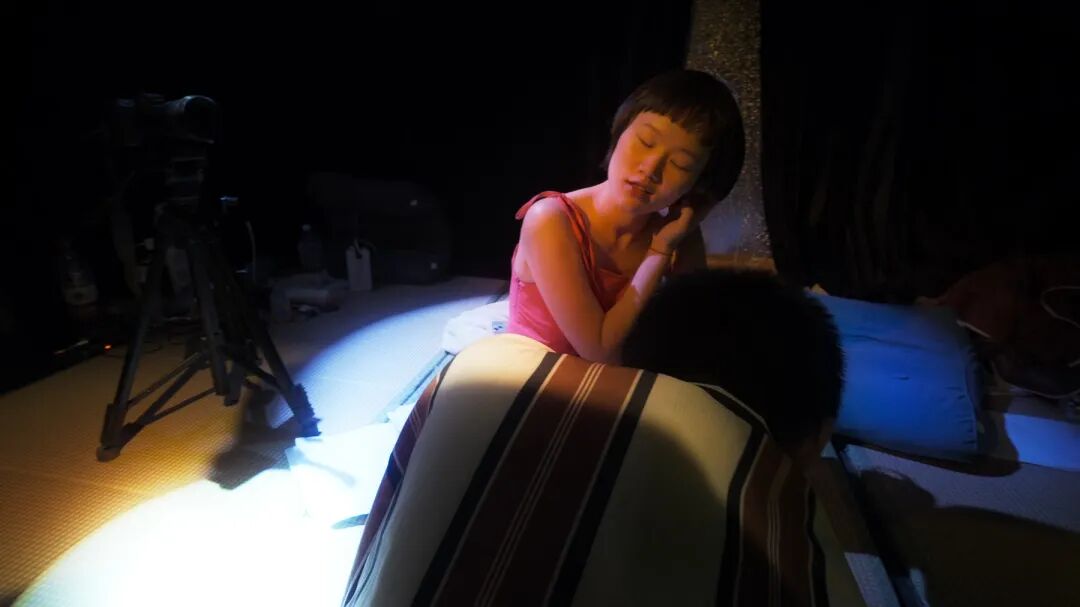
Human Surrender: A "Divine Work" as Live-Site Divination
Why the Person Holding the Camera Must Also Surrender!
Intimacy Does Not Belong to Two People | Human Surrender