
PSYCHOANALYTIC FIELD ATLAS
Someone Is Finally There: Ofra Eshel's "Analytic Unity" and the Ontological Turn of psychoanalysis
PRESENCING / WITHNESSING / TRANSFORMATION IN O
FIELD NOTE
When explanation fails to reach the pain, what is left psychoanalysis?
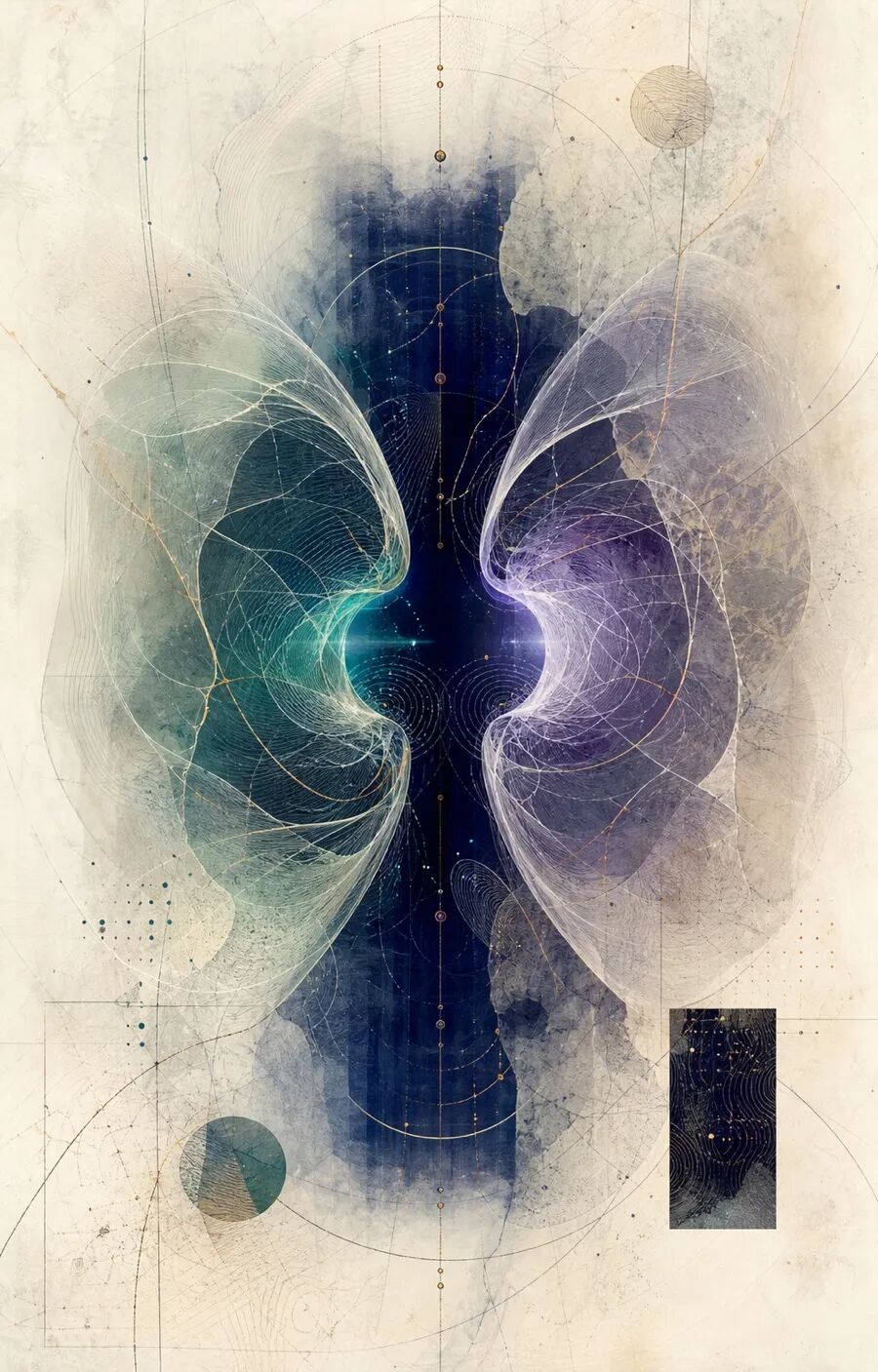
VISUAL FIELD / Non-Human Atlas
Figure 01|Analytical union is not the fusion of two people, but a temporary field of experience: two non-personal transparent fields bending towards the same dark center, but without occupying each other.
psychoanalysisThe most fascinating promise was once "making the unconscious conscious." A symptom is not meaningless, it has a history, it has desires, it has defenses, it has repetitions. If a person doesn't know why he is in pain, analysis will find out the obscured road bit by bit.
But Ofra Eshel is
The Emergence of Analytic Oneness
The question raised in is deeper, and more uncomfortable: if some suffering is not "something that is not yet understood" at all, but is "a catastrophe that has never been truly experienced by a subject," how useful is explanation?
What this book really wants to rewrite is not just a treatment technology issue, but the underlying image of psychoanalysis.
It pushes psychoanalysis from the discipline of "explaining hidden meanings" to the discipline of "making the experience that failed to happen finally happen".
In other words, Eshel is not discussing how the analyst can understand the patient more intelligently, but rather whether the analyst can be real enough, bear enough, be there enough where the patient can least exist.
that's what she calls
presencing
、
withnessing
and
analytic oneness
. These words may seem abstract, but they collectively point to a very concrete clinical reality: some people do not lack explanations, but never have a psychological environment that can survive with them during critical pain.
FIELD NOTE
Conclusion of this article
CORE ARGUMENT / Conclusion of this article
First, Eshel's "analytic unity" is not a gentle version of empathy, but an existential turn: the core of therapy shifts from "knowing the meaning of pain" to "making pain something experienceable."
Second, she inherits Winnicott's idea of "early collapse," arguing that many deep traumas are not the forgotten past, but disasters that have not yet become experienced; it keeps returning because it has never really passed.
Third, she uses Bion's
O
understand treatment as
transformation in O
Not to turn the unknown into knowledge, but to allow the emotional reality that cannot be fully known to gain a bearable form between two people.
Fourth, this theory is the most powerful and dangerous. It can penetrate the clinical darkness where explanations fail, or it can slip into fusion fantasies, therapist narcissism, boundary loss, and the obscuration of hurtful realities. To read Eshel, therefore, is to read both her courage and her risk.
FIELD NOTE
1. The End of Explanation: When Pain Has Not Become "My Experience"
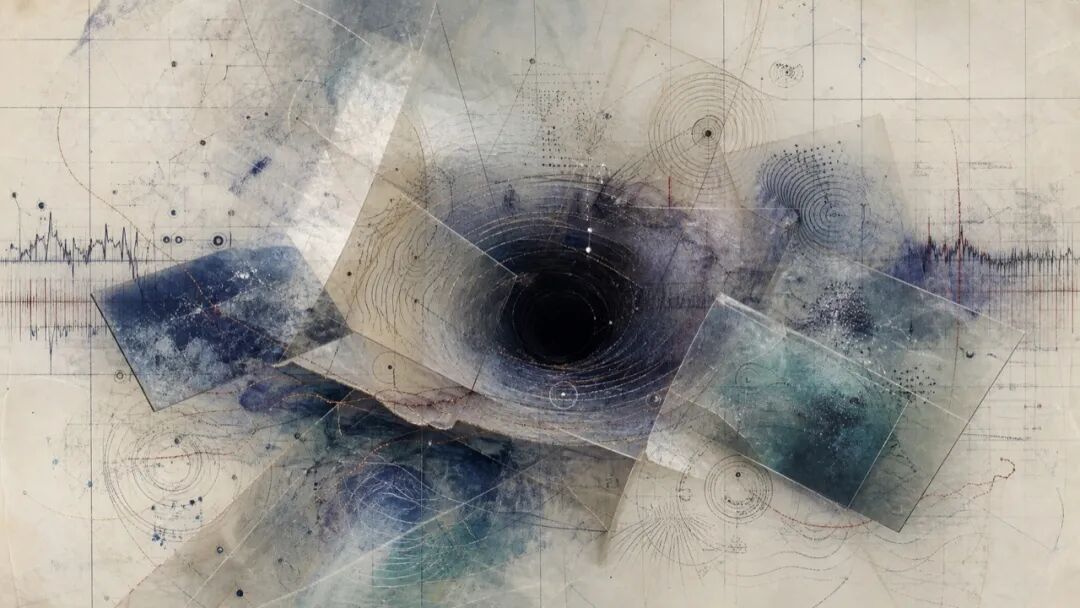
VISUAL FIELD / Non-Human Atlas
Figure 02 | "Unexperienced collapse" is not a forgotten content, but a dark well that has not yet entered the subject's experience. The images use black holes, sound waves and shattered panes of glass to represent a past that is not yet a thing of the past.
Traditionalpsychoanalysis is great at asking the question: What does this symptom mean?
Dreams, slips of the tongue, repeated relationships, physical symptoms, silence, resistance, are all put into webs of meaning. The job of analysis is to translate, piece by piece, the desires, anxieties, defenses, and early relationships underlying the symptoms. This tradition is extremely powerful because it rejects pain as something accidental, absurd, and purely physiological. It insists that human suffering has structure.
But Eshel is concerned with a different kind of pain.
This pain is not because the meaning is too deep to be seen, but because when it occurs, there is simply no subject formed enough to say: "This is what I am experiencing." It is not repressed into the unconscious, but has not yet entered experience.
Not forgotten, but never established as "my past".
Winnicott said that the collapse the patient fears has often already occurred. It sounds contradictory: why be afraid of it if it has happened? It is this contradiction that Eshel captures. When collapse occurs, the subject is not yet capable of experiencing it, so it does not become a thing of the past. It stops in front of the patient's life like a future event, repeatedly approaching, repeatedly threatening, and repeatedly asking to be experienced.
This is the scariest thing about deep trauma.
People are not remembering something, but are being chased by something they have never experienced before.
It does not appear as memory, but as emptiness, deadness, insomnia, physical disintegration, perverse actions, suicidal despair, the inability to love and to be loved.
So Eshel said, psychoanalysis can't just ask "What does it mean?" It must also ask: Is it possible for this to finally be experienced? If a person did not have the psychological environment to withstand it, can today's therapy provide a new environment in which that unexperienced disaster becomes experienced for the first time?
FIELD NOTE
2. From explanation to presence: presencing is not "accompanying you"
The first keyword for Eshel is
presencing
. This term can easily be misread as "the therapist needs to be present," "be there for the patient," or "be more empathetic." But she had something more to say than that.
presencing
Not posture, not technique, not gentle persona. It refers to the analyst putting his or her own psychological existence into the patient's experiential world and becoming a supporting function that can be used in the treatment field.
The analyst does not merely hear the patient's pain, nor does he merely understand the patient's symbolism, but remains alive in the vicinity of the patient's painful area.
"Being alive" here does not mean being emotionally intense, but rather not retreating. The patient brings dead silence in, the analyst pushes it out without explanation
The patient brings in the hole, and the analyst does not rush to fill it; the patient brings in the state of being unable to think, feel, or believe in any relationship, but the analyst can still be there and bear the intrusion of this state into himself.
This is Eshel's rewording of psychoanalysis neutrality.
The analyst is no longer an observer from the outside or someone who cuts into the patient's mind with the tools of interpretation. The analyst himself becomes part of the therapeutic reality. Whether certain experiences of the patient can occur depends on whether the analyst actually enters that field of experience and does not disappear there prematurely.
This is extremely demanding for analysts. Because the truly difficult clinical moments are often not when patients speak out complex materials, but when patients throw themselves into the treatment room in a meaningless, lifeless, hopeless, and languageless state. Ordinary explanations are often too quick here. It is like building stairs in a place where there is no ground yet. The structure is beautiful, but there is no landing point.
The radical thing about Eshel is
She believes that the deepest healing is not to explain, but to finally let a person no longer be alone in that groundless place.
FIELD NOTE
3. From witnessing to co-presence: the radical nature of withnessing
The second keyword is
withnessing
. it's obviously responding
witnessing
that is, "witness".
Of course testimony is important. A pain seen, acknowledged, proven not to be an illusion has healing power in itself. One of the most painful experiences for many trauma survivors is that no one believes, no one hears, and no one testifies.
But Eshel believes that in the deepest clinical areas, witnessing remains at a distance. A witness stands somewhere, sees your pain, and acknowledges that it happened.
withnessing
This drags the analyst into a more dangerous position: not to see the pain, but to be with the pain; not to bear witness to the pain, but to bear it with the patient where the pain cannot be borne by the patient alone.
This is not about suffering for the patient, nor is it about possessing the patient's pain. It is more like the analyst's psychology temporarily becoming an extra organ, so that the patient's unprocessable experiences can be accommodated, felt, and lived out bit by bit between two people.
This idea is similar to Bion's container theory, but Eshel takes it even further. Bion says that the baby throws indigestible beta elements to the mother, who converts them through reverie into thinkable alpha elements and returns them to the baby. Eshel then asked: What if certain experiences are too early, too dead, too intangible, not even to the point of being "transformable into thoughts"?
At this point, the analyst cannot just understand the patient's projections. The analyst must allow himself to be drawn into that unthinking darkness and maintain some kind of usable life there.
withnessing
This is the meaning of: the analyst is not an external processing machine, but a shared presence.
FIELD NOTE
4. "Analytical unity" is not a merger, but a temporary field of experience
Eshel's most controversial concept is
analytic oneness
also known as
two-in-oneness
。
The word sounds dangerous because it conjures up images of the abolition of boundaries, the fusion of subjects, the therapist and patient becoming one. Eshel is certainly aware of this danger. In fact, it is only by acknowledging this danger that her concept can be truly understood.
analytic oneness
Not a merging of reality, nor a therapist crossing the line into the patient's life. It describes certain extreme clinical moments when patient and analyst form a field of experience that cannot be easily separated. This field is not "your psychology plus my psychology", but a temporary common psychological unit. It allows experiences that would otherwise not take place within the patient to finally take place in the analytic relationship.
It can be understood this way: In an ordinary relationship between two people, there is an "I" and a "you", and the two people respond to each other.
In the deep area that Eshel discusses, the problem is not just "how do I treat you", but the patient's "I" itself has not yet been established in certain disasters. Therefore, treatment must first form a more original bearing field, so that "I am experiencing" may appear.
That's why she takes psychoanalysis to an existential level. Therapy is not about first having a complete subject and then the subject understanding the content.
Therapy sometimes involves creating a place for experience to take place where the subject is not yet complete.
But it must be made clear: if this "unity" loses its boundaries, it will turn into a disaster. It is not a mystical union, a therapist's fantasy of omnipotence, an "I know you better than you" possession, or any justification for ethical transgression. It can only hold within a strict analytical framework: time, expense, location, silence, explanation, moderation, responsibility, supervision and self-doubt cannot be eliminated.
real
analytic oneness
It is not to cancel two people, but to allow a third field of experience to briefly appear on the premise that the two people still bear their respective responsibilities.
FIELD NOTE
5. Bion's O: Not to know, but to be
VISUAL FIELD / Non-Human Atlas
Figure 03 | Bion's O is not an object of knowledge, but changes the emotional reality of the observer. The measurement lines in the image curve around the black center, suggesting that the analyst is not outside reality.
Eshel's ability to organize these dangerous concepts relies heavily on late Bion.
Bion distinction
K
and
O
。
K
It is knowledge, something we can know, understand, and express.

O
It is the ultimate emotional reality, a reality that cannot be completely captured or completely objectified. face
O
the analyst cannot just know it, but must somehow become it, bear it, be changed by it.
This is what Eshel calls
transformation in O
meaning.
Common therapeutic changes can often be understood as
transformation in K
The patient goes from not knowing to knowing, from confusion to understanding, from symptoms to meaning. But Eshel believes that the deepest change is not a change in knowledge but a change in the state of being. A breakdown that has never been experienced does not automatically translate into an "early maternal failure" just because it is explained away. It must somehow be relived in therapy.
In other words, the patient does not get a correct theory about the trauma, but in the analyst's presence he is finally able to be in the reality of the trauma without once again being completely isolated, completely disintegrated, and completely disappeared.
This is why Eshel puts Winnicott and Bion together. Winnicott gives her the problem of "unexperienced collapse": some disasters occur without the subject being present. Bion to her
O
direction
In the face of emotional realities that cannot be intellectualized, therapy cannot stop at the level of explanation. Together, the two form Eshel's core proposition: the deepest change of psychoanalysis is when the unexperienced becomes experienced in the shared presence.
FIELD NOTE
6. Black holes, sleep, perversions and dreams: a clinical map of the entire book
Eshel's book is not abstract metaphysics. She repeatedly proves her concepts through extreme clinical material.
The "black hole" patient is one of the most important images.
The so-called black hole does not mean that the patient has an explainable gap, but that the entire relationship space is sucked into the dead silence.
. What the patient brings is not a clear conflict, but a devouring sense of lifelessness. If the analyst only explains, he will often be sucked into a sense of futility; if he rushes to make the patient "react", he will repeat the abandonment of the early environment.
The key to treatment is whether the analyst can stay alive in the gravity of the black hole, so that the dead silence is no longer just swallowed up, but becomes something that can be felt together.
The chapter where the analyst falls asleep in therapy is also poignant. Often the analyst falling asleep is seen as a mistake, a countertransference problem, a professional failure. Eshel does not excuse this situation, but she suggests a deeper understanding: sometimes the patient's dissociations, interruptions in consciousness, and psychological voids pass into the analyst's body.
The analyst's sleep is not simply absent, but may be the physical manifestation of some unthoughtful experience in the therapeutic field.
The point is not that "sleeping is a good thing"
Rather, it depends on whether the analyst can acknowledge, think about and take on this matter again after waking up, so that the originally isolated dissociation can enter a common field.
Seriously perverse chapters push the theory to the ethical edge. Eshel objects to viewing perversions solely as sexual deviations or Oedipal problems. What she saw was
A survival organization: When the inner sense of death is unbearable, people may use extreme physical, ritual, and sexualized repetition to resist mental breakdown.
Perversion is not the secret to happiness but may be the last device to avoid annihilation.
But here also emerges the most important warning of the book. In her work on sex offender material, Eshel admitted that she had penetrated deeply into the darkness of her patients without fully feeling the pain of her victims at the same time. This admission is extremely critical. it explains
withnessing
Not naturally correct. Being together brings understanding, but it may also create blind spots; going deep into the darkness can touch the patient's place of survival, or it may obscure the location of the injured person.
As for the chapter on telepathic dreams, it should be read with even greater caution. Whether readers accept the term "telepathy" or not, what is really worth grasping is its clinical structure: some patients encountered a care environment of "physical presence but psychological absence" in their early years. The mother is there, but not really there. So when the analyst becomes emotionally distant in therapy, the patient's early catastrophes are activated, and the dream acts like a boundary-crossing search mechanism, desperately confirming: Are you still there? Did you leave again?
This is not to ask us to believe in the supernatural, but to remind us that for some patients, the psychological absence of others is not a trivial matter, but a repetition of the collapse of the world.
FIELD NOTE
7. Compassion is not kindness, but shared suffering.
Eshel gets closer and closer to one word in the second half of the book: compassion.
Chinese is often translated as compassion, pity, and sympathy. But in Eshel's case, it's not a gentle moral sentiment, but closer to suffer-with
Suffer with others.
Mercy can stay high. A man stood on the shore, saw people drowning in the water, and said "I understand you are in pain." It may be sincere, but it's still safe. What Eshel calls compassion is even more dangerous: the analyst must allow the patient's pain to hit him or her, allowing himself to enter into that pain field to some extent.
This is not martyrdom or a show of self-sacrifice. True shared suffering does not require the analyst to lose judgment. Rather, it requires the analyst to retain an analytic function even after being struck by pain. The analyst can neither explain coldly nor indulge in empathic self-movement. She must maintain an extremely difficult tension between being involved and being able to think.
The most touching thing about Eshel is that she does not write about treatment as a triumph of light. Many times, therapy begins with being able to enter into a sense of death with the patient. It's not about explaining away death, it's not about telling patients "you actually want to live", it's not about trying to prove that relationships can be repaired
Rather, let the dead, unheld, unheard part be endured for the first time in another mind.
This is why her books feel heavy. She wasn't writing about "How psychotherapy can make people better," but instead
When a person has not really existed for too long, how can another person in therapy help him regain the possibility of existence.
FIELD NOTE
8. The real danger of this book
The more powerful the theory, the more rigorously it needs to be read.

Eshel's theoretical dangers are at least four.
First, fusion fantasy.
analytic oneness
It can easily be misread as "the fewer boundaries, the more real". This would destroy psychoanalysis the most basic ethical conditions. True unity is not a transgression of boundaries but a temporary field of experience that occurs within boundaries.
Second, the therapist is narcissistic. The analyst may imagine himself or herself as the only one with access to the patient's darkness, or even turn the patient's suffering into proof of his own "depth." Once this happens
withnessing
It will degenerate from shared suffering to self-sanctification.
Third, the actual harm is obscured. Particularly in material about violence, sexual assault, crime, and abuse, the analyst's understanding of the perpetrator's inner breakdown cannot replace an acknowledgment of the victim's suffering and realistic responsibility. Understanding is not absolution, and being together is not a withdrawal of ethics.
Fourth, evidence discipline is loose. Eshel's language sometimes verges on mystical experience, easily read as "the more unverifiable, the deeper." This is precisely what requires vigilance. Clinical depth cannot cancel reviewability, and theoretical imagination cannot cross factual boundaries.
So the right way to read Eshel is not to worship her radicality, but to preserve her cracks. She is truly important not because she gives us a perfect answer, but because she forces psychoanalysis to a question that cannot be easily answered: When explanations, meanings, relationships, and knowledge are not enough, what is left in therapy?
FIELD NOTE
9. Inspiration for public writing: Don't explain a person's darkness too quickly
The book also has implications for writing outside the clinic, especially how we write about trauma, intimacy, art, and human breakdown.
There is an impulse to explain in much public writing: Why is this person like this? What was his childhood like? What is his desire? What is his pathological structure? Where is the source of his trauma? This explanation is sometimes necessary, but it is also easy to do it too quickly. It turns pain into cases, people into structures, and overwhelming experiences into meanings that readers can consume.
Eshel reminds us: some darkness cannot be quickly translated. When a writer faces pain, the first responsibility is not necessarily to name it, but to maintain a presence that does not steal the pain. It's not about completing the meaning for the person involved, it's not about packaging the wounds into opinions, but it is about retaining the state of "it has not been experienced yet" in the language.
This is important for art criticism, psychoanalysis writing, and intimacy writing. A truly profound article does not explain every pain in an orderly manner, but allows readers to feel that there is a place here that has not yet been fully grasped by experience. Writing is not about illuminating the darkness into knowledge, but about creating a place next to the darkness where you can stay, breathe, and continue to see.
This is also the fundamental difference between Eshel and ordinary psychological chicken soup. Chicken Soup says: You want to be understood, you want to be healed, and you want to come out. Eshel said: It's not that some people can't get out, but that they never really entered the disaster that they should have experienced. Therapy is not about rushing him out, but about finally having someone who can go in with him and not leave him there.
FIELD NOTE
Conclusion: Someone is finally there, but cannot possess it
VISUAL FIELD / Non-Human Atlas
Figure 04 | Withnessing is not about annexing each other, but about two fields sharing a small dark center at the border: someone is finally there, but cannot occupy it.
Ofra Eshel's "The Emergence of Analytical Unity" really proposes an extreme proposition of psychoanalysis
When a person's pain is so deep that there is no language, no memory, no subject, no hope, psychoanalysis what is left?
Her answer is not some more elaborate explanation, not some gentler reassurance, but a way of being: whether the analyst can be there.
There, it is not a bystander; it is not a substitute; it is not a redemption; it is not a possession; it is not a dragging of the patient into the therapist's own meaning system. It means that where the patient is least able to be himself, another person still exists in a conscious, limited, and responsible way, making it possible for the unexperienced breakdown to finally be experienced together.
this is
presencing
The clinical weight is
withnessing
the ethical weight of
analytic oneness
The most moving and dangerous place.
So perhaps the best title for this book isn't "Analytical Unity" but: Someone Is Finally There.
But one last and equally important thing must be added: just because someone is there, it doesn't mean they can occupy it.
psychoanalysisThe deepest power is not to merge two people into one, nor to make the analyst the hero of the patient's darkness. Its deepest power is to form a common field within strict boundaries that can withstand disasters; in that field, things that have never happened as experience finally begin to happen.
It may be at this moment that a person takes possession of his past for the first time. Not because he finally knew the past, but because someone finally experienced the past with him.
Related reading
The Aesthetics of Events: An Analysis of Erika Fischer-Lichte's "The Transformative Power of Performance"
Intimacy does not belong to two people | "Human Surrender"
From a "corpse" to a tablet: How did early Chinese ancestors speak through living people?
Drama is written in the sand.
p4 Contribution|"Crying of the Unpopular"
The Throne of the Seen: A Reconstruction of Lacanian Theater Theory in François Reno's "The Spectator"
"The Grammar of Events: Actor-Generated Topology (AGT) and the Birth of the Postmodern Subject" (Part 1)
Reconstructing "Theatre and psychoanalysis" Théâtre et Psychanalyse
p4 Contribution|Poetics of Fangs: Preliminary Explanation of Dark Conceptual Theory|Jacob Reber
P4 Theater, ten years of archival records (part)
Deleuze and contemporary art|The heterogeneity of escape
Deleuze and Contemporary Art|The Politics of Screaming in Elegy
Deleuze, Guattari and contemporary art

P4 Theater|A generated university, a winding maze, a hard drive engraved with life
Self-Material Project | "Tangshan Boy - The Artist's Final Chapter" 04
p4 Theory | The Third Subject of Analysis: A Comprehensive Exploration of Thomas Ogden's "Third Presence" Theory