The Aesthetics of Events: A Comprehensive Analysis of Erika Fischer-Lichte's "The Transformative Power of Performance"
Erika Fischer-Lichte's book The Transformative Power of Performance: A New Aesthetics is a landmark work in the field of contemporary theater and performance studies. The book was first published in German in 2004 as Ästhetik des Performativen, and was translated into English by Saskya Iris Jain in 2008 and published by Routledge. This work systematically proposes a new theoretical framework that aims to replace the traditional aesthetic paradigm. Its core lies in shifting the focus of analysis from stable and interpretable artistic "works" to fluid, unpredictable "events" that are co-created by multiple parties. Through this theoretical turn, Fischer-Lichte not only provided a powerful analytical tool for understanding avant-garde drama, performance art and cultural performances since the 1960s, but also profoundly reshaped the theoretical landscape of performance studies. This report aims to conduct a comprehensive and in-depth analysis of the book's core arguments, theoretical mechanisms, key case analysis and its academic impact.
Part One: Foundations of Performative Aesthetics
The opening section of this report will first establish the core paradigm shift proposed by Fischer-Lichte. Its discussion starts from prioritizing "events" over "works" and traces the historical and philosophical soil in which this new aesthetics is rooted, that is, the "performative turn", thereby constructing the foundation of the entire theoretical edifice.
From work to event: announcing a new paradigm
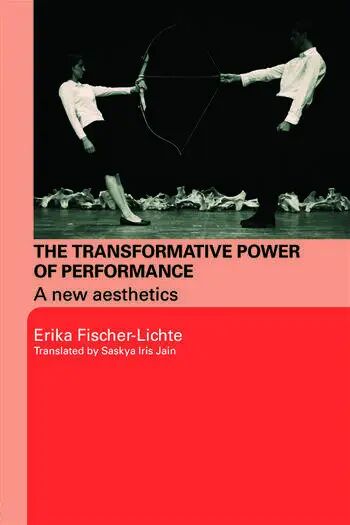
Fischer-Lichte's theoretical revolution began with a fundamental assertion: performance should no longer be seen as a stable, interpretable work of art, but must be understood as an _event_ that is fundamentally contingent, ephemeral, and co-created by its participants. This assertion marks a break with traditional aesthetic theory, which is deeply rooted in hermeneutics (the interpretation of meaning) and semiotics (the study of signs), and whose analytical premise is a static object that can be repeatedly examined.
Fischer-Lichte elevated performance art to the same status as traditional artworks, thereby heralding the birth of a "new aesthetics." The focus of analysis is no longer what the performance means, but what it does for the participants. This new aesthetic paradigm breaks away from the 19th century realist-psychological drama's obsession with "representation". The value of a performance no longer comes solely from its representation of a script or fictional character, but is generated from its own materiality and interactivity.
The essential characteristics of a performance "event" lie in its ephemerality, interactivity and the dissolution of a series of traditional binary oppositions, such as the complete blurring of the boundaries between artist and audience, body and mind, art and life. It is a process that "brings forth itself" and its development trajectory cannot be completely predicted or controlled. This transformation from "work" to "event" is not a simple change of terminology, but a fundamental reshaping of the ontology of performance. It moves performance from a category of "things" that can be analyzed retrospectively to a category of "experience" that requires phenomenological understanding in the moment of its unfolding. Traditional aesthetic theory, whether derived from painting, sculpture or literature, requires a stable "work" as an object of analysis. However, the nature of live performance is ephemeral and unrepeatable. Therefore, applying a work-based analytical model to performance is itself a category fallacy. Fischer-Lichte's theoretical contribution lies in her attempt to construct an aesthetic theory derived from performance itself, rather than rigidly applying theories from other disciplines. By defining performance as an "event," she internally unifies the theoretical framework with the fundamental nature of the medium. The far-reaching impact of this change is that if performance is an event, then the goal of art criticism is no longer to judge a finished product, but must change to the witness and analysis of a dynamic process.
Positioning the "Performative Turn"
Fischer-Lichte's theory did not appear out of thin air, but was rooted in a broad intellectual background-the "performative turn." This term describes a broad intellectual paradigm shift that has occurred throughout the humanities and arts since the mid-20th century, the core of which is a shift from a focus on "representation" to a focus on action, process, and eventfulness. It is this intellectual climate that makes Fischer-Lichte's "new aesthetics" possible and inevitable.
The genealogy of this theory can be traced back to the speech-act theory of language philosopher J.L. Austin, which believes that language can not only describe the world, but also do things. This concept was subsequently further developed in the gender studies of Judith Butler, who defined gender as a series of stylized and repeated bodily behaviors. Fischer-Lichte focuses her analysis on the profound aesthetic changes that have occurred in the visual arts, music, and theater since the 1960s, which she considers to be a key catalyst for her theory. During this period, the rise of "happenings", "Fluxus" and performance art directly challenged the status of traditional artworks as objects of contemplation, and instead pushed the artist's body, actions and the audience's on-site experience to the forefront.
Fischer-Lichte's unique contribution to the "performative turn" lies in her assertion that performative aesthetics aims to redefine traditional binary oppositions (such as subject/object, observer/observed) and to view theatrical performance as a "living event" rather than a semiotic text waiting to be decoded. She even traced the origin of this turn back to the establishment of ritual studies and dramaturgy at the turn of the 20th century, thus giving it a more profound historical pedigree. This series of arguments embodies Fischer-Lichte's theoretical ambition: she is not simply borrowing a popular term, but strategically repositioning the concept of "performativity." Although she acknowledges its roots in linguistics and cultural theory, she explicitly advocates for bringing the discussion of "performativity" back into the realm of art. She draws on a broad cultural "turn" to legitimize a particular "performative aesthetics." By the 1990s, the term "performativity" had become ubiquitous across numerous disciplines, leading in part to the generalization and dilution of its meaning. By anchoring his analysis firmly on specific artistic events, Fischer-Lichte is actually taking back the interpretive power of this core concept for performance studies. She argued that theater and performance art are not only cases of "performativity" but also "privileged fields" where its practical logic is most fully demonstrated and understood. This theoretical intervention made her work a foundational work for the revitalization of arts-centered performance studies.
Comparative framework: theatrical aesthetics vs. performative aesthetics
In order to more clearly reveal the revolutionary nature of Fischer-Lichte's theory, the following will systematically sort out the fundamental differences between traditional theater aesthetics and the performative aesthetics she advocated through a comparative framework. This table is not only a summary of the content, but also an inspiring analysis tool. It concretely makes an abstract theoretical argument concrete and makes its structural logic clear at a glance.
Features
Traditional drama aesthetics (work-centered)
Fisher-Richter's performative aesthetics (event-centered)
core object
Dramatic text; finished work of art.
Live, ephemeral performance events.
audience role
Interpreter; passive recipient of meaning.
Co-creator; active participant in the feedback loop.
meaning making
A hermeneutic reading of signs and symbols.
"Emerge" through sensory experience and interaction.
acting-viewing relationship
Separated by the "fourth wall" (representative).
Physical co-presence; direct, unpredictable interaction.
temporality
Repeatable; pursue consistency across sessions.
Unrepeatable; fundamentally dependent on the "here and now."
core focus
Performance _means_ nothing.
What does the performance _do_ to the participants.
Experience mode
Aesthetic distance; quiet observation.
Embodied participation; liminal experience.
physical status
A signifier that represents a character.
Phenomenal, material presence; the place where an event occurs.
The logic behind the construction of this table is that Fischer-Lichte's theory is established by "exploding a series of false binary oppositions." Tables are the most effective way to present this binary opposition and show how the new paradigm systematically disrupts the old paradigm. By juxtaposing concepts such as "passive recipient" and "active co-creator," "representation" and "co-presence," the table condenses the core argument of a complex 240-page work into its essential structural logic. This provides the reader with a clear, memorable framework for better understanding the more detailed discussions that follow in the report, as well as a conceptual map for exploring the entire book.
Part Two: The Engine of Performance: Autogenic Feedback Loops
This section will delve into the core mechanics of the Fischer-Lichte theory. It aims to explain how a performance event is generated and sustained through dynamic, self-regulated interactions between performers and audiences. This mechanism she named the "autopoietic feedback loop."
Shared bodies, shared spaces: the principle of co-presence
The cornerstone of the Fischer-Lichte system is the basic fact that actors and audiences must be in the same place at the same time. This is not an inconsequential logistical detail, but the ontological foundation of performance.
Performance occurs from the "bodily co-presence of actors and audiences." This shared "lifetime" forms the medium through which all interactions occur. This principle fundamentally challenges the concept of the "fourth wall" in traditional representational drama. In Fischer-Lichte's model, a completely closed fictional world is impossible because the reality of the audience's presence is always a decisive factor in the composition of the performance.
She cited communication theorist Paul Watzlawick's view that in a situation of shared presence, "one cannot not react to the other." Every cough, sigh or shift of attention of the audience is a perceptible event and will be immediately fed back to the performance process and have an impact on it.
Deconstructing autogenic feedback loops
The "autogeneic feedback loop" is the best-known concept from Fischer-Lichte's work. The term "autopoiesis" is borrowed from biology, meaning "self-creation" to describe the dynamic, self-generating, unpredictable cyclical process that constitutes the performance itself.
This cycle is a "self-referential and ever-changing" process. It is specifically manifested as: the performer's actions trigger perceptible reactions (such as laughter, silence, commotion) from the audience, and these reactions are in turn perceived by the performers and other audiences, thereby affecting their subsequent actions and reactions. Because this cycle is self-generating and responsive, performance events always maintain a certain degree of "unpredictability and spontaneity." Its process is extremely unstable and cannot be completely planned or controlled by any party.
Performance, therefore, is not the execution of a pre-existing script or plan; it "comes into being only in its process." Feedback loops are precisely the process by which performance _produces itself_. The "staging" created by the artist only sets the initial conditions for the activation of this cycle, while the real "performance" is the unique and unrepeatable event that emerges after the cycle is activated.
The dissolution of roles: from spectators to participants
The most radical consequence of spontaneous feedback loops is the breakdown of the traditional hierarchical relationship between the active artist and the passive audience.
Fischer-Lichte clearly "exploded the false binary opposition between actor and audience." Audiences are far from passive recipients; their reactions themselves form an integral part of the performance. All participants "share responsibility for what is happening." In extreme cases, this feedback loop can even lead to a complete role reversal. The analysis of Marina Abramović's "Lips of Thomas" in the book is the most typical example: the audience finally could not bear the performer's self-mutilation behavior and intervened, physically stopping the performance. At this moment, they "are themselves transformed into actors."
Avant-garde and experimental theater since the 1960s has often consciously exploited and highlighted the workings of feedback loops. They make this mechanism visible through strategies such as role reversal, creating temporary communities at the performance site, and facilitating physical contact between performers and audiences. Autogenic feedback loops are not only a descriptive model, but also a theory of agency. It reconceptualizes agency in performance as a distributed, relational, and emergent force rather than solely attributed to the author, director, or individual performer. Traditional theater models assume a clear hierarchy of agency: the author creates the text, the director interprets it, the actors perform it, and the audience receives it. However, the theory of feedback loops reveals that every participant jointly determines the direction of events, and no one has absolute control. This means that agency is no longer a property of individuals, but the product of interactions between individuals. In performance, the individual "experiences himself as a subject that is neither completely autonomous nor completely determined by others." This idea has important political implications: if agency in performance spaces is relational and co-creative, then performance itself becomes a model of a different kind of social and political process - one based on mutual influence and shared responsibility rather than top-down control. The "transformative force" of this book's title is therefore ultimately a political force.
Part Three: The Experience of Events: Materiality and Meaning
This section shifts the focus of analysis from the _mechanism_ of events to the _phenomenology_ of experiencing events. It aims to explore how the perceivable, material elements of performance create unique experiences, and how meaning itself is generated within this new aesthetic framework.
material performative becoming
According to Fischer-Lichte, feedback loops operate through the production and perception of materiality. Performance experience is fundamentally embodied and sensory rather than intellectual and interpretive. She breaks down this materiality into a few key components.
The materiality of performance is mainly reflected through three core elements: corporeality, spatiality and tonality.
• Bodily: The actor's phenomenal, material body - its presence, energy, sounds and even smell - becomes the primary focus of the audience's attention, no longer just its function as a character symbol.
• Spatiality: The way space is organized and used directly affects the relationships between actors and the flow of feedback loops.
• Tonality: This includes all auditory elements - vocals, acoustics, atmosphere, and especially rhythm. Rhythm "tunes" the bodies of participants and organizes the operation of feedback loops. Fischer-Lichte particularly emphasized rhythm as an organizing principle that effectively links materiality to cyclical, self-generated processes.
These material elements are not passive backgrounds, but "active forces" that trigger "physiological, emotional, energetic and motor responses" in participants. The materiality of the performance itself becomes "an agent in the self-generating feedback loop."
The emergence of meaning beyond semiotics
This section deals with one of the most complex questions in the theory: if performance is no longer a text waiting to be interpreted, how does meaning come about? Fisher-Richter proposed an "emergence" model.
Meaning is no longer a stable message transmitted from artist to audience. Instead, it "emerges" in an unstable, dynamic way over the course of events. In many cases, "understanding the artist's actions itself is far less important than experiencing the experiences generated by these actions." The audience's perception is in a constant state of flow, that is, "perceptual multistability". Their attention is constantly switching between different foci-for example, between the actor's physical body and the character he or she plays. It is in this instability and oscillation that meaning arises.
It is worth noting that although this theory is extremely subversive, some critics point out that Fischer-Lichte ultimately "coalesced" her theory to a certain extent back into a "broad semiotic" framework when she broke down events into physical, spatial and other components in her analysis and explored their relationships. This critical perspective adds necessary academic depth to understanding his theory. Fischer-Lichte's theory of meaning-making is anti-logocentric in nature. It challenges the supremacy of language and text that has long dominated Western drama theory, and instead locates meaning in embodied, sensory, and emotional experience. Traditional drama is text-led, and the meaning is mainly contained in the playwright's words. Fischer-Lichte's emphasis on materiality consciously shifts the core of experience to the non-verbal level: feeling the energy conveyed by a choir, the instinctive reaction to a painful body, or the sense of unity brought by a common rhythm. She also noted the difficulty of translating these "translinguistic images, fantasies, memories...feelings and emotions" into language after the fact. Her theory thus advocates a bodily, affective knowledge and meaning that exists before or outside of linguistic representation. This aligns her work with broader academic trends such as phenomenology and emotion theory, and poses a major challenge to purely hermeneutic or semiotic analysis methods.
Part 4: The power of change in practice: key case analysis
This section will situate abstract theory into concrete analysis, focusing on the key cases used by Fischer-Lichte to construct and illustrate his argument. These cases are not simple illustrations of the theory; they are the phenomena from which the theory itself is derived.
The Abramovich Case: Lips of Thomas as Liminal Crisis
This section will conduct a multi-dimensional analysis of Marina Abramović's 1975 performance art work, which is a core example in the book. The show is a crucible for testing all of Fischer-Lichte's core concepts.
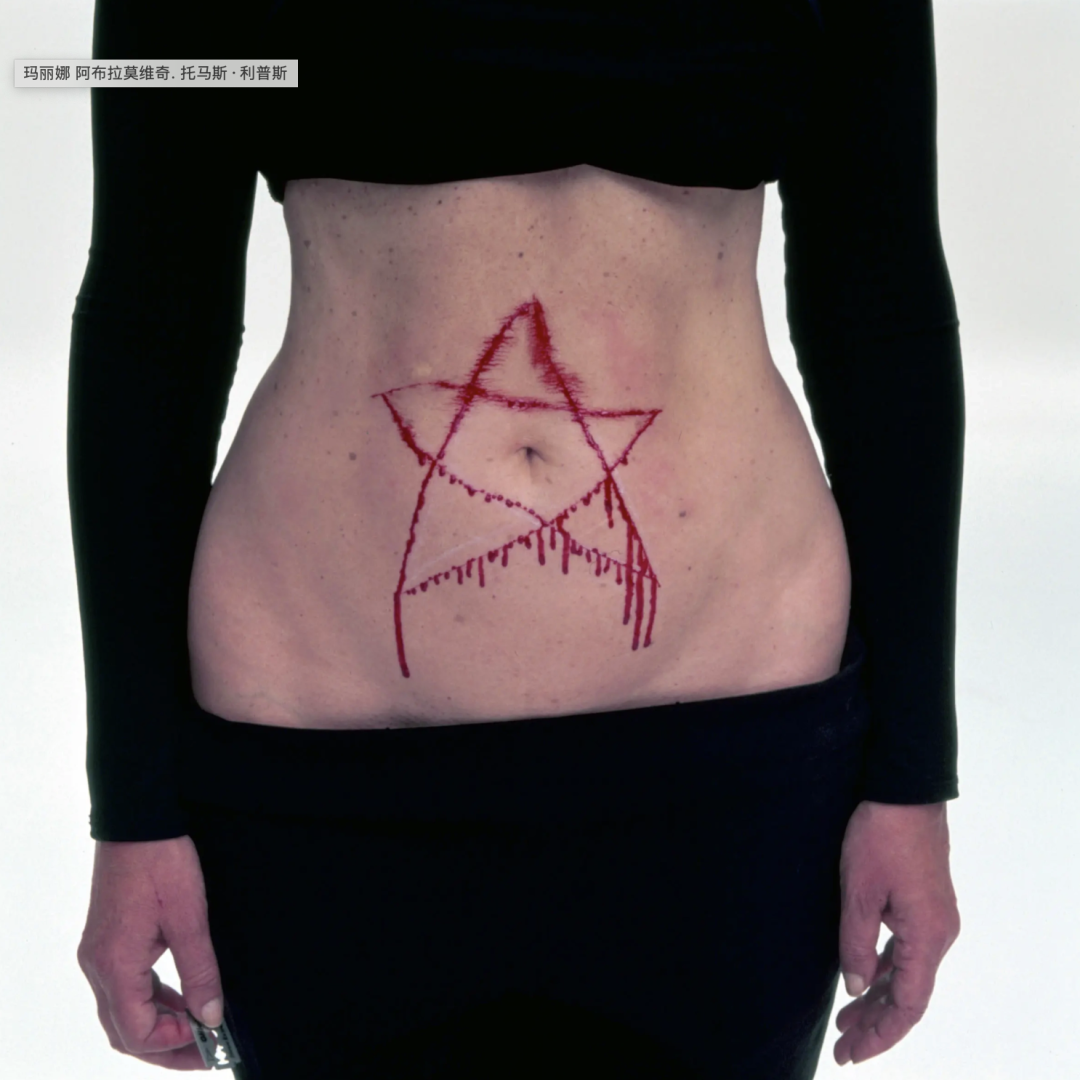
According to the vivid description in the book, the performance included: Abramovich ate a kilogram of honey, drank a liter of red wine, cut a five-pointed star in his abdomen with a razor blade, whipped himself, and finally lay naked on a cross made of ice until the audience couldn't bear it and intervened. The power of this performance stems from the fact that it creates a situation in which the audience is "suspended between the norms and rules of art and daily life, between the imperatives of aesthetics and ethics." They face an unavoidable choice: continue to watch as art spectators, or step forward to intervene as similar people?
Initially, the audience's reaction was a physical signal of horror and dismay. This feedback continues to increase the tension in the scene until it reaches a critical point. This crisis cannot be solved by any conventional behavioral patterns. In the end, the audience decided to lift Abramovich from the ice cross, an action that constituted the climax of the entire incident. At this moment, they are no longer spectators, but become actors, ending the performance through their own initiative. This perfectly illustrates the "power of change" referred to in the book's title.
The Politics of the Gaze: Coco Fusco and Guillermo Gómez-Pena's Caged "Indians"
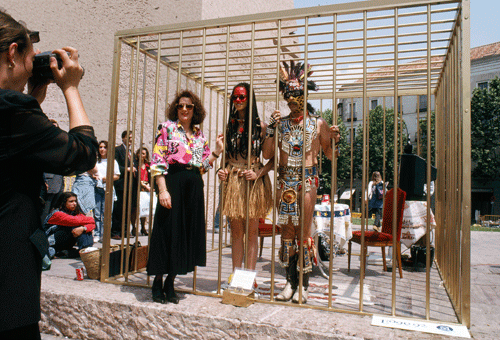
To demonstrate the political dimension of his theory, Fischer-Lichte analyzes another key case: Two Undiscovered Amerindians Visit..., 1992 by Coco Fusco and Guillermo Gómez-Peña.
In this performance, the two artists lock themselves in a cage and act as "undiscovered" Aboriginal people for the audience to visit. The performance was designed to induce the audience to perform actions that "embodied the colonial gaze." Many spectators regard them as spectacles, feed them, take photos with them, and completely enter the role of watching "others".
Fischer-Lichte used this case to illustrate one of her core points: "The act of perceiving the other is always a political act." The performance demonstrates "the transformative power of the gaze directed toward the Other, which can either recognize the Other as a shared subject or reduce it to an object." This makes the performance-viewing relationship itself a field full of ethical and political tensions. The selection of these cases is highly strategic and argumentative. By focusing on radical, body-centered, and often painful performance art, Fischer-Lichte deliberately selects examples that traditional theater theory cannot adequately explain. A traditional aesthetic theory based on representation and interpretation will be powerless when faced with "The Lips of Thomas". This show isn't "about" pain, it's pain itself. Its significance does not lie in a symbol, but in the ethical crisis it creates in the hearts of the audience. Similarly, Fusco and Gomez-Pena's works are not a "reproduction" of colonialism, but an "enactment" of the colonial gaze in real time, using the audience's own behavior as the main material. Through these extreme cases, Fischer-Lichte not only demonstrated the failure of the old paradigm, but also highlighted the explanatory power of his new theory. Her theories were not rigidly applied to these works, but emerged from some of the most challenging artistic practices of the late 20th century.
Part Five: The Reenchantment of the World: Meaning and Critical Context
The final section of the report will synthesize the book's arguments, explore its claims about the ultimate purpose and power of performance, and situate the work within its critical context.
Performance as liminal experience
Fischer-Lichte defines the "transformative power" of performance as its ability to lead participants into a state of "liminality"-a threshold state of "betwixt and between."
Drawing on anthropological concepts, performance events can place participants in a state where conventional social rules, roles and identities are temporarily suspended. Abramović's performance is a typical example of throwing the audience into the liminal crisis between aesthetics and ethical norms. In this liminal state, participants are able to experience themselves and their relationships with others in new ways. They are open to the possibility of transformation-whether it is a shift in perception, a shift in self-awareness, or a shift in understanding of social reality.
The Reenchantment of the World
This section explores the grand theme revealed in the title of the final chapter of the book: "The Re-Enchantment of the World."
By focusing attention on the materiality of bodies, objects and spaces, performance can make the ordinary extraordinary. It transforms the everyday banality and allows participants to perceive the world with a re-intensified intensity. In a world often seen as disenchanted, rationalized, and demystified, performance offers a mode of experience that reintroduces wonder, presence, and serendipity. It allows people to re-experience a world that is vibrant, dynamic and full of potential.
Critical reception and academic impact
Any professional scholarly report must contain a balanced assessment of the influence of the work analyzed and a response to the criticisms it has faced.
The Transformative Power of Performance is undoubtedly an "important reference" that has profoundly shaped academic debates in the fields of theater theory and performance studies. Concepts such as "autonomous feedback loops" have become core vocabulary of the discipline. However, the book also triggered a series of important academic criticisms
• Some scholars have pointed out that despite its radical premises, the theory ultimately returns to a semiotic framework by breaking down events into analyzable components.
• Some concepts, such as "energy", have been criticized as being more assertions than adequate explanations.
• It is also argued that Fischer-Lichte's way of thinking is sometimes too binary and that the feedback loops themselves could be distinguished and analyzed in more detail.
Finally, as Marvin Carlson points out in the book's introduction, an important contribution of this work is to bring a "refreshing continental perspective" to a field long dominated by Anglo-Saxon scholarship. The book's final argument about "reenchantment" positions performance not just as an artistic practice but as a crucial cultural and even quasi-spiritual practice. It suggests that in a secularized world, performance can take on the role once played by ritual: providing an intense, transformative community experience. The book frequently draws parallels between performance art and religious or ritual practices (such as comparing Abramović's self-mutilation to asceticism). The concept of "liminality" is borrowed directly from ritual anthropology. Descriptions of the performance experience are also imbued with ritualistic language of intensifying energy, shifts in consciousness, and the creation of temporary communities. The final claim of "reenchantment" thus combines all these threads. It suggests that this "new aesthetic" is not just a new way of analyzing art, but a way of understanding how performance can provide a modern, secular form of "enchantment" by making the material world present and powerful again. This has greatly improved the landscape of Fisher-Richter theory, moving it from a purely academic discussion to a profound level of cultural concern.
Related reading
Drama is written in the sand.
The Throne of the Seen: A Reconstruction of Lacanian Theater Theory in François Reno's "The Spectator"
"The Grammar of Events: Actor-Generated Topology (AGT) and the Birth of the Postmodern Subject" (Part 1)
Reconstructing "Theatre and psychoanalysis" Théâtre et Psychanalyse
p4 Contribution|Poetics of Fangs: Preliminary Explanation of Dark Conceptual Theory|Jacob Reber
P4 Theater, ten years of archival records (part)
Deleuze and contemporary art|The heterogeneity of escape
Deleuze and Contemporary Art|The Politics of Screaming in Elegy
Deleuze, Guattari and contemporary art
P4 Theater|A generated university, a winding maze, a hard drive engraved with life
Self-Material Project | "Tangshan Boy - The Artist's Final Chapter" 04

p4 Theory | The Third Subject of Analysis: A Comprehensive Exploration of Thomas Ogden's "Third Presence" Theory
If you want to contribute or join the group to communicate, please add Captain
P4 Theater is committed to presenting everyone's dream