"From Location to Relationship: P4 Theater Ten Years of Practical Actor Network Topology Research"
From Position to Relation: A Study on the Actor-Network Topology of P4 Theater's Ten-Year Practice
Summary
This study aims to conduct an in-depth ethnographic and theoretical analysis of the experimental practice of P4 Theater (2015-2025). P4 Theater, with its unique participation mechanism, embrace of "failure" and fluid organizational form, poses a fundamental challenge to the traditional theater production model. This article believes that the key to understanding p4 practice lies in completing a transformation of analytical perspective: from a "positional" topology based on fixed identity to a "relationship" topology based on dynamic connections.
To achieve this transformation, this study constructs a two-level theoretical framework. At the ontological level, this article introduces Bruno Latour's Actor Network Theory (ANT), viewing the p4 field as a heterogeneous network assembled by human and non-human actors (space, objects, rules). On this basis, this article proposes an original analysis tool - the "architect-NPC-player-peeper" four-element dynamic model to track the "translation" process and the flow of functional roles within the network.
Through micro-analysis of specific cases of p4 (such as the evolution of "510 Space"), this article demonstrates that the core mechanism of p4 is not to eliminate the pre-positioned social "position", but to suspend, disrupt and problematize it. In this process, "playing" is disenchanted, and a Victor Turner-style "fusion community" based on shared risks is instantly generated.
In addition, this article will combine Jacques Lacan's psychoanalysis theory and Claire Bishop's participatory art criticism to deeply explore the ethical risks, power reproduction and its profound social implications as a "community of losers" in p4 practice. The study ultimately pointed out that p4's practice is not only an innovation in art form, but also a profound social experiment on how sociality is re-assembled in contemporary cities, providing important theoretical and practical reference for understanding the social function of art and the possibility of public life.
Keywords: P4 Theater; Actor Network Theory (ANT); social topology; relationships; location; architect-NPC-player-voyeur model; participatory art; community; ethics of failure
outline
Introduction
1.1 Origin of research: P4 Theater as a "problem"
The uniqueness of P4 Theater: non-fixed place, mobile participants, persistence in "failure" and "authenticity".
The limitations of traditional theater theory (director-centered theory, text-centered theory) and participatory art criticism in analyzing p4.
The core research question is raised: How does P4 Theater reconstruct the viewing and performance relationship and generate a new type of community through its unique practice? What is its inner working mechanism?
1.2 Core argument: topological transformation from position to relationship
The core argument of this article is clearly stated: The revolutionary nature of p4 lies in its realization of the transformation from "positional ontology" to "relational ontology".
Briefly introduce the ANT perspective and the original four-element model that this article will adopt, and explain why this framework can capture the dynamics of p4 more effectively.
1.3 Research methods and significance
Research method: a combination of theoretical construction, text analysis (based on materials released by p4) and participant observation.
Theoretical significance: Provide a new analytical framework for participatory art research; promote the application of ANT in the field of art; promote interdisciplinary dialogue between drama theory, sociology, and philosophical theory.
Practical significance: Provide organizational and creative models for experimental drama groups to learn from; provide a new perspective for understanding the social connections and public life of contemporary urban youth.
1.4 Overview of thesis structure
Briefly introduce the main content and logical relationship of each chapter.
Chapter 1 Theoretical Framework: Assembling an Analysis Toolbox
2.1 The Specter of "Position": A Critical Review of Traditional Theater Topologies of Power
Analyze the linear power chain and its spatial topology of traditional drama "writer→director→actor→audience".
Discuss the continuing influence of prepositioned social "position" (class, gender, educational background) in the theatrical field.
It should be made clear that this study does not claim that p4 eliminates "position", but "problematizes" it.
2.2 Relational ontology: introducing actor network theory (ANT)
Explain the core concepts of ANT: actors, generalized symmetry, network, and translation (four moments).
Demonstrate why ANT is an appropriate "meta-theory" for analyzing the heterogeneous and fluid practice of p4.
2.3 The Quaternary Model as a Microscope: Architect, NPC, Player and Peeper
Describe in detail the connotation, function and dynamic conversion mechanism of the original four-element model.
It is positioned as a specific analysis tool that applies ANT to observe the p4 field.
2.4 Interpretive Lens: The Intervention of Lacan, Turner and Bishop
Elucidate how to use the theories of Lacan (the Real, gaze), Turner (liminality, communion state), and Bishop (ethics of participation) to explain specific phenomena and build a multi-level theoretical collaboration system.
Chapter 2 The "Architect's" Blueprint: Rules, Space and the Politics of Recruitment
3.1 Groundbreaking: Recruitment as "problematization"
Analyze p4's recruitment copy and explore how it sets the agenda, attracts specific groups of people, and completes the "problematization" moment in ANT.
Discuss the possible "invisible thresholds" and the initial boundaries of the community.
3.2 "Rules" and "space" as core actors
Microscopically analyze the specific "rules" of p4 to demonstrate how it acts as a non-human actor to authorize, prohibit and guide the formation of a relationship network.
Case Study: From "Sculpture Stand" to "510" - a detailed analysis of how the upheaval of space (non-human actors) has forcibly reshaped the density and intimacy of the network.
3.3 The invisibility of the "architect" and the dispersion of power
Explore how the founder's "architect" role achieves "invisibility" as events unfold by solidifying power in rules and spaces, but does this imply a more covert form of power?
Chapter 3 The Generation of Network: NPC Catalysis and Player Game
4.1 "Benefit Granting" of NPC: Catalyst to Start Network Transformation
Analyze the function of "NPC" or "task" in p4 practice, and demonstrate how it can "seduce" participants through predictable behavior, cut off their connection with the external network, and complete "benefit conferment."
4.2 From "voyeur" to "player": a phenomenology of topological transition
Combined with the second-person experience description, the participant's psychological and behavioral transformation from passive observation to active participation is carefully described, which is the "recruitment" moment in ANT.
Analyze the special behavior of "shooting" and demonstrate how it becomes a unique way of establishing subjectivity between "peeping" and "playing".
4.3 The game of "players" and the emergence of "community"
Analyze the collaboration, confrontation, and negotiation between players to see how the network is "mobilized."
Using Turner's theory, the moment of generation of "community" is defined as the manifestation of "state of blending".
Chapter 4 Critical Reflection: The Ethics of Failure, Regenerative Power and the Price of the Real
5.1 The Ethics of Failure: "Embracing Failure" as a Method
Argument "failure" in p4 is not only a result, but also a methodological and ethical gesture.
Contrast this with Bishop's critique of consumer-participatory art that pursues fluid "experiences."
5.2 New Power Generation: An Examination of the Myth of "Decentralization"
Analyze whether new power asymmetries exist in seemingly equal networks.
5.3 The Price of the Real: Ethical Risks from a Lacanian Perspective
Using Lacanian theory, analyze whether p4's pursuit of "truth" may expose participants to traumatic "the Real" prematurely and excessively.
Explore whether there is a protection or guidance mechanism for this psychological risk in its field.
Conclusion
6.1 Research summary: P4 Theater as a relational topology laboratory
Systematically summarizing the research findings of this article, it is reiterated that p4 transforms theater into a self-generated and heterogeneous social network by reconstructing "relationships".
Once again emphasizing "from location to relationship" is the core key to understanding its innovation.
6.2 Theoretical contributions and research limitations
Summarize the theoretical (development of artistic applications of ANT, original analytical models) and methodological (interdisciplinary research) contributions of this article.
The limitations of this study are acknowledged and directions for future research are indicated.
6.3 Epilogue: Unfinished topology and the social mission of art
Returning to the practice of p4 itself, emphasizing its "unfinished" and continuous exploration characteristics.
In the broader social and cultural context, explore the profound significance of p4's practice in thinking about contemporary public life, social connection, and the emancipatory potential of art.
Introduction
1.1 Origin of research: P4 Theater as a "problem"
On the map of contemporary Chinese drama, the ten-year practice of P4 Theater (2015-2025) constitutes a unique and difficult-to-classify "problematic" existence. It is not a traditional theater troupe with a fixed cast and performance venue, but more like a mobile, project-centered art laboratory and social energy aggregate. Its uniqueness is clearly reflected on multiple levels: it wanders around abandoned factories, offices, park lawns and even online spaces, taking the unstable field itself as the core element of creation; it is open to society for recruitment, and the identities of participants are constantly switching between audiences, creators, and actors, making the generation process of the work full of uncertainty; most importantly, it repeatedly emphasizes the capture of "truth", the embrace of "failure", and the dissolution of all established authority in its discourse and practice. In the concluding article, its founder He Fa described it as a generated university, a winding maze, and a hard drive engraved with life. This poetic summary exactly reflects the complexity and non-fixedness of its form.
Facing such a practice form as P4 Theater, the traditional drama analysis framework seems to be stretched thin. Neither the "script-centered theory" that focuses on the text nor the "director-centered theory" that emphasizes the authority of the director can explain the decentralized and co-created production model of p4. Even the recently emerged theories of Participatory Art and Immersive Theater often encounter difficulties when facing p4. Mainstream immersive theater often strives to provide consumers with a carefully designed and smooth "experience", while p4's practice is full of rough textures, uncomfortable tension, and even treats "errors" and "failures" as inherent components of its methodology. Therefore, P4 Theater is not only an art case worth studying, but also constitutes a "question" that challenges the existing theoretical framework: How does P4 Theater reconstruct the relationship between creators, participants and performance space through its unique practice, and in the process generate a new and instantaneous community? Behind its seemingly chaotic and even contradictory operations, is there an inherent generation mechanism that can be analyzed?
1.2 Core argument: topological transformation from position to relationship
In response to the above questions, this study puts forward a core argument: the key to understanding the revolutionary practice of P4 Theater lies in completing a fundamental shift in analytical perspective, that is, from a "Position" topology based on fixed identity to a "Relation" topology based on dynamic connections.
The underlying logic of traditional drama analysis is a "positional ontology" - it presupposes a series of stable social "positions" such as "writer", "director", "actor", "audience", etc., and the relationship between them is determined by these preset positions. Your identity determines your actions. The practice of p4 subverts this logic and presents the characteristics of a "relational ontology": in a carefully designed field, your current actions, who (or what) you choose to connect with, and the way you connect, in turn define your function and temporary "identity" at the moment. Your actions define who you are.
To clearly illustrate this topological transformation, this study will construct a two-level theoretical framework. At the macro-ontological level, this article will introduce Bruno Latour's Actor-Network Theory (ANT), viewing the p4 field as a heterogeneous network "assembled" by human and non-human actors-including participants, space, objects, rules, light, sound, etc. At the micro level of analysis, this article will propose an original analysis tool - the "architect-NPC-player-peeper" four-element dynamic model. The model is not a fixed identity label, but four fluid "functional positions" that actors in a network may occupy. By tracking individuals' "jumps" between these functional positions, and how nonhuman actors enable or impede these transitions, we will be able to reveal the sophisticated, self-generated network dynamics hidden beneath P4 Theater's seemingly chaotic surface.
1.3 Research methods and significance
This study will adopt an interdisciplinary and comprehensive research method, mainly including
Theoretical construction: Integrate and develop actor network theory, Lacanpsychoanalysis, ritual theory and participatory art criticism to form an original, multi-level analytical framework.
Text analysis: Conduct an in-depth interpretation of textual materials such as recruitment copywriting, creative self-narratives, participant feedback, and interview records published publicly over the past ten years in P4 Theater, using them as the key entrance to its internal operating logic and discourse system.
Case ethnographic analysis: Select typical cases such as the evolution of "510 Space" to conduct detailed, ethnographic micro-analysis to confirm and enrich the theoretical model with embodied experience and specific situations.
The significance of this study is reflected in the following two levels
Theoretical significance: First of all, this study attempts to provide a new analytical framework for participatory art and experimental theater research that goes beyond aesthetic judgment and phenomenon description and has sociological and philosophical depth. Secondly, by carefully applying ANT theory to artistic practice cases, this study will promote the application and development of ANT in the field of humanities and art. Finally, it is committed to promoting interdisciplinary dialogue in theater theory and sociology, psychoanalysis and other fields, and exploring new possibilities for artistic research.
Practical significance: An in-depth analysis of P4 Theater can provide other experimental and community art groups with reference models of organization, creation and mobilization. More importantly, in the context of globalized urbanization and increasing social atomization, p4's exploration of how to "generate connections" and how to build a "community of losers" provides valuable practical reference and profound social enlightenment for us to rethink the possibilities of contemporary youth's public life, the nature of social relations, and the liberating role that art can play.
1.4 Overview of thesis structure
This paper is divided into four chapters in addition to the introduction and conclusion.
The first chapter will systematically build the theoretical framework of this article. On the basis of a critical review of traditional theater topology, actor network theory will be introduced as a "meta-theory", and the "quaternary model" as a core analytical tool will be elaborated on, while defining the functions of "interpretive lenses" such as Lacan, Turner, and Bishop.
Chapter 2 will focus on the function of "architect" and analyze how p4 completes the initial "assembly" and "problematization" of the entire actor network through the politics of rules, space, and recruitment.
Chapter 3 will go deep into the dynamic generation process of the network, using the "quaternary model" to trace how NPCs catalyze, how players play, and ultimately the complete "translation" chain that leads to the emergence of "community".
Chapter 4 will enter the level of critical reflection and explore the "ethics of failure" in p4 practice, the regeneration of new power, and the possible ethical risks in the pursuit of "truth."
Through the above progressive analysis, this study hopes to provide a comprehensive interpretation of the complex cultural phenomenon of P4 Theater with both theoretical depth and empirical details.
Chapter 1 Theoretical Framework: Assembling an Analysis Toolbox
In order to effectively analyze the complex practice of P4 Theater, we must first get rid of the inertial constraints of traditional theater theory and actively "assemble" a more adaptable and penetrating theoretical toolbox. The purpose of this chapter is to systematically construct this theoretical framework consisting of three levels: "metatheory", "analytical tools" and "interpretive lens". It will first conduct a critical review of traditional theater's "position"-based topology to establish the starting point of our research; then, introduce actor-network theory (ANT) as the ontological foundation of the entire study; on top of this, elaborate on our original "four-dimensional dynamic model" as a core analytical tool; and finally, explicitly integrate the theories of Lacan, Turner, and Bishop as an interpretive lens to deepen the analysis of specific issues.
2.1 The Specter of "Position": A Critical Review of Traditional Theater Topologies of Power
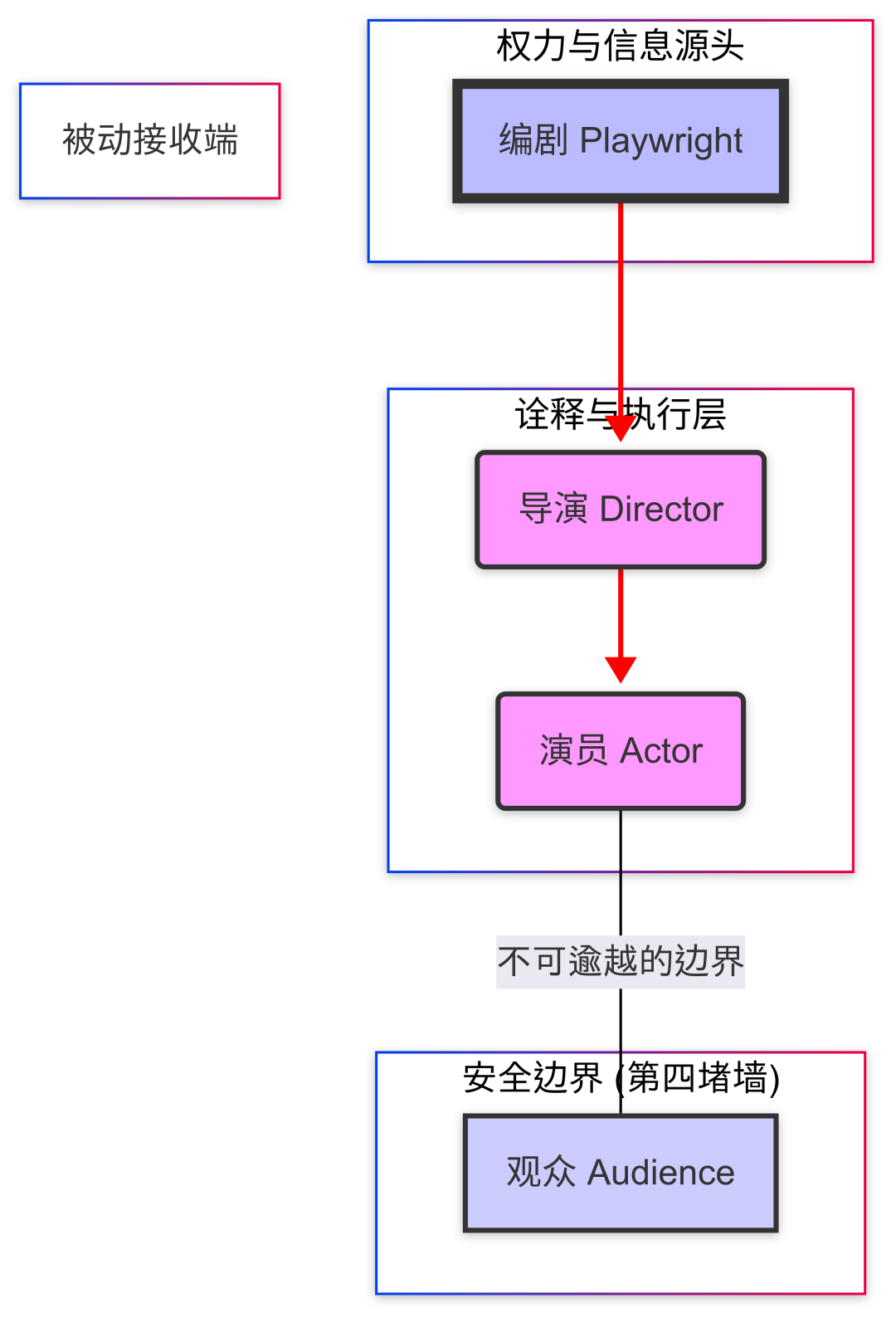
The internal structure of traditional drama, no matter how changeable its aesthetic style, often follows a stable social topology based on "position". This topology is defined by a linear, hierarchical chain of power: screenwriter → director → actor → audience. In this chain, each role is assigned a relatively fixed "position", which determines its function, scope of power, and relationship with other positions. The screenwriter is the source of meaning, the director is the authoritative interpreter, the actor is the faithful executor, and the audience is the passive and safe receiver. In terms of physical space, this power topology is strengthened through the binary opposition of "stage-auditorium" and the insurmountable boundary of the "fourth wall".
However, analysis of P4 Theater must be wary of the oversimplified assertion that it completely "eliminates" position. In fact, before entering the p4 field, participants have already been engraved with various stubborn social "positions" - their class identity, educational background, gender temperament, cultural capital, etc. These pre-existing "positions" are like "ghosts" and will not disappear completely due to an artistic experience. They profoundly influence how individuals engage, their preferences for building relationships, and their sense of safety in the field. Therefore, the core argument of this study is not that p4 has created a "positionless" utopia, but rather points out more precisely: p4's practice consciously suspends, disturbs, and problematizes these pre-positioned and solidified social "positions" through a set of exquisite mechanisms. It creates an "exceptional state" in which "relationship" can temporarily gain priority over "position", thereby providing the possibility for the generation of new subjectivity and sociality.
2.2 Relational ontology: introducing actor network theory (ANT)
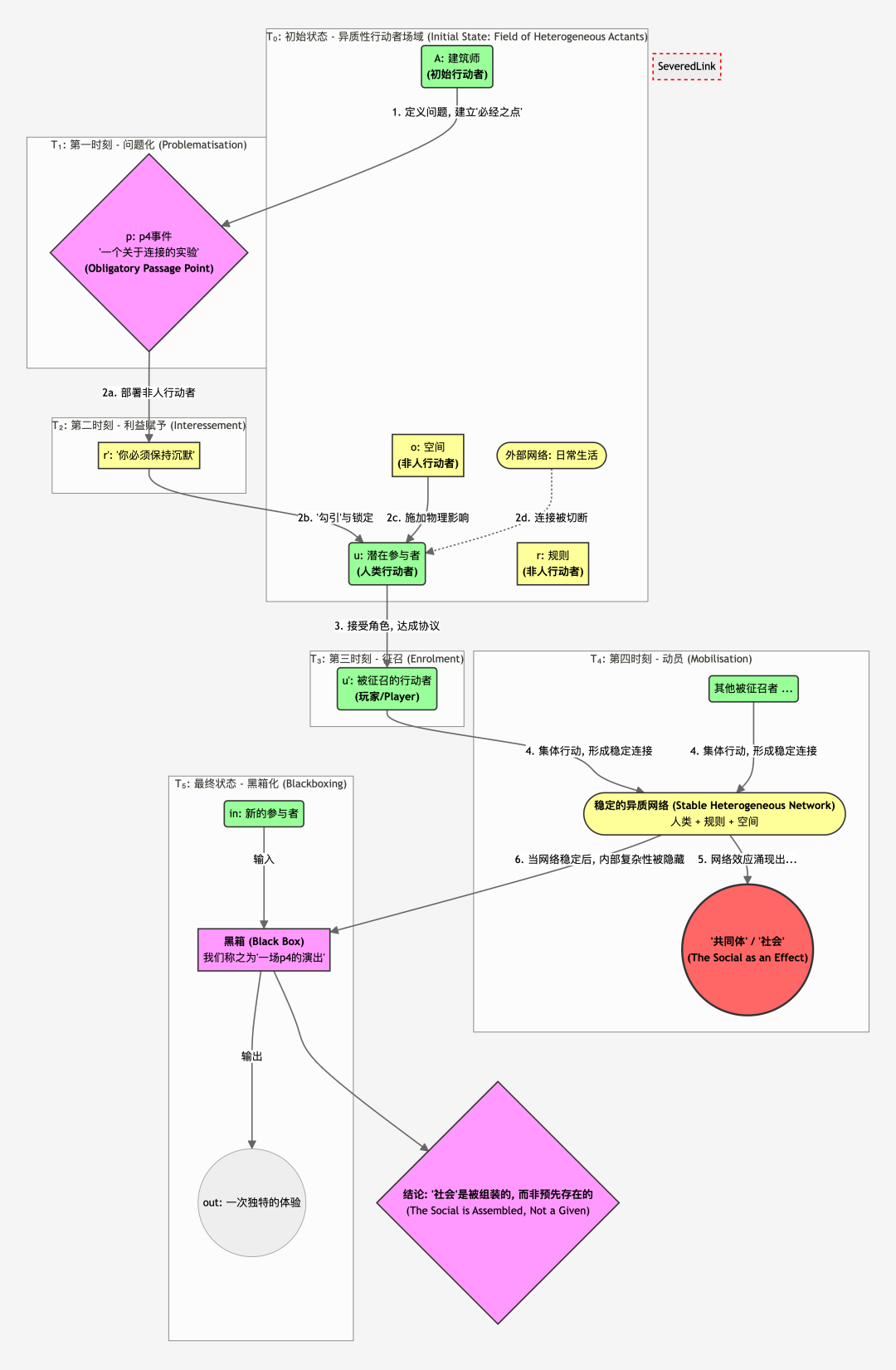
To understand how "relationships" gain priority, Bruno Latour's actor-network theory (ANT) provides us with the most fundamental "meta-theoretical" support. The revolutionary nature of ANT lies in its "generalized symmetry principle". It refuses to pre-divide the world into two realms: "human/society" and "nature/matter". Instead, it advocates treating all beings that can "make a difference" - whether human or non-human - as equal "actants". The so-called "society" or any order is not a pre-existing background, but a fragile and dynamic "Network" that is "assembled" by these heterogeneous actors through constant alliances, negotiations, and struggles through a process called "Translation."
Applying ANT to the analysis of P4 Theater means that we will no longer regard space, objects, and rules as passive "environments" or "props", but as actors as important as human participants.
The space itself (such as the smallness of the 510 office) enforces interpersonal distance by its physical properties.
A rule (such as "You can pause at any time") authorizes or prohibits specific behavior.
An object (such as a chair) "invites" or "rejects" certain postures by its form.
The perspective of ANT provides the ontological cornerstone for our transformation "from position to relationship". It allows us to see that the field of p4 is not a container in which "people" move, but a constantly generated network of relationships woven by humans and non-humans. Analyzing p4 is to track the assembly process of this network.
2.3 The Quaternary Model as a Microscope: Architect, NPC, Player and Peeper
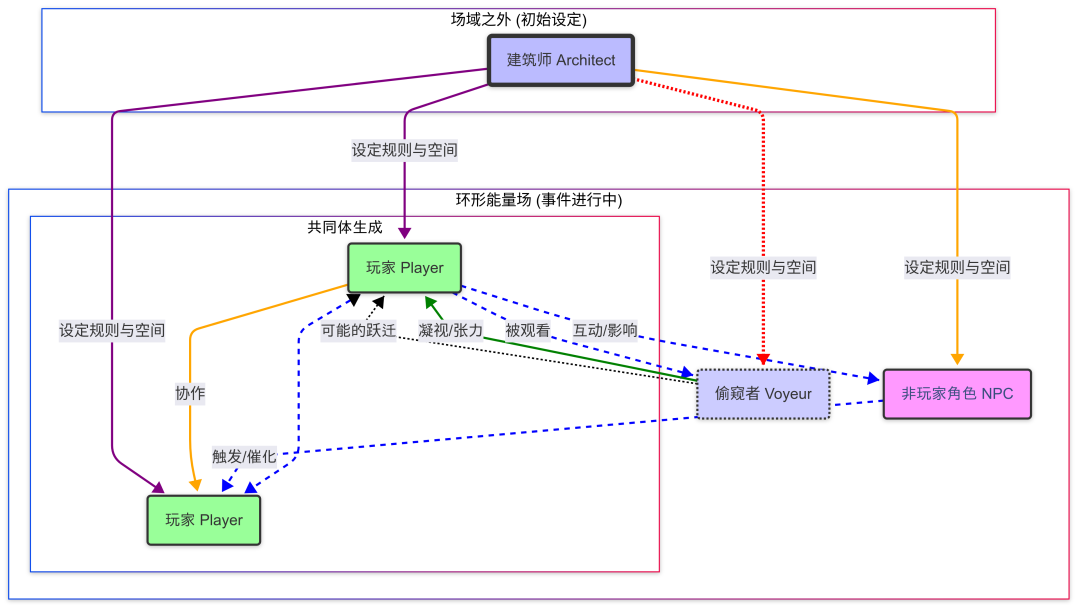
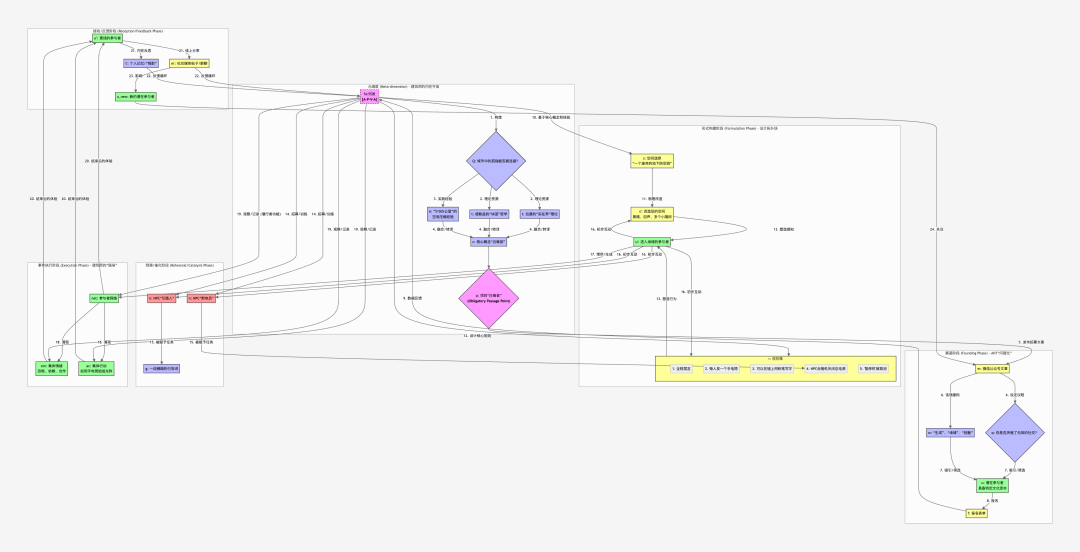
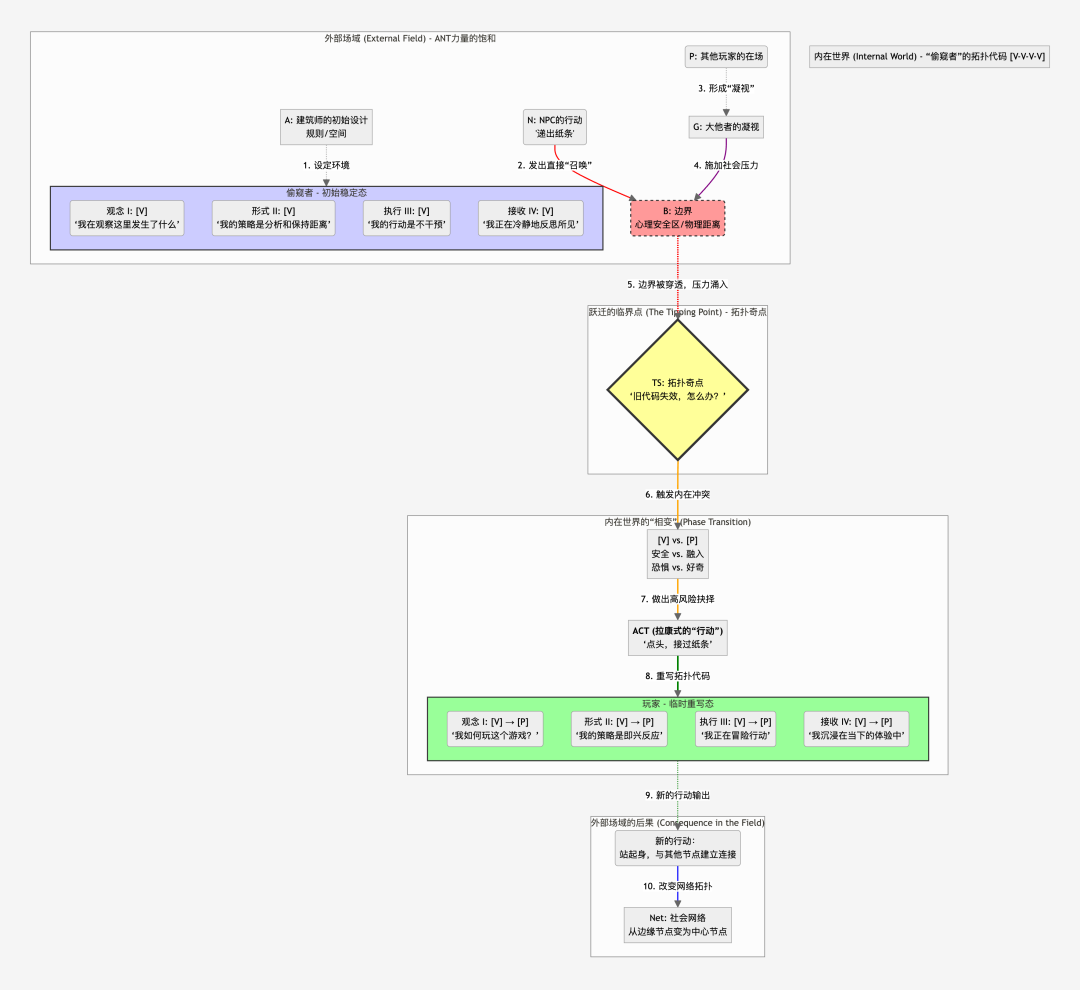
If ANT provides a world view, then we need a specific "microscope" to observe the microscopic world of p4. To this end, this study constructed an original analysis tool: the "architect-NPC-player-peeper" four-element dynamic model. The four roles in this model are not fixed identities but functional positions that any human actor in the network may temporarily occupy
Architect: The designer and founder of the network. Its function is to complete the "Problematisation" of the network by setting rules, transforming space, and issuing recruitment before the event begins, and injects unstable "potential energy" into the entire field.
NPC (Non-Player Character): The catalyst and stabilizer of the network. Usually played by a core group of members who perform simple, repetitive tasks. Its function is to initiate events, break deadlocks, and serve as a predictable variable to "interessement" other actors into the network.
Player: The core builder of the network. They are those participants who have accepted the network "contract" and actively interact, game, and create. They are actors who have been "enrolled" and successfully "mobilized" (Mobilisation), and the formation of the community mainly occurs among them.
Peeper: The boundaries and tensions of the Internet. They are those players who try to maintain their traditional audience position but find themselves in an awkward position due to topological changes. Their "non-participation" is an action in itself, and their "gaze" constitutes pressure on players and maintains the dynamic tension of the network.
The key to this model is its dynamic nature. Individuals can continuously "jump" between these four functional positions, and it is this fluidity that constitutes the internal driving force for the continuous self-generation of P4 Theater network topology.
2.4 Interpretive Lens: The Intervention of Lacan, Turner and Bishop
Based on the analytical tools of ANT's meta-theory and four-element model, we introduce three "interpretive lenses" to provide in-depth explanations of specific observed phenomena, thereby building a multi-level theoretical collaboration system.
Jacques Lacan's psychoanalysis: When we observe the intense anxiety in the p4 field, the obsessive pursuit of the "real" and the pressure caused by the "gaze", Lacan's theory will provide key explanatory power. Its concepts of the Real (the Real), Gaze and the Big Other will help us understand the deep psychodynamic and ethical dimensions of p4 practice.
Victor Turner's Ritual Theory: Turner's theory is indispensable when we try to define the nature of the "community" generated by p4. The concepts of liminality and communitas can accurately describe the temporary, equal, strong emotional connection state that breaks the daily social structure.
Claire Bishop's Participatory Art Criticism: Bishop's critical framework provides a powerful weapon when we need to distinguish p4's practice from other contemporary participatory arts. Her theory helps us discern the essential difference between p4's practice and those "artificial hells" that she criticizes as "experience consumption", thus highlighting p4's ethical seriousness and social criticism.
To sum up, the theoretical toolbox assembled in this chapter aims to establish a comprehensive research framework that has both a grand ontological vision and fine micro analysis tools, as well as a profound interpretive lens. It will guide us in the following chapters to launch a systematic and in-depth topological exploration of the complex practice of P4 Theater.
Chapter 2 The "Architect's" Blueprint: Rules, Space and the Politics of Recruitment
From the perspective of actor-network theory, the formation of any network begins with a "translation" process initiated by one or more core actors. In the practice of P4 Theater, we summarize the function of this initial stage as the function of "Architect". This chapter will focus on this function and explore how p4 lays the foundation for its network topology through careful rule design, strategic use of space, and unique recruitment politics, and completes the initial "Problematisation" of participants. This is not a simple technical preparation process, but a foundational action full of power, desire and political implications. It prescribes the "laws of the game" and the boundaries of possibility for the entire field.
3.1 Groundbreaking: Recruitment as "problematization"
The network assembly of P4 Theater does not begin the moment participants step into the physical space, but begins when its recruitment copy is released in the public domain. These texts, whether posted on social media or spread through specific communities, constitute the first step in the formation of the network - "problematization" in the ANT sense. The core of "problemization" is to raise a "problem that must be solved through me" (Obligatory Passage Point, OPP). p4's recruitment text attracts and screens its initial actors by constructing such an OPP.
By analyzing p4's recruitment texts over the years, we can discover several typical strategies of "problemization"
Constructing a "puzzle": A title such as "ComeP4 TheaterPlant Your Seed | A Journey from Mystery to History" does not provide clear performance information, but proposes a "puzzle" full of mystery and unknowns, packaging the art event into a "mysterious journey" that requires the participants' personal investment to solve.
Appealing to "trauma" and "desire": Recruitment such as "A centrist self-help guide for accusing love after failure" or "Drama and Fear | "Personal Chronicles - Dedicating Our Future"" directly touches on the common emotional dilemmas and existential anxieties of contemporary urban youth. It defines the p4 field as a "safe" space where personal trauma can be processed and desires that have no place to release, thereby attracting those with such emotional needs.
Issue "challenges" and "commitments": "p4X Challenge Recruitment", "Come and be the torch that ignites the fireworks of occasional sequence combinations!", etc., with a radical and challenging attitude, summoning participants who are eager to take risks and seek breakthroughs. What it promises is not a comfortable "watching" but a transformative experience of "becoming".
It is worth noting that this process of "problematization" is inherently political. It does not treat everyone equally. Its discourse system (such as the frequent use of terms such as "generation," "disenchantment," and "community") and emotional appeals have invisibly constructed an invisible "entry threshold." It is more likely to attract young intellectuals or literary lovers who have certain cultural capital, some understanding of experimental art, and a specific emotional structure. Therefore, when the "architect" laid the foundation, he had already unconsciously delineated an initial, homogeneous boundary for this seemingly open community.
3.2 "Rules" and "space" as core actors
When participants are "problematized" by recruitment copywriters and enter the field, they immediately encounter the two most powerful inhuman actors: rules and space. In the practice of p4, these two are endowed with strong initiative by the "architect". They are no longer passive backgrounds, but the core force that actively shapes the relationship network.
Rules as actors: The rules of p4 are usually announced at the beginning in the form of a verbal contract, which is characterized by simplicity and fundamentality. For example, "There are no fixed seats here", "You can remain silent, but your silence will be seen", "This is a place without a 'fourth wall'". The function of these rules is to
Authorize: The rule "You can pause the event at any time" gives each participant unprecedented power and breaks the director's absolute authority.
Prohibit: The "please put away your cell phone" rule is intended to cut off participants from external social networks and force them to focus on the network of relationships being formed within the venue.
Guide: Rules guide the relationship network by setting the basic interaction grammar, making it develop in a more unpredictable and risky direction.
Space as Actor: p4's use of non-traditional spaces is a major feature. Space is no longer a neutral container, but an active accomplice.
Case Study: From "Sculpture Table" to "510" - Network Topology Reconstruction under Space Compression. In 2021, p4 moved from a large factory building with "two hundred square meters and eight meters high" to an office with only "16 square meters". This drastic spatial change provides us with an excellent case to observe the dynamics of space.
In large factories, wide spaces allow for great physical distance between participants. This makes the position of the "peeper" very safe, and connections between individuals require greater initiative to establish. The network is sparse and polycentric in the initial stage.
In the "510" office, the extremely small space (non-human actors) forcibly compresses the interpersonal distance. The founder of p4 described: "Everyone who came had to squeeze together, so that connection had to happen." Here, unintentional physical contact and unavoidable eye contact have become the norm. The space itself minimizes the threshold for building relationships, whether awkward, conflictual or intimate. It rudely deprives "peepers" of their safe distance and forces everyone to immediately become a closely connected node in the network. It can be said that the space "510", with its own physical properties, has powerfully promoted the densification of the network and the rapid formation of communities.
3.3 The invisibility of the "architect" and the dispersion of power
After completing the initial setting of the network through recruitment, rules and space, the "architect" (usually the founder or core organizer) often chooses to be "invisible" or retreat to the margins during the event. This seems to be a transfer of power, aiming to achieve a "decentralized" and self-generated field.
However, from the perspective of Foucault's power analysis, this is not the disappearance of power, but the dispersion and transformation of power. The architect's power has been deeply inscribed in the "physical laws" of the entire network through the rules he/she designs and the spaces he/she chooses. He/she no longer needs to control the field by giving direct orders, as the field itself regulates itself according to his/her blueprint. The "freedom" that participants gain in the venue is actually a kind of "controlled freedom" within carefully designed boundaries.
The analysis in this chapter thus reveals the complexity of P4 Theater "creation" phase. It is a "groundbreaking" process full of strategy and politics. Through a series of exquisite designs, the "architect" "translated" his intentions into the basic operating logic of the entire network, and successfully involved a group of heterogeneous and unrelated actors into a "problem" he set, paving the way for the next stage - the comprehensive generation and game of the network.
Chapter 3 The Generation of Network: NPC Catalysis and Player Game
If the function of the "architect" is to draw a blueprint for the network and inject initial "potential energy", then the real vitality of the network is reflected in its internal dynamic generation process. This chapter will focus on the evolution of the p4 field as the event progresses, using the "architect-NPC-player-voyeur" four-dimensional model to trace in detail how a sparse collection of unfamiliar individuals is gradually "translated" into a tight and dynamic network of actors. This process begins with the "benefit conferment" of NPC as a catalyst, passes through the critical "recruitment" of "players" by "peepers", and finally leads to the emergence of the community as a result of "mobilization" in the complex game of "players".
4.1 "Benefit Granting" of NPC: Catalyst to Start Network Transformation
In the initial stage of the p4 field, although the participants have been "problematized" and placed in an environment full of rules and spatial power, the network is usually still in a wait-and-see, high-tension state of silence. It is often the "NPCs" (non-player characters) in our models that break this deadlock and initiate network transformation. In p4's practice, NPCs are not "minor characters" in the traditional dramatic sense, but core actors programmed to perform specific tasks and serve as network catalysts. Their functions perfectly correspond to the second moment of "translation" in ANT - "Interessement".
"Benefit conferring" refers to an actor using a series of devices and strategies to "seduce" and "lock" other actors, making them "interested" in joining their own network, and at the same time cutting off their connections with other networks. The NPC in p4 achieves this function in the following ways
Creating "events" to attract attention: NPCs create the first "event" in an otherwise homogeneous field by performing simple, repetitive or even bizarre actions (such as endlessly drawing lines on the ground and asking everyone the same question). This event is like a magnet, forcibly attracting the wandering eyes (attention network) of the "peepers", forcing them to shift their attention from their inner monologue or observation of the environment to the action that is taking place and needs to be interpreted.
Provide a "low-risk" interaction entrance: Since the behavior of NPCs is predictable, non-emotional, and programmed, the social risk of interacting with them is much lower than interacting with a completely unknown and unpredictable "peeper". When an NPC hands you an item, it is a clear, scripted "proposal" that provides hesitant participants with a relatively safe transition into the "player" role.
Interpreting the field as "living rules": The actions of NPCs are the embodiment of the abstract rules set by the "architect". Their presence allows other participants to learn the "grammar" of this strange world through observation, thereby lowering the cognitive threshold for participation.
Through these methods, the NPC successfully "seduce" the participants, pulling them out of their isolation and inward contraction, and creating the necessary conditions for the next stage - "recruitment" to occur.
4.2 From "voyeur" to "player": a phenomenology of topological transition
Enrollment is the most critical and fragile step in the network formation process. It refers to actors successfully assigning and locking roles to other members, making them accept and start playing them. In the field of p4, this is embodied in the functional position of the participant from "peeper" to "player" topological transition. This transition was not a simple decision, but a phenomenological event full of internal struggles and external pressures.
Transition critical point: This critical point is usually triggered by a direct "call". This call may come from an NPC (such as asking you a question directly), or from a participant who has become a "player" (such as inviting you to join their game), or even from the silent pressure of the atmosphere of the field. At this moment, the "peeper's" safe distance is broken, and he/she is pushed to a crossroads where a choice must be made.
"Shooting" as a special way of transition: As the founder of p4 emphasized, the act of picking up a camera or mobile phone and "shooting" constitutes a unique way of transition in the p4 field. It is neither a fully engaged "player" nor a completely alienated "voyeur", but a "suspended" participation. Through the action of "shooting", the actor not only maintains a certain aesthetic distance from the event, but also actively intervenes and constructs the meaning of the event through the selection of shooting objects, composition, etc. This behavior enables participants to occupy a reflexive (self-reflexive) position and find a unique and subjective foothold of their own between "seeing" and "doing". It is p4's original development of the traditional participation model.
Consequences of the jump: Once an individual completes this jump, whether as a "player" or a "photographer", his/her position in the network topology has fundamentally changed. He/she changes from a passive observer of the network to an active constructor. Every action he/she takes will create ripples that affect other nodes in the network, and must also bear the risks and responsibilities that come with the action.
4.3 The game of "players" and the emergence of "community"
When enough participants are "recruited" as "players," the entire p4 field enters its core stage: a complex interactive gaming network dominated by "players." This corresponds to the last moment of "translation" in ANT - "mobilization". At this stage, the recruited members no longer play passive roles, but actively and spontaneously act on behalf of the interests of the entire network, allowing the network as a whole to operate stably and reproduce itself.
Complex relationships between players: The interactions between players generate a variety of relationship types, including collaboration, confrontation, negotiation, imitation, betrayal, etc. These relationships are fluid and unstable, and together they weave a complex and ever-changing "event script." Meaning is no longer preset by "architects" but "emerges" from these unpredictable games.
The emergence of community: The "state of blending" appears during the game process of players. At a specific moment, "community" will emerge as a peak experience. Using Victor Turner's theory, we can accurately define this community as "Communitas". It usually occurs in the following situations
Complete tasks together: When a group of players successfully collaborate toward a common goal (no matter how absurd), a sense of collective accomplishment transcends individual boundaries.
Shared failure: When a collective attempt fails and all participants face the ensuing embarrassment, silence, or frustration, a deeper connection based on "shared vulnerability" is established.
Sharing a taboo or secret: The "meme" or secret generated in the field and understood only by those present constitutes a strong link that separates this temporary group from the outside world.
The emergence of this "fusion state" marks the peak of p4's network assembly. At this moment, isolated individuals were successfully "mobilized" to form a temporary, efficient network of actors full of emotional energy. At this point, P4 Theater's core goal of "generating a community" has been realized through specific and non-replicable events.
Chapter 4 Critical Reflection: The Ethics of Failure, Regenerative Power and the Price of the Real
If the analysis of P4 Theater only stops at praising its generating mechanism and affirming its community experience, it will inevitably fall into a naive romanticism. A rigorous academic study must conduct a critical reflection on its claimed concepts and actual operations. P4 TheaterAs a radical social laboratory, while breaking the old framework, does it give birth to new and more hidden power structures? Does its persistent pursuit of "truth" come with ethical risks that cannot be ignored? What critical value does its unique "ethic of failure" have in the contemporary art ecology? This chapter will focus on these issues and carry out critical reflection from three levels, aiming to reveal the complex contradictions and profound tensions behind p4 practice.
5.1 The Ethics of Failure: "Embracing Failure" as a Method
In P4 Theater's self-narration and practice, "failure" is a core concept that is repeatedly emphasized - from the naming of "Loser Salon and Loser Alliance" to the calmness of "mistakes can only be concluded after being proven." This constitutes p4's most distinctive ethical stance. Rather than viewing failure as an accident to be avoided, it elevates it to a necessary methodological and ethical principle.
Resistance to consumerist "experience": We can refer to Claire Bishop's critique of mainstream participatory art in Artificial Hell as a reference. Bishop pointed out that the essence of many so-called "immersive" or "participatory" projects is to provide middle-class consumers with a well-designed, safe and controllable "experience product" that ultimately leads to pleasure. Under this logic, negative experiences such as "failure", "embarrassment" and "conflict" are strictly excluded. p4's "ethics of failure" constitutes a direct resistance to this logic of consumerism. It refuses to promise a smooth, enjoyable experience and instead throws participants into a situation filled with uncertainty that can lead to frustration and discomfort. What it provides is not a "work" for consumption, but an "event" that requires participants to bear together with their own vulnerability.
The social meaning of "failed community": The community generated by p4 can therefore be defined as a "failed community". The bonds of community are not based on shared success or identity, but on shared risks of failure and shared witnessing of each other's vulnerability. In a highly competitive social environment where "success studies" are highly valued, such a space that can legitimize "failure" and find connection and strength has a profound social and psychological comfort function. It provides a temporary asylum (asylum) for individuals who feel marginalized or "failed" in the mainstream value system.
However, this embrace of failure is not without its problems. Is it possible that it has evolved into a romanticization of "incompetence" that eliminates actors' political agency to change reality? Will the emphasis on "failure" screen out those participants who are unwilling or unable to withstand such psychological pressure, thus creating another form of exclusion in fact? These are the tensions that must be faced within an "ethics of failure."
5.2 New Power Generation: An Examination of the Myth of "Decentralization"
P4 Theater prides itself on its "decentralized", "co-created" and "anti-authority" stance. However, any field that claims to be "without power" is most worthy of us using Foucault's power analysis to examine the regeneration of new power relations. To what extent is p4's "decentralization" a reality, and to what extent is it a carefully constructed "myth"?
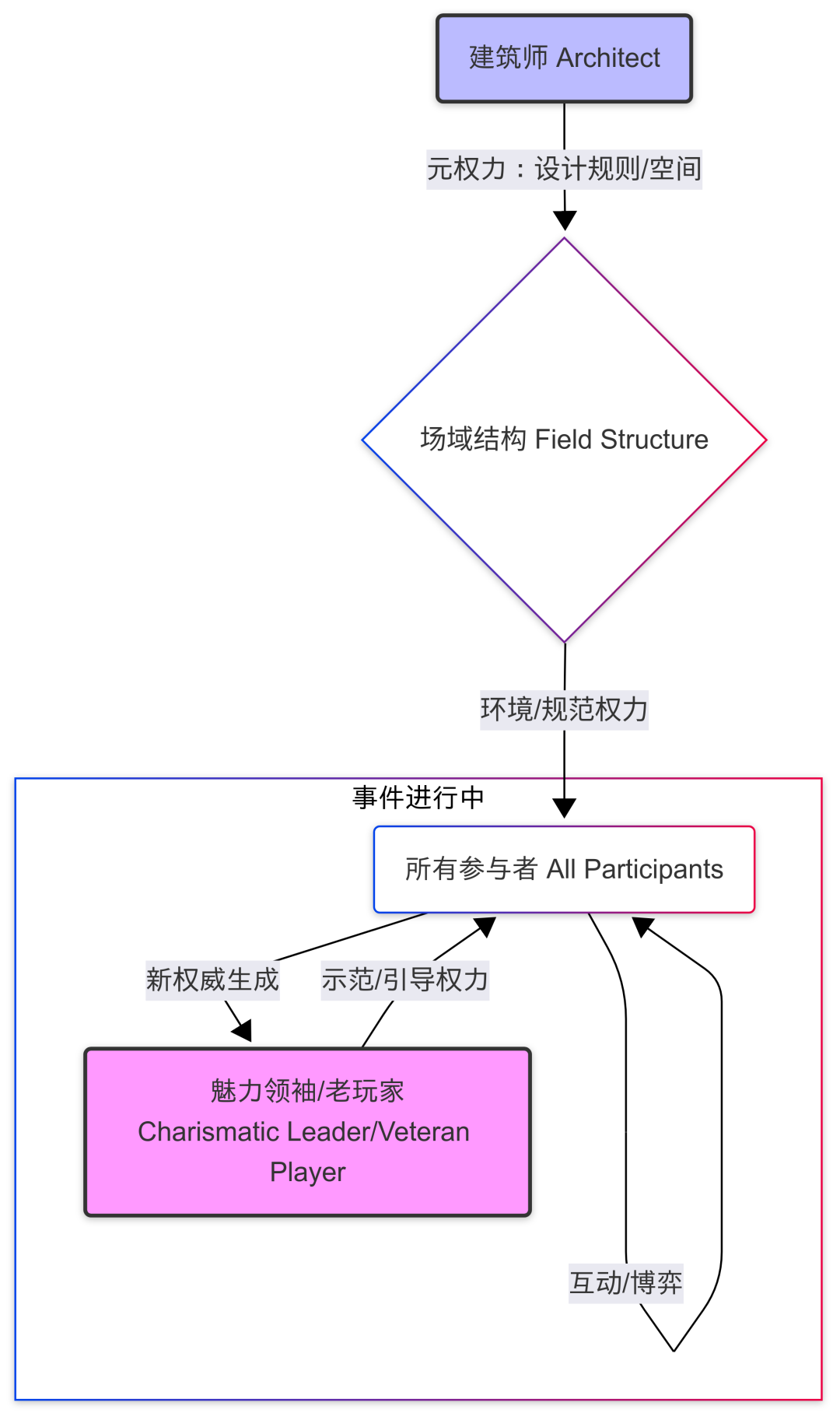
The unshakable meta-power of the "architect": Although the founder or core organizer (architect) chose to be "invisible" during the event, as analyzed in Chapter 2, they have already mastered the most fundamental "meta-power" by designing the initial rules, space, and recruitment. They define the boundaries and basic syntax of the entire "game". The "freedom" of participants is freedom within this preset framework. This kind of power is structural, more diffuse, less visible, and therefore potentially more stable.
The "Charisma" authority of the founder's charisma: In p4's texts and practices, the founder He Fa's personal will and artistic ideas are everywhere. From the introduction of psychoanalysis theory to the philosophical thinking on "failure", his personal imprint is deeply imprinted. Although this kind of "Charismatic" authority based on personal talent, vision and charisma is different from the institutional power of traditional directors, its influence may be more powerful and covert. To what extent is the participants' recognition of the p4 concept a result of following this personal charm? When "anti-authority" itself becomes a kind of authority, is it possible for participants to challenge it?
Invisible levels of "old players" and "new players": In any continuously operating community, a circle structure consisting of "core members" and "marginal members" will naturally form. For p4, there is inevitably an asymmetry in information and experience between those "old players" who have participated many times and deeply understand its "jargon" (terms such as "generation", "disenchantment", "field" and other terms) and unspoken rules, and the "new players" who are entering for the first time. This asymmetry translates into an invisible power relationship. The behavior of veteran players is more likely to be regarded as "examples", and their interpretation of the rules is more authoritative. This may invisibly suppress the spontaneity and creativity of new players, making the so-called "free generation" actually imitating an existing "p4 style".
Therefore, the power analysis of p4 reveals a paradox
In order to realize a decentralized and equal field, p4 must rely on a highly centralized initial design controlled by an "architect"; in order to resist external authority, it may internally generate a new authority based on personal charm and community qualifications. Acknowledging and examining this paradox is key to understanding the complexity of p4.
5.3 The Price of the Real: Ethical Risks from a Lacanian Perspective
P4 TheaterThe most radical pursuit is to capture the "reality" - the "reality that cannot be erased and suppressed". This pursuit can accurately correspond to "the Real" (the Real) in Jacques Lacan's psychoanalysis theory. the Real is the pre-symbolic, traumatic core of reality that transcends language (the symbolic realm) and imagination (the imaginary realm). p4's practice can be seen as a carefully designed "machine", whose purpose is to break the daily symbolic order and imaginative identification, so that the moment of the Real can "pierce" the surface of reality, so that participants can have a shocking experience.
Theater as a "trauma machine": When a participant is asked to perform an embarrassing task in front of everyone, when a heated argument touches the deep personal pain, when the sudden silence makes all disguises invisible... At these moments, the "script" of daily life fails, and the traumatic core of the Real is exposed. This experience is undoubtedly profound and can "liberate" suppressed emotions, but it also comes with huge ethical risks. Does p4 provide participants with adequate psychological preparation and "safety net" to face this possible trauma? When a participant suffers psychological harm during an experience, who in this "decentralized" collective will bear responsibility?
The Gaze of the "Big Other" and Subject Anxiety: The p4 field eliminates the "fourth wall", making every participant completely exposed to the gaze of others (the big Other). This gaze with nowhere to escape will greatly arouse the subject's existential anxiety. As p4's article says: "When you meet naked, you will always feel helpless again under the gaze of the 'big other'." This kind of anxiety is certainly the driving force for "real" reactions, but it may also lead to defensive withdrawal or destructive behavior. To what extent is p4 exploiting this anxiety to achieve its artistic goals? Where are the boundaries of this kind of utilization?
To sum up, p4's pursuit of "truth" is a double-edged sword. It gives his artistic practice unparalleled depth and power, allowing it to access fundamental levels of existence. But at the same time, it also places it in a dangerous ethical terrain. A complete evaluation of p4 must include a sober assessment of the "cost" it may cause. It is not only an artistic community, but also a social and psychological laboratory that needs to take its ethical responsibilities seriously.
Conclusion
6.1 Research summary: P4 Theater as a relational topology laboratory
Through a systematic theoretical construction and case analysis, this study draws a dynamic topological map for the complex practice of P4 Theater in the past ten years. We traverse its seemingly chaotic appearance, delve deeply into its inner generative mechanism, and finally reveal its core logic as a radical sample of contemporary experimental art. The core argument of the study is that the fundamental innovation of p.4 theater stems from its successful ontological transformation from "position" to "relationship". It no longer sees actors as identity entities occupying fixed social "positions"-whether as "actors" or "audiences"-but rather as action nodes that continuously generate their own functions in a fluid network of relationships. Here, action precedes identity and connection defines presence.
To dissect this process, we first critically reviewed the "position"-based topology of traditional drama, and introduced Actor Network Theory (ANT) as a "meta-theory" throughout the text, viewing the field of p.4 as a heterogeneous network "assembled" by human and non-human actors (space, objects, rules, emotions). On this basis, this study originally proposed a four-element dynamic model of "Architect-NPC-Player-Peeper" as a sophisticated analysis tool to track the "translation" process and the flow of functional roles within the network.
Through this theoretical framework, we clearly show that p4's network generation follows a path that can be analyzed: it begins with the "architect"'s foundational "problematization" through rules, space, and recruitment; then, the "NPC" serves as a catalyst to complete the "benefit assignment" to the participants by creating events. "give"; in the most critical link, the individual is "recruited" as an active "player" or a reflexive "photographer" through a phenomenological "leap" full of inner struggle; in the end, in the complex game of "players", the entire network is successfully "mobilized", a Victor Turner (Victor Turner) Turner, "Communitas" based on shared risk can emerge in an unrepeatable moment.
At the same time, this study does not stop at description and praise. In the critical reflection in Chapter 4, we deeply explore the inherent contradictions and tensions of p4 practice. We demonstrate how its "ethics of failure" constitutes a powerful resistance to consumerist art; we examine the regeneration of a new power relationship based on the meta-power of the "architect" and the seniority of the community behind its myth of "decentralization"; and with the help of Jacques Lacan's theory, we reveal the ethical risks and psychological costs that accompany its persistent pursuit of "truth" that cannot be ignored.
6.2 Theoretical contributions and research limitations
The theoretical contribution of this study is mainly reflected in three aspects
Methodological innovation: This article provides a comprehensive analytical framework with sociological and philosophical depth for participatory art and experimental theater research that goes beyond traditional aesthetic judgment and phenomenon description. This framework combines the grand vision of ANT with the micro insights of our original four-component model, demonstrating a possible path for how to systematically study complex, fluid art practices.
Cross-field application and development of theory: By applying ANT to the specific art case of p4, this study not only verified the explanatory power of ANT in the art field, but also enriched and developed the application strategy of ANT through concrete tools such as the "quaternary model".
Promote interdisciplinary dialogue: This study consciously integrates theoretical resources from theater theory, sociology (ANT), psychoanalysis (Lacan), anthropology (Turner) and art criticism (Bishop), aiming to break down disciplinary barriers and explore new possibilities for art research in contemporary theoretical trends.
At the same time, we must be honest about the limitations of this study. First, due to constraints, this study mainly relied on the analysis of public text materials and the interpretation of second-hand experiences, lacking long-term, in-depth fieldwork and participant observation. This makes the analysis of the specific experiences of individual participants potentially insufficient and more of a theoretical deduction. Secondly, this study failed to track the long-term impact of the p4 community after the event-that is, whether and how the experience of this "instantaneous community" was transformed into the participants' daily lives.
These limitations also point out the direction for future research. For example, future research can use more in-depth ethnographic methods to examine how the experience of p4 affects their social relationships and self-perception by following a group of participants over a long period of time. Alternatively, a broader comparative study can be conducted to compare p4 with other domestic and foreign community art projects and alternative organizational forms, so as to locate its uniqueness and universality in a broader perspective.
6.3 Epilogue: Unfinished topology and the social mission of art
The practice of P4 Theater is, by its nature, "generative" and "unfinished". Its topological exploration is always in dynamic change, rejecting any final definition. This may be its most valuable quality today. In a world that is increasingly solidified and "disenchanted" by algorithmic recommendations, virtual social interaction and consumer logic, p4 uses its rough, direct and even risky approach to tenaciously open up a "state of exception", a field where the "iron cage" of modernity is temporarily ineffective.
Here, "playing" is disenchanted, just to allow real encounters to be enchanted; "failure" is embraced, just to allow fragile individuals to connect; "authority" is questioned, just to allow the possibility of co-creation to occur. P4 Theater ultimately reveals to us that community is not a distant utopia, nor is it a ready-made product that can be purchased. It is only when we bravely give up the sense of security conferred by our "position" and devote ourselves wholeheartedly to the unpredictable web of "relationships" that we can experience the fragile and precious reality that we have woven together with our own hands.
This may be the social mission that P4 Theater undertakes at the moment. It reminds us that art can serve far more than just aesthetics or entertainment. It can be a social experiment, an ethical practice, a tool for liberation. It is not only exploring new forms of drama, but also exploring new ways of connection between "people" and "people". It is a painful but necessary exercise that teaches us how to relearn "togetherness" in this age of fragmentation.
Appendices
A. Chronology of P4 Theater related activities
B. Explanation of key terms

C. Relevant interview records
D.P4 Theater related content
P4 TheaterFounderHe FaWeChat