The Enthroned Gaze
A Close Reading of Lacanian Theater Theory in François Regnault's Le Spectateur
The Enthroned Gaze: A Lacanian Restructuring of Theatrical Theory in François Regnault's Le Spectateur
Abstract: This essay offers a systematic theoretical archaeology and critical interpretation of François Regnault's foundational 1986 book Le Spectateur. Traditional theater theory, from Aristotle's catharsis to empirical approaches to spectatorship, has tended to regard the spectator as an empirical individual or group with psychological depth. The central argument here is that, with the help of Jacques Lacan's psychoanalytic framework, Regnault carried out a Copernican revolution in theater theory: he remade the spectator from an active viewer into a passive, structural theoretical position interpellated by the theatrical dispositif.
Through a close reading of Le Spectateur, this essay analyzes the core components of Regnault's theory step by step. First, it examines how the theatrical dispositif operates as a machine for capturing desire: its aim is not to satisfy the spectator, but to sustain the circulation of desire. Second, it focuses on the cornerstone of Regnault's theory: Lacan's dialectic of the eye (l'oeil) and the gaze (le regard). The essay shows that theater is not essentially about what the spectator sees, but about how the spectator is captured by a gaze coming from the stage as objet petit a, and is thereby constituted as a subject through the experience of being watched. Finally, it explores how Regnault uses the concept of the Real (le Réel) to explain those theatrical moments that break symbolic order and produce the unsettling enjoyment of jouissance.
This essay traces the genealogy of Regnault's thought and shows how his theory emerges at the intersection of Lacanian psychoanalysis, Althusserian structuralism, and Brechtian theatrical innovation. Through rereadings of classic cases such as Molière and Claudel, and through attempts to apply the theory to contemporary theatrical practice, the essay argues that Regnault's Le Spectateur provides more than a powerful tool for theater criticism. It reveals theater as a sociocultural practice whose essence is a carefully designed structure of desire, a ritual space in which the subject appears under the gaze of the Other.
Keywords: François Regnault, spectator, Jacques Lacan, psychoanalysis, gaze, dispositif, objet petit a, desire
Introduction: What Do We See, or What Is Looking at Us?
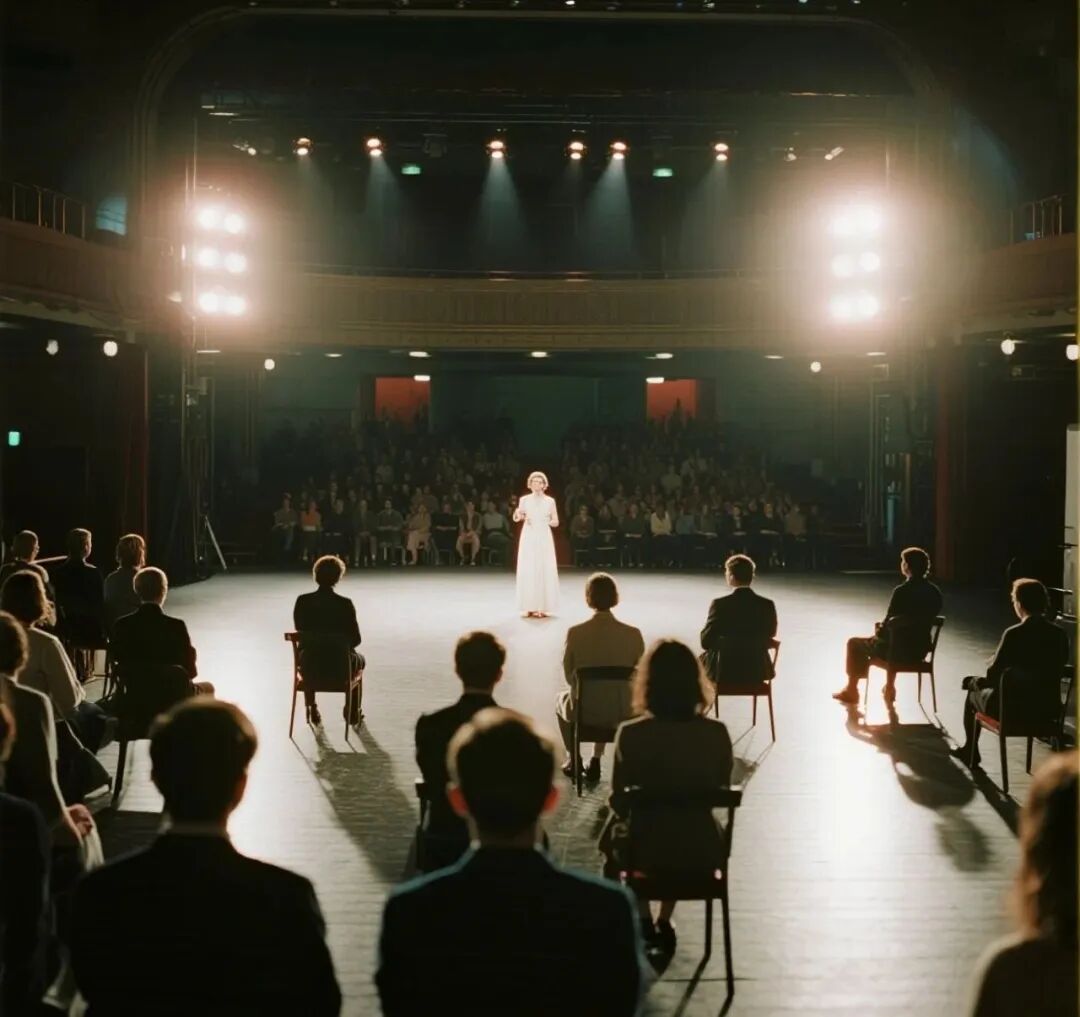
Before the sacred darkness of the theater descends, there is a conventional ritual. The lights dim, noise recedes, and countless independent individuals gather into a silent, expectant community. For a long time, the spotlight of theater theory has remained on the stage: on the grand narrative of the text, the actor's skill, and the director's craft. The audience, that silent sea, even when acknowledged as a necessary condition for theater, is often treated as a passive receiver, a vessel waiting to be filled with emotion and enlightened by thought. We are used to asking: what did the audience see? What did they feel? What did they understand?
Yet in his epochal book Le Spectateur, the French philosopher, psychoanalyst, and theater theorist François Regnault turns this theoretical spotlight around with startling calm and sharpness. His question is no longer about the content of seeing, but about the structural premise of the act of seeing itself. He forces us to consider a subversive possibility: before the spectator watches the stage, has a prior gaze from the stage already fixed the spectator and manufactured them as spectator? The core of Regnault's theory lies here.
We should no longer ask: what does the spectator see? We should ask: what is it, within the scene, that gazes at the spectator and thereby constitutes them as spectator? The spectator is not the subject of a view, but the object captured by the gaze.
This claim transforms the spectator from an object of psychological or sociological study into a purely theoretical object. Regnault's Le Spectateur is not a handbook of audience psychology, but a structural map of theater's machine of desire. The task of this essay is to draw that map carefully, reveal the theoretical forces behind it, and evaluate its value and tensions within contemporary theater theory.
To do so, we first enter Regnault's theoretical arsenal, where three core weapons borrowed from his teacher Jacques Lacan are on display. The first is the theatrical dispositif. For Regnault, theater is far from a neutral space. It is a precise ideological machine in the Althusserian sense. Through architecture, light control, social contracts of silence and attention, and other arrangements, it creates a singular field. The aim of this dispositif is not entertainment, but the construction of a frame that guides and captures libido. Regnault might describe it this way
The theatrical dispositif does not serve our eyes. It sets a trap for our desire. It offers no satisfaction, only a frame in which desire can keep operating. Darkness is not there to help us see more clearly, but to hollow us out and make us pure carriers of desire.
The second, and the keystone of the theory, is the dialectic of the gaze. Regnault strictly distinguishes the spectator's active looking, the eye (l'oeil), from the gaze (le regard), which comes from the scene as object. When we think we are watching the stage, we are in fact being gazed at by some unexpected point on the stage: an actor's look, a prop, even a void. This point of the gaze is, in Lacanian theory, objet petit a, the mysterious object that provokes our desire yet can never be fully possessed. It is the bait of desire, the hook the scene casts toward the spectator.
In the deepest darkness of the theater, when our eyes think they are sovereign, the real light comes from an unexpected point on the stage. It does not illuminate something; it pierces us, declaring: you are here, you are seen. That is the gaze. It is a blind spot, yet it exposes everything.
The third concerns the ultimate aim of theatrical experience: jouissance. Unlike comfortable pleasure (plaisir), which remains within symbolic order, jouissance is a painful enjoyment that appears when symbolic order collapses and the Real breaks in. A slip of the tongue, an out-of-control performance, violence or passion that cannot be explained by words: these are cracks of the Real in the theater. They break theatrical illusion, but they also bring the strongest shock. Theater's highest achievement is to guide the spectator toward this dangerous border.
The essay is divided into four parts
Part I, The Genealogy of a Theory, traces the source of Regnault's thought and situates it at the intersection of Lacan, Althusser, and Brecht.
Part II, Core Concepts of Le Spectateur, provides a close textual analysis of the book's key concepts.
Part III, Applications of the Theory, tests how Regnault uses his theory to analyze specific dramatic works and applies it to contemporary theatrical phenomena.
Part IV, Critical Assessment, reflects on the limits of the theory and explores possible dialogues with feminism, postcolonial thought, and affect theory.
Ultimately, this essay argues that François Regnault's Le Spectateur offers much more than a new method of theater criticism. It is a theoretical prism that refracts the deepest secret of theater as an ancient art form: theater is not about stories, but about desire; not about imitation, but about construction. Its final aim is not to let us see the world, but to let us glimpse, under the gaze of the Other, the unsettling void of our own existence. This is the glorious and thorned crown of spectatorship that Regnault places on us.
Part I: The Genealogy of a Theory, the Intellectual Foundations of Le Spectateur
Part I: The Genealogy of a Theory - The Intellectual Foundations of Le Spectateur
Chapter I: Jacques Lacan's Legacy, Blueprint for a Machine of Desire
Chapter 1: The Lacanian Legacy - Blueprint for a Machine of Desire
Introduction: A Theoretical Transposition
François Regnault's Le Spectateur does not simply apply psychoanalysis to theater, as if inserting a ready-made key into a lock. Its intellectual ambition goes much further. Regnault accomplishes a more thorough and radical theoretical transposition. He rewrites the entire coordinate system of Jacques Lacan's psychoanalytic theory, its topology of subject, desire, gaze, and the Real, into a theory of theater. Here psychoanalysis is no longer an external tool for interpreting theater; it becomes the internal logic of the theatrical event itself.
The theater is not a couch waiting for psychoanalysis. It is already an analytic field. It does not contain the unconscious; it is the public staging of the unconscious (la mise en scène de l'inconscient). We are not using Lacan to explain theater. We are revealing that theater itself is Lacanian.
This chapter draws the theoretical blueprint Lacan provides. It unfolds four Lacanian pillars of Regnault's theater theory: the divided subject ($) as an empty place; the dialectic of the eye and the gaze as the core drive of theater; objet petit a as the bait of desire; and the three registers of the Real, the Symbolic, and the Imaginary (R.S.I.) as the structure framing theatrical experience. Only by understanding this machine of desire can we understand how Regnault frees the spectator from psychological fog and places them on a new structural throne.
1.1 The Divided Subject ($): The Empty Throne in the Auditorium
The starting point of Regnault's theoretical architecture, and also its most frequently misunderstood cornerstone, is his depersonalization of the spectator. To grasp this, we have to return to Lacan's subversion of Descartes' 'I think, therefore I am.' Lacan's subject is not a unified, self-sufficient center of consciousness, but a subject split by language, that is, by the Symbolic and the field of the Other. Its sign is $: S barré, the barred S. The subject thinks precisely because it is caught in language; the truth of its existence lies in the lack that language cannot fully capture.
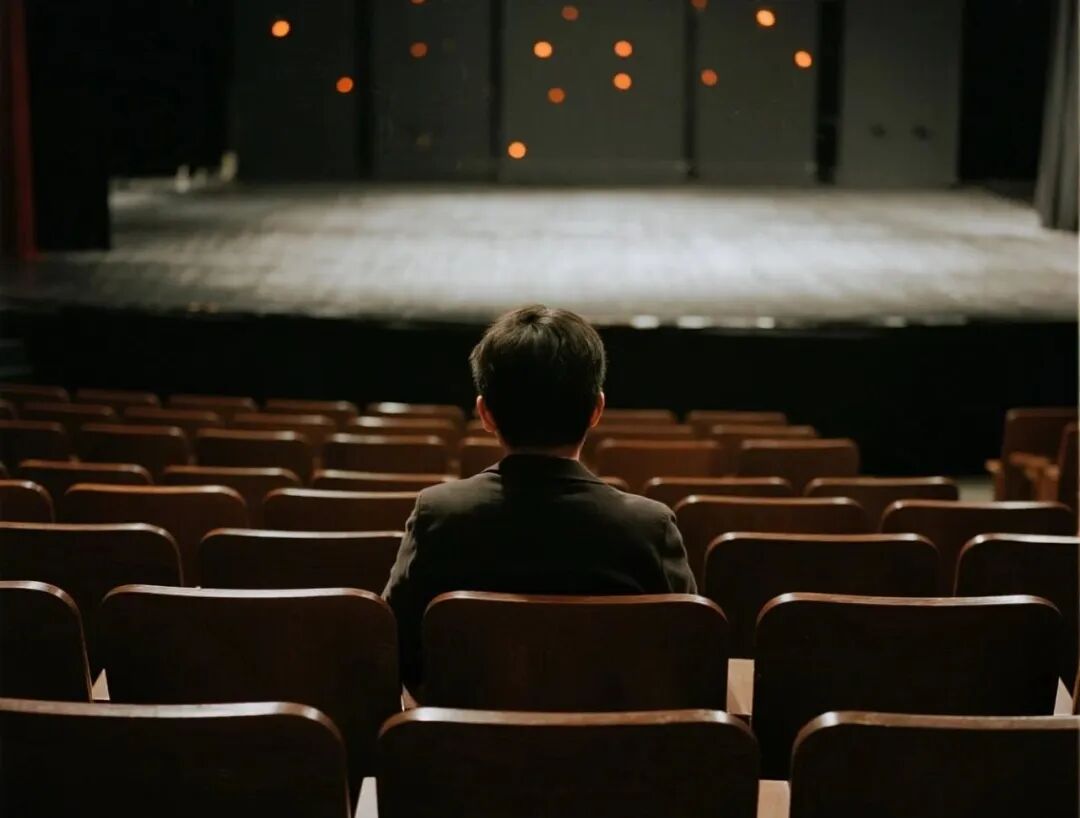
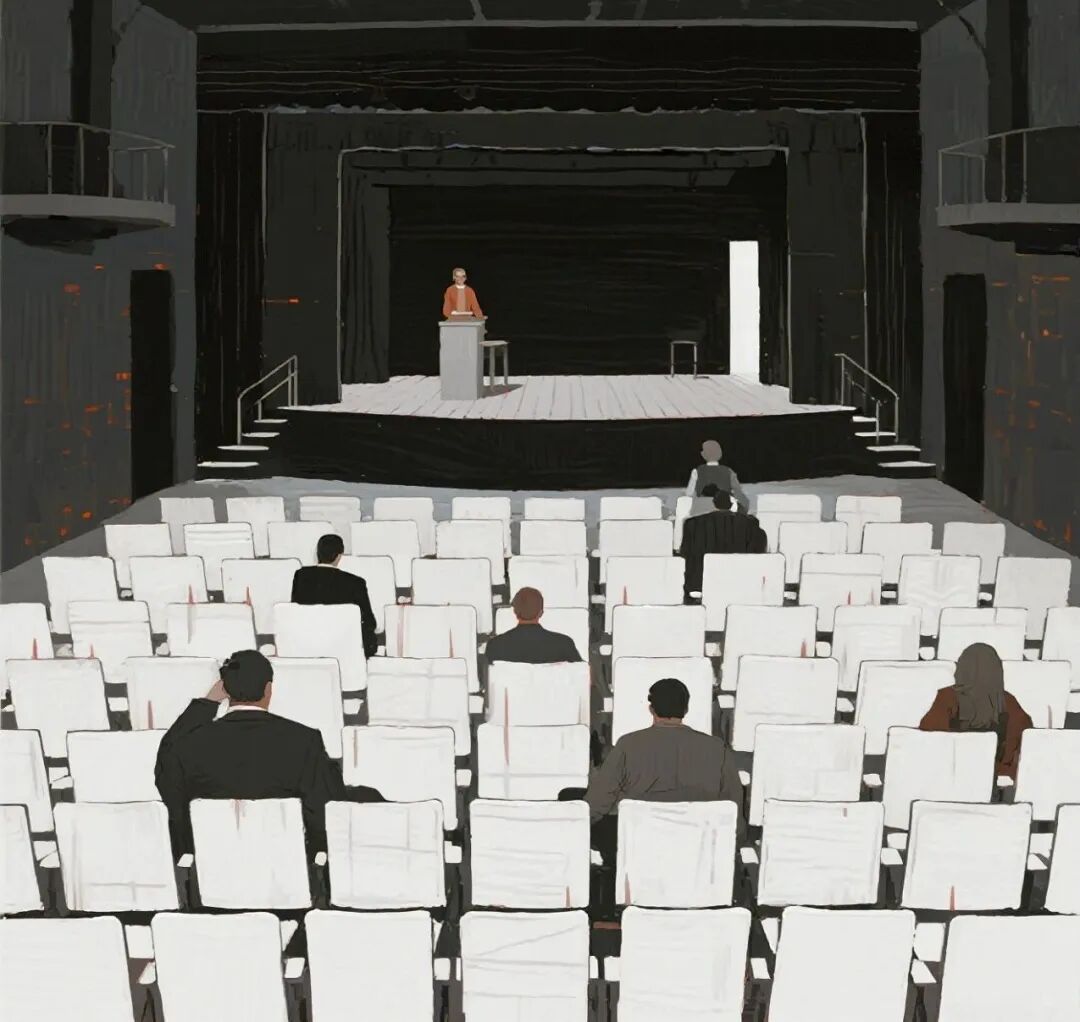
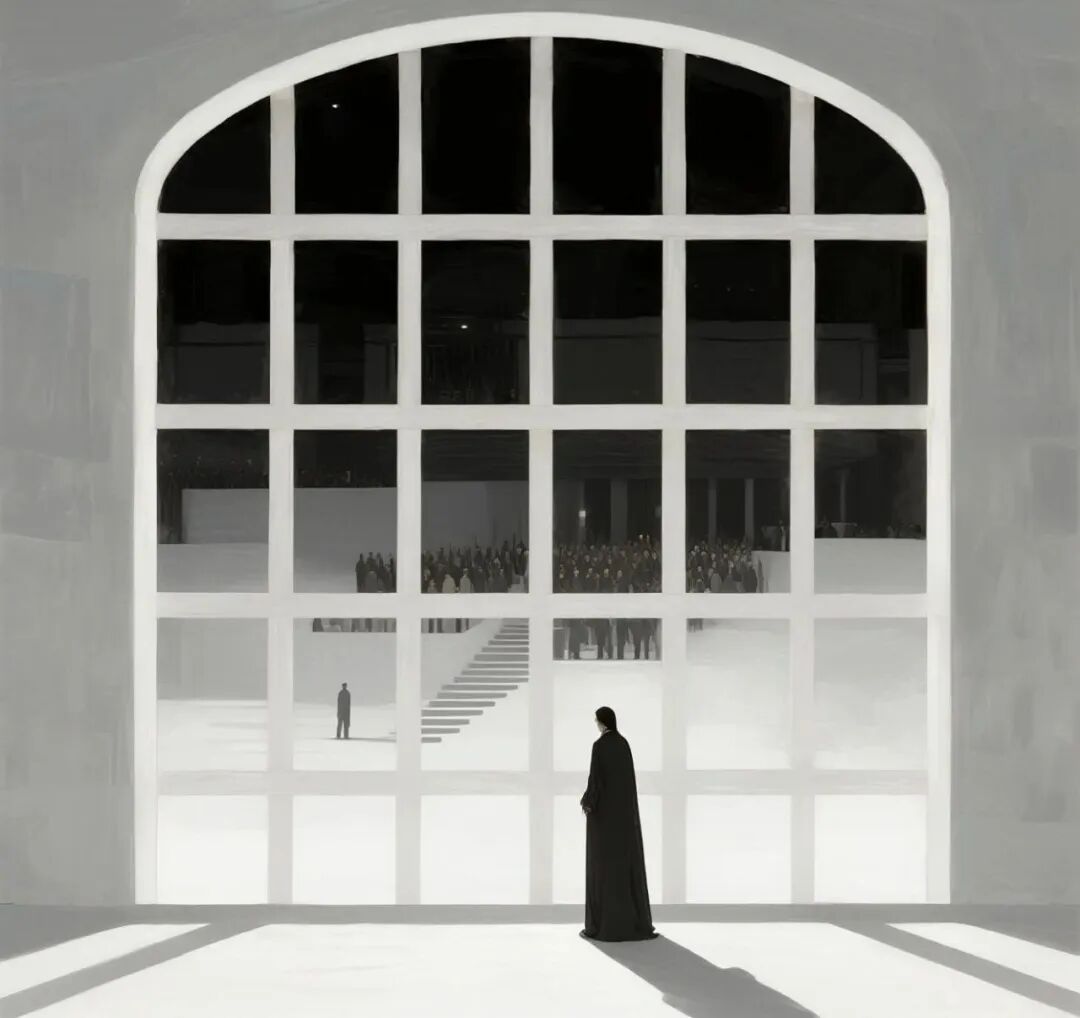
Regnault sees that the auditorium is the perfect topological model of this divided subject. The moment an individual spectator enters the theater and disappears into darkness, they undergo a symbolic death. Social identity, personal psychology, and daily worries are suspended. The spectator is no longer Zhang San or Li Si, but an anonymous, pure position of seeing. This position matters not because it is occupied by a flesh-and-blood person, but because it is itself a structural void (un lieu vide structural).
The darkness of the auditorium is a baptism. It washes away your name, your history, your presence. It does not grant you the power to look. It reduces you to a pure lack. You watch not because you desire to see something, but because you yourself are a void waiting to be filled by images from the stage, even though such filling will never truly occur.
Thus, the "audience" in the Regnault theory was not a "person" in the psychological sense from the outset. He is an algebra symbol () a vector of desire. This radical de-psychological step is essential to enable Regnault to bypass all traditional mudslides on "coherence", "identity", "emotional projection". Recognition does occur, but it is a secondary phenomenon that occurs above this structural space, not the root of the audience experience. The theatre's "devices" call for this empty mass position. Audiences buy tickets and accept the contract: they volunteer to be the vector of desire that awaits definition. This radical de-psychological step is essential to enable Regnault to bypass all traditional mudslides on "coherence", "identity", "emotional projection". Recognition does occur, but it is a secondary phenomenon that occurs above this structural space, not the root of the audience experience. The theatre's "devices" call for this empty mass position. Audiences bought tickets and accepted the contract: they volunteered to be the one waiting to be defined.
1.2 The dialectic of eyes and eyes: the core driving force of the theatre
If the divisive subject is the structure of the gallery, the le regard is the invisible string that connects the stage to the audience. It's the best and most central of Regnault theory. He draws on the well-known distinction Lacan made in the eleventh speech of the The Four Fundamental Concepts of Psychoanalysis
Eyes (L'Oil): belong to the subject and are active, geometric observational behavior. It is understood at the level of our consciousness as a tool for subjects to try to control and understand their visual world. In the theater, that's what the audience thinks it is doing: looking at the stage with its own eyes.
Look at (Le Regard): It's not a subject, it's from the scene itself. It is a pre-existing, objective point from which the light seems to be looking at the subject. It was not seen, but made the subject feel "detected". It is a trap (piège), a stain (tache), an alien that causes major anxiety and desire in the visual field.
Regnault's genius lies in his assertion that the whole of the theatre's "mechanisms" exist, the primary purpose of which is to suppress the control of the "eye" so that "gaze" becomes visible. The darkness of the gallery, the physical distance from the stage, and the programmed performance of actors are all elements that weaken the audience ' s ability to view the stage in a proactive manner and make it impossible to target the stage completely. It is in this sense of power that the audience is more likely to be captured by "gaze".
A classic example is Lacan's narmorphose, which is used to illustrate vision, such as Hans Holbain Jr.'s " Ambassador ". The two ambassadors in the picture represent the height of human knowledge and power (the symbolic world), all of which can be clearly appreciated by spectators (eyes). However, in the future of the picture, there is an unrecognizable stain that has been stretched. Only when the viewer moves to a particular, irregular angle on the side of the painting will this stain appear as a skull - a symbol of death - and an invasion of the Real. This skull, it's "look." It is in the painting, but it is not a narrative; it has been "watching" the viewers and laughing at the futility of their attempts to control everything.
Regnault believes that the theatre is a giant, living deformation.
"Each element of the stage may be the carrier of the gaze. It may not be the main actor, but a tool that is forgotten in the corner; it may not be a key line, but rather a sudden silence; it may even be an unconscious, imperfect gesture by actors. And it suddenly took you, and it made you realize that you were not watching a performance safely, but that you were there, and that you were exposed to the performance. At that moment, you were no longer the owner of the "look" but the prisoner of the "seen."
This experience of visual capture is both disturbing and uniquely attractive. It's the power more powerful than the energy that drives the viewer to keep watching, that's what Lacan calls "vision scopique".
1.3 Small paira (L'Objet petit a): the bait of desire and the magic of theatre
So, what's the mystery point of being a observant carrier? In Lacan ' s theoretical algebra, it is a small pair (objet petit a).
"Small paira" is one of the most complex and central concepts of the Lacanian theory. It is not the object of desire (l'objet du désir), but the cause of desire (la cause du désir). It is a "reste" that the body "falls" when the subject enters the symbolic realm and cannot be symbolized by language. It has no substance per se, it is a "empty" placeholder, but it is this empty space that drives the subject to look for an alternative object to fill it. Common forms of "objet petit a" include breast, faeces, sound, gaze.
Regnault transposed the "objet petit a" directly into the theatre analysis as the ultimate secret of dramatic charm. Everything on the stage, the text, the plot, the frame, is just a framework designed to make a objet petit a emerge.
Actor's voice: It's not just a means of transmitting lines. The sound's sound, the rhythm, the breathing, the physical existence of these transcending semantics can directly affect the audience and be the bait of desire.
Actors' eyesight: When an actor breaks the "fourth wall" and looks directly at the audience, he is not talking to a specific audience, but is throwing his "gaze" as a "objet petit a" to the audience, causing collective commotion and anxiety.
A key props: like the skull of Yorick in Hamlet, it is more than just a props. It carries death, vanity and the past, and it becomes a fascinated "objet petit a" with "gaze".
A silence, a gesture: these non-linguistic moments, which cannot be fully explained, tend to capture audiences better than large lines. They are the "holes" of meaning, and it is from these holes that desire emerges.
"The success of the drama is not so much how complete it is, but whether it has successfully hatched one or more `small pairs'. When the audience comes out of the theatre, it is often not the turn of the plot, but the indelible look of an actor, an indelible piece of music, or a heartbreaking gesture. These are the hooks of desire. The drama never gave us what we wanted, but just what made us want."
1.4 Trawling in the triad (R.S.I.): frame the level of the dramatic experience
Finally, Regnault uses the Lacan's model of ** Borroméen, the Le Réel, Le Symbolique, S, I'Imaginaire, I** the structure around which the dramatic experiences come together.
Imagination (I): This is the most visible and understandable dimension. It is based on Lacan's theory of the "simulation phase", which corresponds to the image of the audience and the actors on the stage. Audiences see their shadows in their characters and share their joy and sorrow. This is where the traditional theatre theory of "complementarity" takes place, and it is the foundation of plaisir. For example, the audience was moved by Romeo and Juliet's love.
Symbolic boundaries (S): This is the skeleton and the rules of the theatre. It includes the language of the script, narrative structure, etiquette, social norms and the social contract of the theatre itself (when to applaud and when to silence). The symbolic community is the domain of the "others" and the expression of social order and law. Audiences understand the drama and follow the ceremonial rituals, and they operate in symbolic circles. It ensures that the theatre is carried out as an orderly event.
Realism (R): This is the most central and difficult dimension. The real world is the one that resists symbolicism, and it is the existence of a disorderly, traumatic existence outside of language. It is not "reality", but a crack in the structure of reality. In theatre, real people usually break in in an alarming and disturbing way
Stage accidents: actors forget their words, their props are damaged, and these moments break the perfect order of the symbolic world and expose its void.
Excessive violence or passion: like Artaud's "cruel theatre", which displays screams, spasms, blood, which go beyond the interpretation of the language and directly affect the senses of the audience, bringing with it a mixed sense of pain.
Laugh: In Regnault's view, especially the Molière's comedy, the deep laughter comes not from pleasure, but from the sudden collapse of symbolic order (such as hypocrisy, rigid social norms). This smile is a release and a tense reaction to the abyss of truth.
For Regnault, a great play is a game of tact between three circles. It attracts audiences first through the identity of the imagination, then through narratives within the framework of symbolism, but its ultimate aim is to occasionally and precisely tear open a crack and allow the "gaze" of the Real to be launched, thereby enabling the audience to experience the profound pleasure that transcends pleasure.
Chapter 2: Framework for Structuralism - From Alducé to Theatrical "Mechanisms"
Chapter 2: The Structuralist Frame - From Althusser to the Theatrical "Dispositif"
Introduction: From the Psychoanalytic 'Inside' to the Ideological 'Outside'
If the first chapter we are talking about the "software" of the dramatic desire machine - that is, the unconscious program provided by Lacan about the operation of the subject and the desire - then the chapter will focus on the "hardware" of the software, that is, the "mechanism" of the theatre. François Regnault is here displaying his deep brand as a Louis Althusser student. He understood the theatre as a specific, historic, material establishment, which functions well beyond aesthetic entertainment. This device has an amazing homogeneity with the "ideological State Machine" in Althusser.
Regnault's idea is that he has welded the grand political theory of Althusser seamlessly with that of Lacan's micro-desiration. In his view, the operation of the theatre was precisely the perfect display of the ideological "interpellation" individual being the subject. The goal of Regnault, however, is not a traditional ideological criticism. He was more interested in how the ideological machine served that deeper, Lacanian desire capture mission.
"Theater is a strange machine. It is dressed in ideology, but with more energy. It calls us citizens, believers or critics, but all this superficial identity is shaped for a more secret purpose: To grind us into a perfect object of desire, a pure object that can be seen through. Ideology is the front stage of the theatre, and psychoanalysis is its backstage."
This chapter will deal with this "device" in two steps. First of all, we will use Althusser's theory to explain how the theatre, as an ideological State machine, "calls" the audience through a series of material practices. Secondly, we will introduce the concept of "structural causality" in order to reveal how Regnault perceives the real dynamics of the dramatic event, not from the intention of the creator, not from the reaction of the audience, but from the very, depersonalized structural operation of the device.
2.1 Ceremony of "Interpellation": Theatrical dispositifs as ideological State machines
In his book Ideology and Ideology State Machines, Althusser drew a distinction between oppressive State apparatuses (such as the army, the police) and ideological State apparatuses (such as churches, schools, families, cultural institutions). The latter function is to reproduce productive relationships through ideology rather than non-violence. Its central mechanism is ** "Call for Information"**: Ideology calls to individuals like the police in the street, "Hey, you!". When the individual responded to this call ("Is he calling me?"), he was "captured" and recognized himself as the subject of this ideology.
Regnault applies the theory almost word for word to the theatre situation. In his view, the process of becoming an "audience" was a typical, highly ritualized call to mind. This process began long before the drama began
Purchase of tickets: This is not only a commercial exchange but also a symbolic contract. Individuals voluntarily accepted the incoming "audience" status and agreed to abide by its rules by buying tickets.
Access and space training: The architecture of the theatre is itself a material expression of ideology. The viewers are directed through specific halls and corridors to find their assigned seats. This discipline of the body, as described by Michel Foucault, is aimed at transforming mobile individuals into fixed and observed objects. Audiences are placed in pre-set "positions" and their bodies are bound to chairs, thus preparing for the spiritual "catch".
Darkness descends and silences: this is the culmination of the call. The darkening of the light is both a deprivation of the everyday world and a mandatory internalization. It removes individuals from social interaction and makes them isolated, stage-oriented units. The silence that follows is a collective submission. The audience gave up the right to speak and gave the right to listen and watch to the stage, the "Grand Auto".
Regnault will describe this process
"When darkness overwhelms you, the call for ideology completes its final blow. It whispers to you: "Hey, you, the man who waited in the dark!" You can't respond because your voice has been denied. The only choice you have is to be the one it defines you as a "Le Spectateur." You think you're looking for a dream of freedom, and in fact, you're just entering a more sophisticated cage."
Through this series of ceremonies, the original heterogeneity of individual collections was successfully shaped as a homogenous and functional "audience" subject. They were informed of their "roles" and "functions" in this particular time - that is, watching and being played by the stage. This ideological construction, carried out by the device, paved the way for the launching of the Lacanian desire mechanism described in chapter I. Without this Alduser-style "teaching" process, the "catch" of the more powerful will be impossible.
2.2 Structural causality (Causalité Structurale): non-substantiated drama
Another central contribution of the Althusser doctrine is its reflection on "structural causality", which is used to counter Hegel's aims and empirical linear causalities. In his view, the various elements of a social pattern (economic fundamentals, superstructures) operated in such a way not because of an external purpose or the intent of a subject, but because of the "presence of an absence" of the entire structure itself. The structure determines the functions and relationships of its internal elements, but the structure itself is invisible and can only be felt through its "effects".
Regnault translated this complex philosophical concept into an excellent analysis of dramatic events. This leads him to an amazing conclusion: the theatre is a non-subjected performance.
Against "authors' intention": The meaning and effect of the theatre does not depend at all on the intentions of the author or director. The creator himself is just one element of this huge dramatic "device", also governed by the logic of structure. They may think they're expressing something, but what really works is the theatre structure itself.
Anti-Audience Focus: Similarly, the effect of the drama does not depend on the individual feelings or collective reactions of the audience. The laughter, tears or applause of the audience is not the cause of the event, but the "outcome" or "symptoms" of the structure.
So where is the "cause" of the drama? Regnault's answer is that the reason is the structure itself. It's the separation of the stage from the audience, the confrontation between darkness and light, the tension between text and performance, the conflict between social etiquette and potential desire. The sum of these relationships, which form the structure of "in absentia", regulates the conduct of the whole dramatic event.
"People always want to find a master for the drama: the ghost of the author, the will of the director, or the trial of the audience? Regnault told us that there was no one above the throne. The real order is the theatre itself. It's like an invisible chess player, moving the actors on stage and the audience down there. The passion, thought or shock that we have experienced is only the effect of the board. The real subject of the drama is the absent structure itself."
This view is highly subversive. It means that the success of a theatre is not so much the result of artistic creativity as the success or failure of a structural experiment. The successful drama is the successful operation of the device, which precisely produces the effects that it is designed to produce - the desire to capture, and to make "gaze" visible.
For example, the reason why a comedy is funny is not how clever the lines are written, but because its script structure accurately touches a point of pain in the social symbolism order (e.g., the Molière's attack on hypocrisy), which triggers the kind of unsettling "smuggling" that the audience sees when the order collapses. Directors and actors, just the implementers of this structural mission.
Chapter III: The echo of the dramatic history - Brecht's legacy and the reshaped "disconnection"
Chapter 3: Echoes in Theatrical History - Brecht's Legacy and the Reinvention of "Distanciation"
Introduction: the productivity of a "mystification"
No scholar trying to build a radical theatre theory in the second half of the twentieth century can bypass Bertolt Brecht ' s legacy. The Epic Theatre and its core strategy, Verfremdungseffekt, which is often translated into French, constitute a watershed in modern theatre practice and theory. It aims to awaken the audience from the hypnotic state of the Aristotle theatre and to replace emotional insulation with rational scrutiny. However, when François Regnault faced this monument, what he did was not simply salute or bypass, but rather a profound, lacanic theory of "diversion".
Regnault's interpretation of Brecht is a highly productive "creative error". He retained the form of "separation" but totally subverted his declared purpose. In Regnault's view, the real power of eccentricity does not lead the audience to a more sober and politically critical subject of consciousness, as Brecht would have wished; rather, by destroying the peaceful identity of the audience in the imagination (l'Imaginaire), it forces it to confront the disturbing "le regard" from the Real (le Réel).
"Brecht thought he was handing the audience an autopsy knife to analyze the pathology of society. But he didn't realize that the blade would turn to the audience itself at some point. The greatest achievement of separation is not to make the audience `see' the fraud on stage, but to make them `felt ' their position as viewers itself, or a trick. It is not a bridge to knowledge; it is a ticket to the abyss of division."
This chapter will begin with a brief review of the original intent of the Brecht doctrine, which is to build a rational, politicized audience. Subsequently, we analysed the core of Regnault's Lacanian toolbox, which was thoroughly reshaped from a cognitive tool of the symbolic community of Le Symbolique to a desire device that touched the Real of Le Réel. This theoretical "assassination" eventually turned Brecht, a Marxist believer, into an unconscious pioneer of Lacanian theory.
3.1 Utopia of Brecht: Building rational, political audiences
To understand the subversive nature of Regnault, we must first clearly grasp the objectives of Brecht. Brecht's entire drama project is based on criticism of the "Aristotle" or "dramatic" theatre. In his view, traditional theatres paralyze the critical capacity of viewers by creating illusions and encouraging emotional resonance between the audience and the role, making them passively receptive to the ideology presented on the stage. This "hypnosis" must be broken.
To that end, he has developed a series of techniques for "out-of-effect"
The actor's "model" is not "playing": the actor should distance himself from the role and "quote" the role's words and actions, like a witness, rather than become a role.
Breaking the fourth wall: speaking directly to the audience, by means of interpretation, singing, subtitles, etc., always reminding them that "this is a performance".
Non-linear, partial narratives: "shows" rather than "scenes" to organize dramas, each of which is relatively independent and aimed at generating thinking rather than promoting suspense.
Exposure of theatre mechanisms: direct exposure to viewers of technology such as light, landscape conversion, etc.
All these techniques serve a common purpose: to prevent the audience from entering the mirror identity of the imagination. Brecht wants to move the audience from a passive "sensor" to an active "thinker" who observes social experiments like scientists. He hoped that the audience would come out of the theatre not with feelings of cleansing, but with questions about social realities and an urge to change them. This is a classic enlightened ideal, one that believes that reason and knowledge can lead to liberation. In short, Brecht is trying to take the theatre experience from imagination to the sense of criticism of symbolism.
3.2 Regnault's Lacanian reading: From political criticism to the appearance of "gaze"
Regnault fully recognizes the validity of Brecht's skills - that they have indeed succeeded in breaking the imagination. However, his interpretation of its "effects" is the same as that of Brechtnan. Regnault believes that when the emotional ties between the audience and the role are cut off, they do not automatically jump into a calm, well-known analyst. On the contrary, they will find themselves in a deeper predicament.
Regnault's argument is that the real result of the out-of-effects is not to push the audience to the rational heights of the symbolic world, but to plunge them into a fissure between the imagination and the symbolic world, and thus to glimpse the Real.
"Brecht wants the audience to be a judge. But when it happened, the audience found itself on the stand. He is no longer a judge, but is tried by that naked and ruthless stage mechanism. What he has experienced is not intellectual clarity, but a sense of dizziness under his eyes, with his own craziness. This is a sense of joy, not knowledge."
From this point of view, Brecht's drama, and in particular its most successful practice, is the perfect producer of "jouissance". The shock that the audience experienced in "Mother and her children daring " may not come at all from a rational reflection of war, but rather from the role of a bold mother itself as a stubborn, never-ending "little pair of aa", who dragged her truck like the hard core of a real world and repeatedly struck the logic of symbolic order. What the audience feels is a complex feeling of piety and pain, which is the characteristic of pleasure.
Thus, after Regnault's reread, Brecht became a contradictory hero. He wanted to create a Marxist, materialistic theatre, but inadvertently became the most profound dramatist of Lacanian theory. He wanted to reveal ideological hoaxes, but unexpectedly revealed the truth about the structure of desire. He wanted the audience to be the master of history, but he let them experience the weakness of being the object of desire.
Part II: The refinement of the core theory of Audience
Part II: A Close Reading of the Core Concepts in Le Spectateur
Chapter 4: "Audiences" as a hollow place (Lieu Vide)
Chapter 4: "The Spectator" as an Empty Place (Lieu Vide)
Introduction: a concept cleansing
In the long history of theatre theory, the word "audience" has become overstretched by a hierarchy of psychological, sociological and ethosistic interpretations, and has become swollen rather than pure. It usually points to an empirical entity: individuals or groups in the theatre who have flesh, emotions and ideas. Theorists are constantly studying their reactions, their understanding, their social composition. However, François Regnault began a radical concept of "cleaning". He waved the occam razor, shaving it away from all the empirical, psychological flesh attached to the word "audience" until it revealed a structural, algebraic skeleton.
Regnault's analysis of the "audience" is not any one of you or me who went into the theater, but the functional space that the drama "devices" envisaged. This position precedes any individual and defines the functions of any person who occupies it. This is a complete dehumanization and formalization, based on the doctrine, as we have discussed in chapter I, of Lacan's doctrine on the division of subjects ($).
"We must clear the audience before we discuss the audience. We must forget the faces, the expectations, the whispers. What we're dealing with is not a crowd, but an architectural and theoretical void. This void is "audience." Everyone who comes in after that is just this empty temporary, fungible filling."
This chapter will elaborate further on this core argument. We will begin with an analysis of how Regnault systematically criticized and rejected traditional audience theories. Secondly, we will elaborate on the key distinction between "location" and not "individual" and reveal the structuralist logic behind it. Finally, we will explore the underlying motivations for viewers to enter the theatre - not to seek entertainment or inspiration, but to participate in a game of desire that is doomed to failure, driven by its inner "manque".
4.1 Criticism: rejecting the audience in psychology and sociology
Regnault's theoretical construction began with a complete "break". He pointed to two mainstream audience models
The Psychological Paradigm: This paradigm is based on the Catharsis of Aristotle and follows the classical theory of epathy, until modern emotional projection and identity. The common denominator is that they place the core of the dramatic experience in the inner psychological activities of the audience. Through their role identity, they experience emotional ups and downs and downs, eventually reaching some kind of psychological balance or disillusionment. According to Regnault, this model makes a fundamental mistake: it misperceives the "effect" (e.g. emotional) of the theatre as the "cause" or "essential" of the theatre.
"Psychology turns the theatre into a large emotional clinic. It cares whether the audience cries, laughs and is satisfied. But it's like studying the side effects of drugs without concern for their chemical composition and functioning mechanisms. Audience emotion is simply the steam that desires the machine to operate, not the fuel that drives it. The real fuel, the structure, the missing."
The Sociological Paradigm: This paradigm focuses on the social composition of the audience, class affiliations, cultural capital (e.g. the theory of Bourdieu) and the ritual function of visual behaviour as a social interaction. Regnault does not deny the validity of these analyses, but he believes that they also remain at the surface of the phenomenon. Sociological analysis can tell us who is watching, and the social context in which they are watching, but it cannot touch on the power of the act itself.
"Sociology paints us a map of the gallery, which shows class, taste and distribution of power. This is a useful map. But it's a map. It doesn't tell us under the surface that all this is driven by an unconscious desire geological formation. When you sit in that darkness, you bow to the same law of desire, whether you are a nobleman or a civilian."
Through this double-line criticism, Regnault cleared an empty space for his theory. The "audience" he wants to study is neither a psychological "inner me" nor a "identity" of society, but an abstract, a priori structural existence.
4.2 "location", not a person: the triumph of structuralism
The concept of "location" is a key entry point to the understanding of Regnault theory. It is derived directly from the structuralist ideology of Althusser and Foucault. A "location" is the sum of a series of relationships and functions defined by a larger structure or "device". For example, on board, the meaning of the "king" position is determined not by the physical properties of the wood or ivory, but by its relationship to other pieces (post, vehicle, soldier) and the functions it has been assigned to (the end of the "dead" game) throughout the rules of the game (the symbolic world). Any piece of wood that meets the specifications is put on it, and the king is.
Regnault applies this logic perfectly to the audience
Defined by the device: The viewer's "location" is predefined by the theatre's "device". It is defined physically (on a particular seat in the gallery), sensoryly (in darkness, towards light sources) and socially (required to be silent and expected to react at a given moment).
Functional rather than substantive: The function of this position is to become the "other pole" projected by stage action. Without this "place" of viewers to receive and be played, performances on stage are meaningless and cannot even constitute "acts". Its function is to be "visited", "acted", thus making the stage the subject of "seeing" and "role".
Replaceability: Who sits in this position, from a structural point of view, is irrelevant. The psychological differences of the individual, the social context, bring only some "colour" or "noise" to this abstract structural position, but do not change the function of the position itself. A doctoral student and a plumber, once in the audience, must follow the same basic rules, which are equally exposed to "gaze".
"Don't ask, "Who am I?" When you're sitting in the theater. And ask, "Where am I?" Your identity has been replaced by the position you occupy. You are no longer a person of free will, you are a functional point in a structure. Your mission is to perform the role of "audience" -- a passive, expected, ready to be captured."
This view is cold, but it has a strong theoretical interpretation. It explains why hundreds of different people can be shaken by the same drama at the same time. This is not because they share a common mentality, but because they occupy a "position" of the same structure and are hit by the same structural event.
4.3 Tickets to desire: as the "missing" subject
If "audience" is just an empty functional position, then what drives a living person to occupy it voluntarily, and even for a fee? Regnault's answer is back to Lacan: it's desire (désir), the root cause of which is the intrinsic and irreparable "miss" (manque-à-être).
Rakan believes that at birth, a person is thrown into a web of languages (the symbolism) from a complete state of completeness with his mother. This process has made us "subjects", but it has also deprived us forever of the primitive state of existence, which coincides with the existence of "être". As a result, the subject became a fundamental "miss of existence". Desire, which is the missing form of school expression that drives us to find the object that fills this void - the "objet petit a".
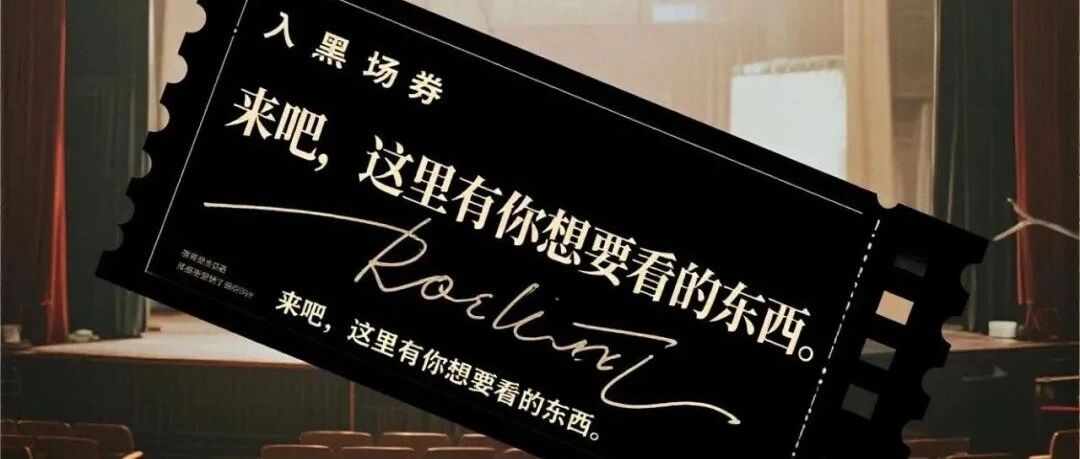
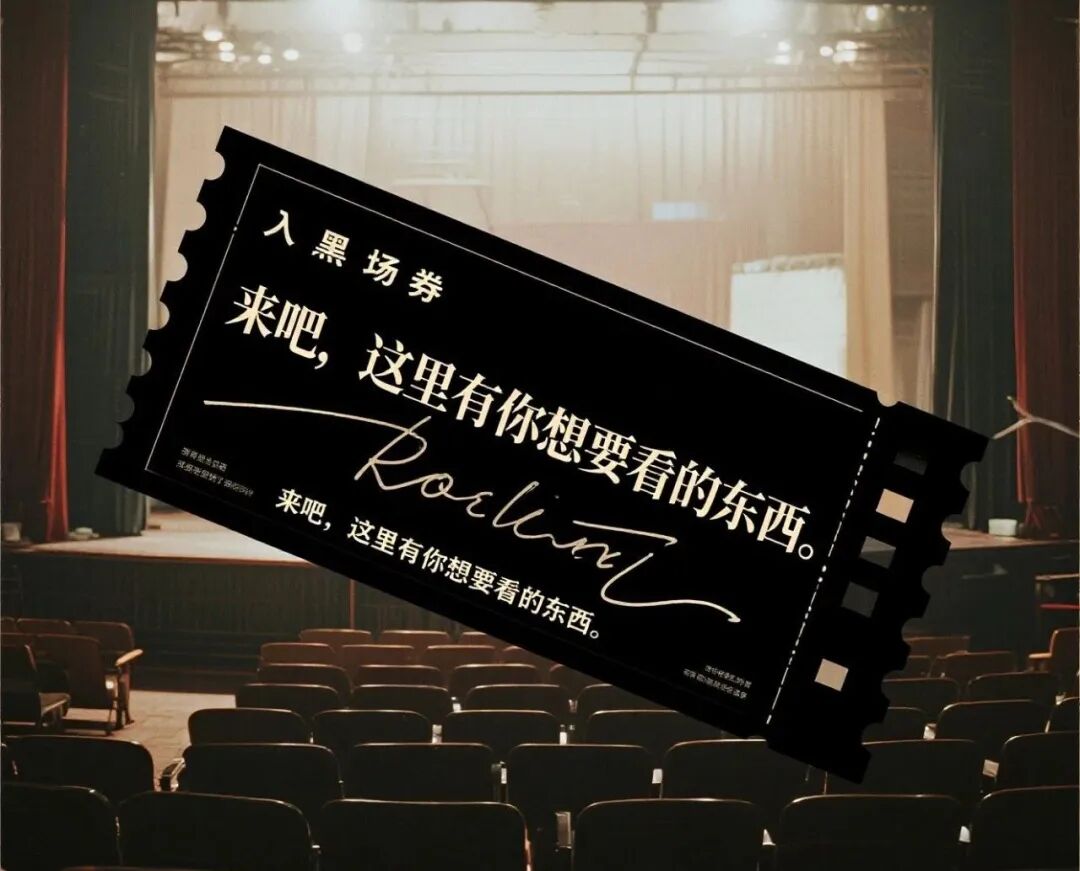
Theater, in Regnault's view, is the perfect stage for this desire to pursue the game. It promises to potential audiences through propaganda, posters, play reviews: "Come on, here's what you want to see. There are wonders, passions, secrets. The hole in your heart will be filled here."
"The ticket is not a piece of paper, it's the physical form of your desire. What you bought was not a show, but a promise -- a false promise of satisfaction. The theater says to your desire, "I know what you want." And your desire says, "Please show me." It's a scheme destined for conspiracy from the beginning."
However, the real trick of the dramatic device is that it never really delivers on that promise. It only keeps "showing" the bait of desire (small pair a), but also "hidden" by various means (e.g. delay in the plot, symbolic veil) so that the flames of desire remain burning rather than being extinguished by satisfaction. Audiences experience a two-hour show not with the missing filled full, but with a cycle in which desire is inspired, seduced and sustained. When they leave the theatre, the audience does not take away satisfaction, but rather a more explicit "satisfaction". This is why the audience will return to the theater again.
Chapter 5: Theatrical "devices" (Le Dispositif Théâtral) - machinery to capture obscurity
Chapter 5: The Theatrical "Dispositif" - A Machine for Capturing the Gaze
Introduction: From a Space to a Machine
In daily languages, "theater" usually refers to a physical space, a building in which the theatre is performed. But in François Regnault's theoretical vision, "theater" was replaced by a more dynamic and functional term: "le device". This concept, which is deeply influenced by Michel Foucault's philosophy, refers not only to a passive container, but rather to an active, heterogene collection (ensemble hétérogène), whose members include words, formations, construction forms, legal provisions, scientific statements, philosophical and moral propositions. The essence of the device lies in its strategic function - to respond to and influence an emergency in a network of power and knowledge.
Regnault transposed the concept to the theatre with revolutionary intent. Theatrical "devices" are no longer simply a combination of stage, light and seating; they are a carefully designed desire machine with clear strategic objectives or a more powerful machine. Its state of emergency is the "miss of existence" of the subject; its strategic objective is to capture, direct and ultimately shape the desire and gaze of the audience.
"Don't treat the theatre only as stones and velvet. To see it as a hunter's trap. Each element - darkness, silence, the height of the stage, the rise and fall of the curtain - is part of a trap that is carefully designed to lure prey (the desire of the audience) into a particular path and eventually exposes it to the deadly blow of `gaze'."
This chapter will dismantle the complex machine. We will first analyse the key "parts" that make up this machine and reveal their respective functions. We will then focus on the core production area of the machine, La Scène, and explore how it can become the domain of the Grand Auto and the launching pad of the Eye. Finally, we will analyze the main production activity of the machine, "La Représentation", and reveal its dialectic as a "ruse", with the aim of demonstrating and concealing the eternal tension between desire and desire.
5.1 Composition of the device: Anatomy of a desire machine Learn.
Regnault's concept of "devices" is holistic and emphasizes synergy between elements. For clarity of analysis, we can break it down into the following key subsystems
1. Architectural subsystem (The Architectural Sub-system): this is the most material expression of the device.
The two-dollar dichotomy of the stage/audience: this is the most classic and ideological design of the proscenium stage. It physically divides two worlds: a bright, watched, actiond "stage"; and a dark, watchful, static "audience". This separation imposes a fundamental power relationship that is seen and seen.
Darkness and light: the darkness of the audience is, as stated above, a deprivation that emptys the individual and makes it an anonymous, vulnerable desire container. And the light of the stage turns it into an isolated visual focus that is given special importance. Light is not here for lighting, but for "framing", to cut a space of desire out of a messy reality.
2. The Social Contract Sub-system: Unwritten rules for the installation of non-materials.
Orders of silence: The audience is expected to remain quiet and to give full voice to the stage. This reinforces the position of the stage as the sole source of meaning.
The obligation to focus: the audience is expected to focus entirely on the stage, and the light of a mobile phone or the exchange of ears are seen as an act of "defunct". This focus ensures that the energy of desire is not drained, but is fully directed towards the goals set by the device.
Collective conspiracy: Audiences collectively agreed to "presumably believe" what happened on the stage, that is, "willing suspension of poems". Regnault would go further and say that this is a collective conspiracy of desire, and that we all work together to preserve the illusion so that the game of desire can take place.
Technical aesthetic subsystem (The Technology-Aesthetic Sub-system): This is the component of the device responsible for the production of "content".
Le Rideau: The curtain is a perfect symbol of the dialectic of desire. When it closes, it hides the stage, thus greatly stimulating the audience's expectations and imagination ("What's after it?"). When it rises, it reveals the scene, it seems to satisfy the desire, but it actually leads it to more specific objectives. Every rise and fall of the curtain is a provocation and a reset of desire.
Texts and performances: the language of the script, the suspense of the plot, the body of the actor, the sound, the gesture, are specific tools designed to produce a "small pair". Together they made a web of meaning and sense to capture audience attention.
"The device is a ruthless conductor. It divides the acoustics with a command bar of the building, creates tension with dark sedentaries, and harmonizes the rhythm with the social contract rhythm. Actors and text are just notes on its score. And the whole symphony has one theme: desire. There's only one audience: the empty audience."
5.2 The stage (La Scène) as the domain of "others" and the source of "gaze"
Of all the parts of the device, the stage (La Scène) occupies an absolute central position. In Regnault's Lacanian interpretation, the stage acquired a dual identity
This post is part of our special coverage Global Voices 2011. In the Lacanian theory, the "big other" is the incarnation of order and the assembly of language, law and social norms. It is a virtual authority that guarantees consistency of meaning. The stage, in the theatre, played that role. It is the source of meaning and the issuer of all the rules. The characters speak on stage, but what really speaks is the language itself, the "big other". The audience believes in stories that happen on stage because they acquiesce in the authority of the stage as "others".
"Le Regard" launch pad: however, the stage is not just the perfect symbol of order. It's also a place full of cracks and blind spots. It is in these cracks that "gaze" occurs. When problems arise in the functioning of the symbolic order -- for example, when a character utters some kind of madness that goes beyond everyday logic, or when a scene displays pure violence that cannot be fully explained by language -- - The stage is no longer a source of stability, but has become a disturbing mystery with a "real world". At this point, the stage is no longer just a "visited" object, and it is beginning to "see" to the audience.
"The stage is a double god. On one hand, rational, spoken and fatherly, it tells us stories and establishes order. On the other side is the silent, irrational, Medusa-like gaze, which says nothing but petrochemicals us with its very existence. The art of theatre lies in the alternation of the two faces, maintaining a dangerous balance between order and chaos."
5.3 The dialectic of La Représentation: displaying and hiding the trick Count
And finally, we're going to analyze the main production activities of the machine, namely, "reproduction" or "movement". Since Plato, "re-emerging" has often been understood as a "mimesis" of reality. Regnault totally abandoned that view. In his view, the re-emergence of theatre was not a mimic, but a unique production that produced the effects of desire. This productive activity is a fine "ruse", the core of which is a dialectic between display and concealment.
Montrer: Theatrical dispositifs must show something to attract and focus desire. It shows wonders, shows conflict, shows the body and emotions of actors. This display is a direct call to the audience ' s desires and promises a visible and consuming satisfaction.
Hide (Cacher): However, if desire is fully satisfied, it dies. The device must therefore be concealed simultaneously.
Physical Hiding: Creating an "hos-scène" by using sidescreens, backstages, scenes to make people think that something more important is happening there.
Hiding narratives: Delaying the discovery of key information through suspense, riddles, pens.
The hiding of symbols: the language itself is a concealment. It represents what is referred to (signifié), but it means that it can never be completely captured. The more the lines are spoken, the more the unspoken "real" lies behind them.
This set of displays and hidden games creates a constant tension. The audience was like the kid in Lacan's fable who looked at the closed door, and the closedness of the door itself was more stimulating than anything that might exist behind it. The re-emergence of the theatre is one of these open doors.
"The re-emergence of art is not to show us, but to make us long to see. It's like a strip dance, and every revelation is accompanied by a new shade. Its ultimate purpose is not to show us nudity (reality), but to keep us forever in the expectation of nudity. The truth of the drama is not what it shows at last, but a series of elegant deceptions that it sustains our desires."
Chapter 6: The moment of jouissance - when real people break in
Chapter 6: The Moment of Jouissance - When the Real Intrudes
Introduction: Beyond the Pleasure Principles
In traditional aesthetic discourse, the end point of artistic experience is often described as "plaisir" or "beauty". It is a harmonious, comfortable experience that makes the subject feel whole and content. It follows the "pleasure principle" of Freud's early theory, i.e. the tendency of power over multi-economic systems to seek less tension and more energy stability. However, one of the most subversive contributions of the Lacanian theory is the introduction of a concept that goes beyond the principle of pleasure: "Jouissance".
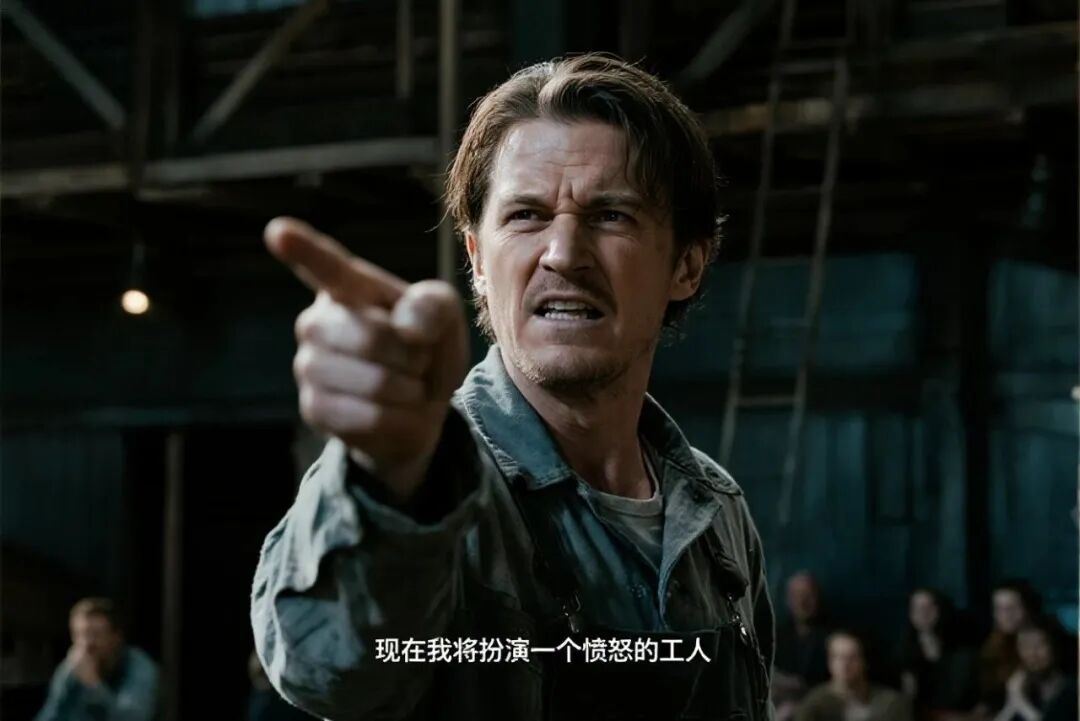
Jouissance is a very difficult French word to translate. It is not simply "enjoy" or "happy". It is an excessive, painful enjoyment, an almost unbearable joy when the subject is too close to the heart of the traumatic, unsymmetrical "real world", the "das Ding, la Chose". It is a destructive force that threatens the stability of subjects and the balance of symbolic order. If "happy" is a game within the rules of the symbolic world, "happy" is the burning of the rules themselves.
François Regnault introduced this concept into the dramatic theory, with a shocking intent. He asserted that the aim of the most profound and great theatre experience was not to provide comfortable "happy", but to push the audience to the edge of "happy". The ultimate purpose of the dramatic device is not to comfort the audience, but to allow them to experience the faintness of the mass collapse.
"Enjoy is the sugar coat of the drama, and pleasure is its bitter medicine. The audience came for sugar coats, but a great play would inadvertently let him taste the bitterness of medicine. This bitterness, burning your throat, makes you feel like you're alive. It destroys you, and it is in this destruction that you touch a core of existence. This is the tragic grace of the theatre."
This chapter will first clarify the key difference between "happy" and "happy" in theatre. We will then analyse in detail the typical moments in the dramatic performances of the Real, which can trigger pleasures. In conclusion, we will take the example of Regnault's in-depth analysis of the particular phenomenon of "laughter", which reveals that even the most profound roots of comedy can be embedded in the soil of pleasure.
6.1 Distinction between Plaisir and Jouissance: two economic models of theatre experience
In order to understand Regnault's argument, we have to draw a strict distinction between two different forces over a multi-economic model
1. The Economic of Plaisir
Area: the imagination (I) and the symbolism (S).
Principle: Reduce tension, maintain balance and follow social norms and linguistic logic.
Theatre performance
Fulfillment: a story of a structured, first-end response, puzzles solved and conflicts resolved.
Emotional resonance: Audience works with the protagonists of good and is satisfied to see the bad people punished.
Convergence of aesthetics: beautiful lines, harmonious designs, flowing performances, everything is right.
Audience experience: comfort, safety, controllability, satisfaction. The subjectivity of the audience is recognized and strengthened.
2. The Economic of Joy
Area: Real world (R) intrusion.
Principle: Unlimited increase in tension, disruption of balance, transcendion of language and symbolic order.
Theatre performance
Fragmentation of structures: no logical leap, no extenuating circumstances, open and disturbing endings.
Emotional spillovers: Actors display uncontrolled, excessive passions (screams, spasms, ecstasy) that are stronger than role-playing needs.
The disharmony of the aesthetics: stingling voices, unstable images, disturbing scenes of violence or pornography, challenging audience senses and moral bottom lines.
Audience experience: painful, dangerous, out of control, fascinating. The subjectivity of the audience was threatened, feeling divided and dizziness.
Regnault believes that most of the theatres remain at the "joy" level, which is a good entertainment product, but not a great art. Great art, such as the tragedy of Sophukles, some of Shakespeare's works, and Artaud's idea of a "cruel theatre", have in common the courage to touch the forbidden zone of "excitedness".
"The drama of joy is like a loving mother who embraces you and tells you that everything will be all right." The pleasure drama is like a strict father or a crazy lover who challenges you, hurts you, forces you to face your own existence for nothing. We aspire to the former, but what we really remember is the latter."
6.2 Intrusion of the Real: the pleasure trigger in the theatre
A sense of pleasure is not a commodity that can be produced at will. It only happens at certain moments when the veil of symbolism is torn open and the Real's hard core is torn apart. Regnault, in Audience, suggested a variety of such triggers
The actor's "Présence" is not a good actor. It refers to the physical presence of actors that transcend the role they play, and the physical nature of their bodies - sweat, fatigue, breathing, potential vulnerability - directly impactes the audience. At that moment, the audience saw no longer Hamlet, but a real, dead body speaking of death. This "physical presence" is a piece of reality.
The limits of language: A sense of pleasure may arise when a language reaches the boundaries of its ability to express.
Poetry's ecstasy: like the raging poems in Claudel's play, which are almost out of grammatical control, the language itself seems to be burning, trying to speak out.
Scream and silence: a pure, non-linguistic scream, or a long, intense silence, can point more than words to the hollows of the Real.
"Accidents" on stage
Unintentional accidents: actor forgets words, props are damaged. These moments break the perfect illusion and expose its falseness. Audiences experience a strange feeling of embarrassment and excitement, which is the faint form of pleasure.
Intentional "accidents": Such "accidents" are often deliberately created by modern pioneer theatres. For example, an actor suddenly stopped performing and began to talk about his private affairs; or a performance deliberately went out of control and chaos. These strategies are designed to force the Real into the arena.
Cruelness and violence: Alto's "cruel theatre" is the ultimate example of the theory of pleasure. He wants to play a direct role in the audience's nervous system through plagues, spasms, bloody images, bypassing reason. Such a direct attack on the body is intended to destroy symbolic defence and give the audience the experience of a life-shock in a primitive, pre-linguistic language. It's a pure, deadly pleasure.
6.3 The paradox of the smile: comedy as another form of pleasure
Regnault's analysis of "favourableness" is no more unique and profound than his application to comedy, especially in the case of Molior. The traditional theory is that the smile is based on a sense of superiority (Hobbs), disharmony (Condé) or depression (Freud). Regnault offered a Lacanian interpretation.
In his view, the laughter of the Molière comedy (such as The Hypocrites) was not an easy pleasure. It is a complex and even somewhat tense response. This laughter is rooted in the fact that the audience has witnessed the cornerstones of social symbolism (legal, moral, linguistic, etiquette), shaken and subverted by an intruder (such as the hypocrite Darduff) or a stubborn (such as the cynical Alceste).
Tartuffe is a perfect "semblant." He was so perfectly imitating the symbol of religious piety that the whole symbolic order could not help him, and he almost devoured him. The audience laughed because they saw the incompetence and fragility of the symbol order. Law and language appear so vulnerable in the face of pure disguise.
Alceste is the voice of the "real world". He refused to symbolize the compromises and lies of the world and insisted on saying "all the truth". This pursuit of "real" also poses a deadly threat to the symbolic order of social interaction.
In both cases, the audience laughs with a fear. They laughed because the hypocrisy that symbolized order had been revealed; but they were also afraid because the social fabric on which they depended was so unreliable.
"Morey's laughter, standing by the abyss. You laughed at that clown who almost dumped the building, but your laugh was so cold and sweaty, because you realized that the building you lived in was not solid. Such a smile is an early mourning for the death of the symbol of order, as well as a sickness from the death."
So, comedy laughs, in Regnault's view, can be the path to "jouissance", like the tears of tragedy. They all come from the sight of a symbolic breakdown. Tragedy is facing this collapse, and comedy is dealing with it in a dramatic, defensive way.
Part III: Application of Theory - Theatrical Critic Practice of Regnault
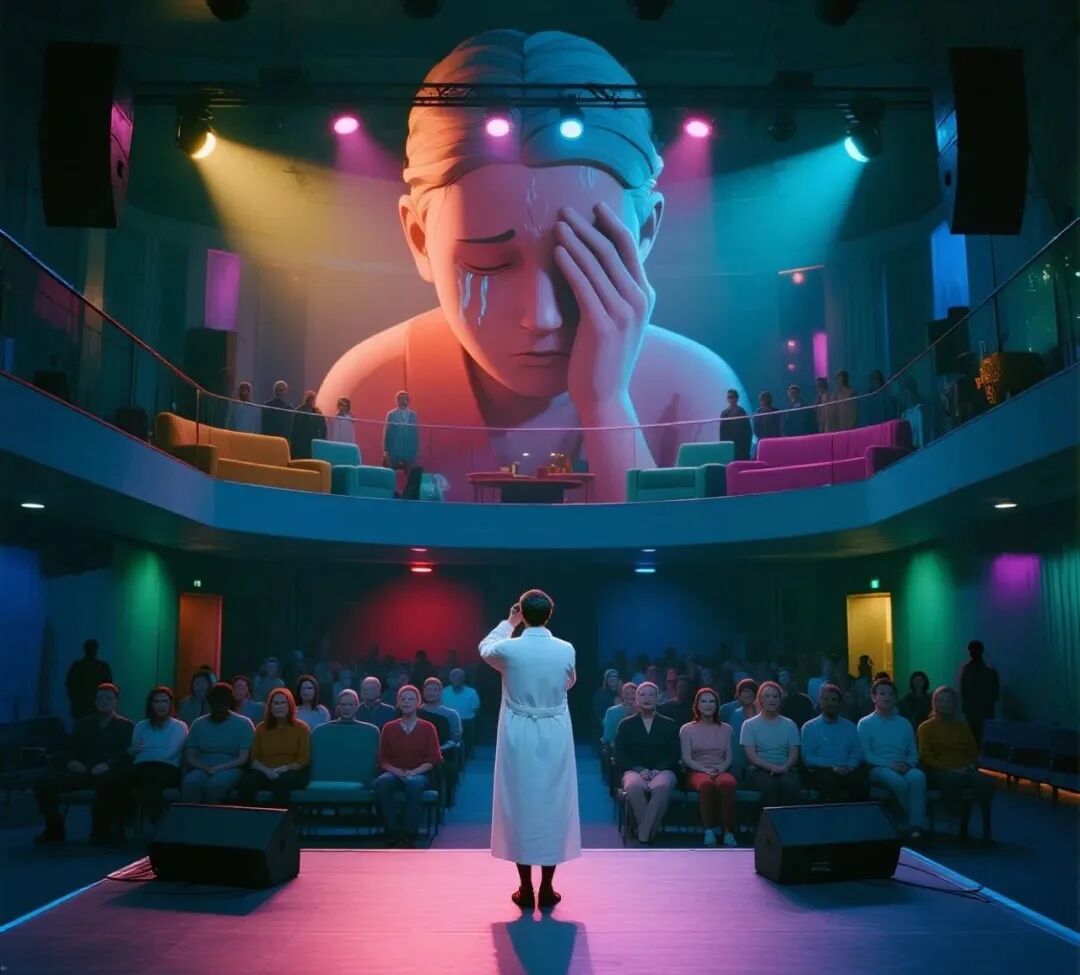
Part III: Theory in Application - Regnault's Practice of Theatrical Criticism
Chapter VII: Case analysis - tracking eye view in classic texts
Chapter 7: Case Studies - Tracking the Gaze in Canonical Texts
Introduction: From Blueprint to Architecture
If the first part is a theoretical blueprint, the task of this chapter is to show how Regnault uses this blueprint to analyze the specific theatre "building". Regnault's critical practice is not a simple "subject analysis" or "person review". It is a structural diagnostics. Like a psychoanalyst, he listens to this "patient" phrase of the dramatic text, but his aim is not to understand the face of the phrase, but to identify the unconscious "symptoms", "slip of the tongue" and "rupture point" because it is in these places that the true desire and internal conflict of the text are revealed.
Regnault's case analysis usually focuses on a central issue: How is the theatre's "devices" specially adapted to produce the unique "gaze" effect and, ultimately, the form of "excitedness"? He's concerned about the unique "mutual economic model" of each piece.
"Every great drama is a unique desire machine. The Molière machine is a sophisticated, ironic social lens. Claudel's machine is an ambitious telescope that tries to capture sacred gaze. It is not the task of critics to judge the good or bad of these machines, but to reverse engineering (reverse-engineer) them and to reveal how their inner gears and levers work."
This chapter will select two key cases that Regnault has repeatedly referred to in his writings and articles - - Molière and Claudel - to demonstrate the concrete application of their critical methods. Subsequently, as an original contribution to this paper, we will try to activate and test the contemporary applicability of the Regnault doctrine by analysing a more contemporary dramatic phenomenon that may challenge its theory.
7.1 Molière: the dramatic breakdown of order
As we foreshadowed in chapter VI, Regnault's interpretation of Molière is the most representative example of its theoretical application. He saw the comedy of Molière, in particular its "comédies de caractère", as an experiment on how symbolic order was disturbed and subverted by an "other thing".
Case: Le Tartuffe
Theatrical setup: The whole play was set up in a rich middle-class family (the Orchon family). The family is a microcosm of the social symbol order, with its established rules, hierarchy and value system (represented by the voice of reason, Clement).
"Another"/ "Small pair a": Darduff. The danger of Tartuffe is not that he is a simple liar. His wisdom is that he is a perfect disguise. He does not "have" piety, but he is perfectly "playing" the symbol of piety. He used the "shell" that symbolized order (religious discourse) better than anyone, thus emptying its "nerves". Dalduff himself has become a walking, attractive "objet petit a", which has triggered a pathological desire (a homophobic obsession) and attracted the attention of the audience.
Caution: The audience experiences a double gaze when watching The Hypocrisy. On the one hand, they look at Darduff's hypocrisy from a God's perspective (as Al Quintow is hiding under the table) and get the pleasure of a "see through" trick. But on the other hand, they also felt a deeper "gaze" from the role of Tartuffe. This gaze seems to be laughing at the audience and society as a whole: "You see, the whole symbolic order on which you have maintained is so vulnerable that I can play it over the palms with only a few prayers and a few gestures."
Production of a sense of pleasure: The pleasure of the play is not from the last king ' s intervention and justice (which is only for the end of censorship, a forced stitch). True pleasure arises from the entire process of witnessing the imminent collapse of symbolic order. When Orghon gave Dalduf all his property, and when both law and reason seemed powerless, the audience experienced a dizziness of fear and excitement. Here, it's a defensive mechanism to deal with this traumatic perception. We laugh in order to hide our fears: the "real" of our world is so fragile.
Regnault's analysis raised the Hypocrisy from a simple moral sarcasm to a deep philosophical parable about the vulnerability of "real", "concealing" and symbolic order.
7.2 Paul Claudell: a noble call to the holy gaze
If Molière's plays are horizontal and social, Paul Claudel's plays go to school vertically. Regnault saw Claudel as an absolute, sacred playwright who tried to summon a dramatic device from the eyes of the big Other.
Case: Partage de Midi
Theatrical dispositifs: Theatrical language in Claudel is at the heart of their devices. This is an ambitious, poetic, religious and rhythm-filled verset claudélien. This language itself seeks to go beyond daily communication to become a container capable of carrying divine revelation. The scenery is usually symbolic and extremely simple and is intended to provide a ceremonial space for the language.
Desires and taboos: The story revolves around four people on a ship bound for China, centred on the unpermissible passion between married women Ysé and three men. This passion, especially the love between Ize and Mesa, has been portrayed as an absolute, destiny force that transcends secular morality. It is both an "alternative path" to God's love and a sin.
Claudell's play is no longer about a specific "objet petit a", but about the pervasive, silent, judging God. The characters struggle in passion, and every choice they make, every word they say, is as if they were reporting to God, trying to find a place for their existence in God's eyes. Audiences are invited to enter, not in a common sense of the role, but in a common experience of this situation of "godly eyes".
Joissance of the Sublime: what the viewers experience when they watch the Claudel drama is not a moribund sarcasm, but a kind of "the sublime" experience in the Kant sense. Faced with an incomprehensible, mountain-leaving poetic language and an absolute passion that transcends human ethics, the audience feels small and limited. This "infinite sense of oppression" was finally transformed into a painful and gruesome sense of pleasure. It is an extraordinary experience that is felt, mixed with piety and fear, when it is overwhelmed by a stronger power.
Regnault's analysis revealed the "theological-wigby" structure of the Claudel's drama. It is a machine that tries to turn the passion of human beings (Eros) into the thirst for sacred things (Agape), even though this road is filled with sin and punishment.
7.3 Contemporary theoretical application (original contribution): tracking out of control in immersion theatre
Regnault's theory was born in the whole period of the frame stage. So, is his theory still valid in the "fourth wall" completely destroyed contemporary immersive theatre? This constitutes the ultimate test of its doctrine.
Case analysis: Sleep No More from the British Punchdrunk
Theatrical dispositifs: this is a complete subversion of traditional devices.
Clear space: no fixed stage and audience. The whole play took place in a multi-storey building, and the audience was free to swim.
Anonymized viewers: The viewers are asked to wear a uniform white mask, which is more effective than darkness in removing personal identities and converting them into "$" in the sense of Regnault, anonymous and functional.
The promise of silence: the viewers are strictly forbidden to speak, making them pure, ghost-like spectators.
A Gaze Uncontrolled and Diffused: In traditional theatres, the sources of sight (stage) are clear. But in Sleep No More, the gaze became everywhere and thus out of control.
Multiple focus: At all times, multiple performances take place in different spaces. The audience is always in an anxiety of "missing out", which in itself drives their desires.
The actor's inverted gaze: the actor sometimes stops suddenly, grabs a masked audience and performs a one-on-one closely. At this moment, the audience suddenly turned from a voyeur to a subject. It is the strongest and most direct attack of "gaze", often with a devastating impact on the audience.
Audiences gaze at each other: masked viewers are also part of each other's landscape. You see other phantom masks moving around you, and you know that you are being observed. The entire space became a maze of mutual vision.
A new pattern of pleasure: pleasure in the production of immersion theatre, unlike Molière or Claudel. It's a loss of pleasure. Audiences continued to fail in their pursuit of storylines, eventually abandoning symbolic control over "complete narratives". Instead, they enjoy pure, mysterious, sensory experiences. This process of abandoning control and subjugating itself to the large and confusing logic of the device is itself a pleasure. You don't try to "understand", you just become part of the drama.
Conclusion: Regnault's theory, instead of being ineffective in the face of immersion theatre, shows an amazing interpretation. The immersion theatre can be seen as an extreme variant of the Regnault theatre "device". By deconstructing traditional devices, it creates a stronger and more ubiquitous desire capture system. It no longer requires a central stage to launch "observe", but rather to disperse "observe" throughout the environment, leaving the audience with no escape. It ultimately confirms Regnault's core argument: the essence of the drama is not in the story, but in the "mechanical device" that is carefully designed to shape the behaviour we see and the subject experience.
Part IV: Critical assessment and future outlook
Part IV: Critical Assessment and Future Prospects
Chapter 8: Internal tension and external criticism
Chapter 8: Internal Tensions and External Critiques
Introduction: The boundaries of a theory
François Regnault's Audience opened an unprecedented frontier for dramatic research with its theoretical purity, depth and system. It is, however, this extreme purity that constitutes the boundary of its doctrine and the potential "achilles". When we place this sophisticated Lacanian instrument in a broader theoretical spectrum and more diverse dramatic practice, a number of questions emerge: is its universality at the expense of historical particularities? Does its emphasis on structure unfairly suppress the emotional and physical dimensions? Does its seemingly neutral "gaze" mask the deep power politics behind it?
The purpose of this chapter is not to overthrow the theoretical building of Regnault, but to explore the strength of its heavy wall and to indicate where it may be necessary to strengthen or open new windows. We will engage in critical reflections from four key dimensions: first, to explore the tension between the generality of its theoretical model and its historical specificity; secondly, to engage in a dialogue with the increasingly important contemporary emotional theory (Affect Theory); again, to re-examine its concept of "gaze" from the perspective of feminism and post-colonialism; and finally, to reflect on the possible closedness and "theoretical hegemony" of its theoretical approach itself.
"The greatness of a theory is also reflected in the quality of criticism it triggers. Regnault's theory, like a steep mountain peak, provides us with an unparalleled vision, but climbing it, or even just walking around it, will make us aware of the existence of other paths and of the landscape that this mountain peak itself has hidden. Our mission is to paint these hidden landscapes."
8.1 Theoretical universality vs. History
Regnault's theoretical model has a strong universality across time and space. The "audience" position, the "device" function and the "gaze" mechanism he described seemed to apply equally to the ancient Greek open theatre, the Shakespeare Global Theatre and contemporary experimental black boxes. This generality is the source of its theoretical power, but it also constitutes its main potential shortcoming.
Is there a risk of levelling the huge historical, cultural and social differences between the ancient Greek citizens, the "grandlings" of the Elizabeth era and the contemporary middle-class audience being placed under the same abstract "$" symbol? Are the ritual, community and political functions of the ancient Greek drama really the same as the individualization, psychologicalization and commodification features of modern bourgeois theatres, the subjects called for by their "devices"?
The applicability of non-Western drama: Regnault's theory is almost entirely based on Western drama. Will this theory be "controversial" when confronted with dramatic traditions such as the Japanese can play, the Indian Brahma or the Chinese play, which have very different aesthetic principles, performance relationships and philosophical foundations? For example, the relationship between the audience (see box) and the performer (shower) is more based on a shared, highly programmed cultural memory and the aesthetics of the Unseen (yūgen) than on a Lacanian desire/miss model. The imposition of concepts such as "gaze" or "objet petit a" could result in theoretical and violent colonization.
Challenges of the digital age: In the age of YouTube live, VR dramas and TikTok dramas, traditional theatre "devices" are being dismantled and re-engineered. How will Lennon's theory based on physical co-presentation and dark closed space respond when the audience can stop, fast-track, and comment on the curtains, when the presence becomes replicable and delayed? Does that mean that we need a new, digital "module" that is more powerful than multi-economic?
Critical conclusion: Regnault's theory should perhaps be seen more as an in-depth analysis of a particular modern Western theatre device, modelled on the Italian frame stage, than a universal truth that is universal. Recognition of its historical limitations does not diminish its value, but rather allows us to better position our contribution.
Structure vs. Emotion vs. Act and the Body
Regnault's theory, as a typical product of French structuralism, is deeply sceptical about psychology and charisma, so it consciously excludes "emotion" and purely physical "sensation" from its core analysis. However, since the twenty-first century, accompanied by an "emotional turn", a growing number of theorists (e.g. Eve Sedgwick, Brian Massumi) have begun to emphasize the importance of "emotional" as a pre-linguistic, non-personal, inter-physical strength.
In Regnault's model, the audience's body is primarily a disciplined object, bound to a chair to catch it with ease. But emotional theory reminds us that the audience's body is also a positive "sonning board". Theatrical sounds, rhythms, light can directly affect the nervous system of the audience and trigger "emotional" reactions at the physical level (e.g., goose bumps, heart rate, muscle stress) that precede any conscious "understanding" or "identity".
The relationship between "emotional" and "favourable": the concept of "jouissance" in Regnault does touch upon the limit of the body. However, it is a devastating and extreme experience associated with "real-world" trauma. Emotional theory is more concerned with the non-destructive, building blocks of physical strength that flow in daily experience. The pleasure of a purely kinetic performance, or the resonance of a body triggered by a beautiful piece of music, can hardly be subsumed into the dualism of "plaisir" or "jouissance". They seem to point to another more powerful than a multi-economic model.
The return of the phenomenon: books such as Erika Fischer-Lichte's Performing Aesthetics have re-emphasized the performance as an "event" "self-generated feedback loop" (autopoeietic feedbackback loop). In this model, the energy of actors and viewers (whether physical or emotional) stimulates each other and creates the uniqueness of performance together. This is in stark contrast to Regnault's one-way "structural causal link", which is determined by the device.
Critical conclusion: Regnault's theory, because of its insistence on pure structure, may underestimate the dynamics of the body and the emotional flow of the former language in the dramatic experience. Future studies can combine Regnault's structural analysis with the physical analysis of emotional theory and explore how structures can guide and shape emotional flows, and how emotional outbreaks can in turn shock and change structures.
8.3 Conservative politics: cross-examination of feminism and post-colonial theory Question
Regnault's "le regard" is an abstract, seemingly neutral structural concept. However, since Laura Mulvey's landmark article, Visual Pleasure and Narrative Cinema, in 1975, we can no longer speak of a "gender-free" gaze.
The Male Gaze: Mulvey points out that in mainstream Hollywood films, cameras (the gaze of the dispositif), the eye of the male lead and the eye of the audience often conspire to portray the role of women as a passive, pornographic wonder. This "male gaze" is a manifestation of patriarchy. Regnault's theory, because of its emphasis on structural universality, does not fully explore whether "gaze" in theatre devices also has deep gender codes. When a naked woman's body is on stage, is it really just a neutral "objet petit a" working? Or does it activate a specific set of sexier economies that serve male viewers?
The Colonial Gaze: Similarly, post-colonial theories (such as Frantz Fanon, Edward Said) reveal the power role of "gaze" in colonial relations. Through their "gaze", the colonizers "otherize" the colonized people, portraying them as alien, primitive and in need of indoctrination. Is this colonial power relationship also inadvertently replicated when a Western theatre expresses alienity? Can Regnault's theory effectively analyse this racial and cultural politics that stares at us?
Critical conclusion: Regnault's "gaze" theory needs to be further politicized and contextualized. It is not enough to point to the existence of "gaze", but we must also ask: whose eyes is that? It serves whose power? The integration of Regnault's structural analysis with feminist and post-colonial power analysis would be a very productive direction for research.
8.4 Theoretical closedness and "theoretical hegemony"
Finally, we need to reflect on Regnault's methodology itself. A common criticism of Lacan psychoanalysis is that it is a closed system of high self-conformity and self-cycling. Any objection to, or lack of understanding of, the doctrine can be interpreted as a form of "resistance", thus further confirming its validity.
Unverifiable hypocrisy: is there a similar problem with Regnault's theory? It seems that any dramatic phenomenon can be "explained" by its terms. A success story is the success of the device in producing pleasure; a failure is the failure of the device. Is this force of interpretation an expression of its deepness or a symbol of its cyclical justification?
The threshold of terminology: Regnault's writing is highly dependent on Lacan's terminology, which, while building on its theoretical rigour, sets a very high reading threshold, which could lead to a "elitist word" that only a few "in-circles" can master, thereby excluding other critical voices.
Critical conclusion: In using Regnault doctrine, we must maintain a methodological vigilance. It should be seen as a powerful "detection light" rather than as a "one-size-fits-all key" to explain everything. It can light up some of the dark corners of the theatre, but we must also realize that the stronger the beam it throws, the deeper the shadow around it.
Conclusion
Reaffirming the core argument: a paradigm shift in theory
The core argument of this paper is that the book " Audience ", published by François Regnault in 1986, is not a simple addition or amendment to the theatrical theory, but a fundamental paradigm shift (paradigm Shift). It shifts irreversibly the centre of dramatic research from the "re-emerging content" of the stage to the invisible but decisive structure of desire between the stage and the audience. By carrying out a systematic "theory shift" in Jacques Lacan's psychoanalytic theory, Regnault has accomplished a seemingly impossible task: He found a non-psychological, non-sociological and purely structural basis for theatre theory.
Our research shows that this "Regnault revolution" was achieved through a series of theoretical operations that were rounded up
Audience "de-centre" and "structured": Regnault uses "audience" from an active, psychologically deep, empirical individual to "clean up" a "empty position" ($) of the `functional, algebraic type' foreseen by the dramatic "dispositif". The essence of this position is the "manque" in the sense of Lacan, which drives desire, not emotion or reason, to become the fundamental driving force for the audience to enter the theatre.
Theater's "mechanized": Regnault has recast the theatre as a sophisticated and Althusserian ideological** "dispositif"**. Through architecture, social contracts and aesthetic technology, the machine calls and instructs audiences, and its ultimate strategic objective is to systematically capture and direct libido.
At the heart of "gaze": the archstone of Regnault's theory is his brilliant application of the concept of le regard. He argued convincingly that the essence of the drama was not "seeing", but how the audience was captured as "objet petit a" from the scene. The magic of the theatre stems from the moment when the subject feels divided and fascinated in the experience of "watching".
The ultimate goal of "jouissance": ultimately, Regnault points to the culmination of the theatre experience from the traditional aesthetic "plaisir" to the Lacanian "jouissance". It is a painful and excessive enjoyment that comes when there is a symbolic breakdown in order and when the Real break in. The greatest drama is not intended to appease, but to push the audience to the edge of the fragmentation of the subject.
By analysing the case studies of Molière, Claudel and even contemporary immersion theatres, this paper validates the strong interpretation of the doctrine in critical practice. It penetrates the dramatic images of different times and different styles, revealing the deep structures of desire, disguise, missing and obscuring beneath it.
In short, François Regnault's " Audience " forces us to confront a permanent and profound question: What happens when we watch? His answers were complex, subversive and sometimes disturbing. He told us that, in what seemed to be a safe darkness in the theatre, we were involved in a dangerous game about how our own subjectivity was constructed, divided and driven by desire. We thought we were the kings who went to the play, but finally found that we were just sitting on an empty throne crowned with "gaze".
The work of this paper is to try to understand the configuration of this throne, to trace its blueprints and to assess the shadows of its glory. And perhaps the ultimate significance of this work is that it will allow us to walk into the theater the next time the lights go out, with a new, more conscious sense of consciousness about what is about to begin, about ourselves.
Read about
P4 Inputs to dental poetry: Preliminary interpretation of dark conceptual theory
P4 Theater, 10-year archive (partial)
The heterogeneity of Deleuze and contemporary art.
The politics of the screams of Deleuze and contemporary art.
Deleuze and Guattari and contemporary art
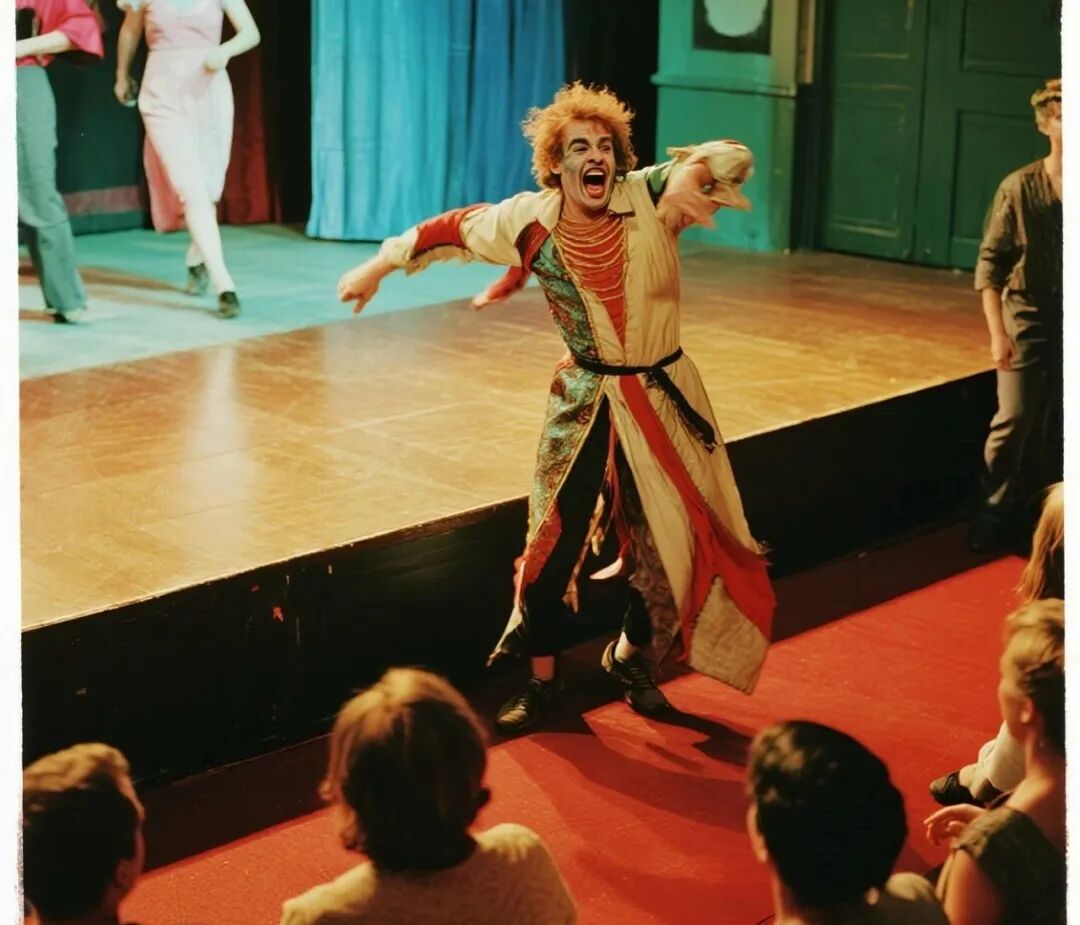
P4 Theater built a university, a crumbling maze, a hard drive engraving life.
Self-inflicted project "Tangshan Youth - The Artist's Final Book"
If you want to make a contribution or communicate, put it on. Long